Posted on 05/19/2020 8:51:20 AM PDT by Kaslin
In a crisis, flexibility is king, especially for those in the classroom. But union bureaucracy makes it impossible to innovate.
As public school teachers with a combined 33 years of experience, we know we’re supposed to be “union strong” and never air unions’ dirty laundry. But the coronavirus crisis has pitted unions against teachers, students, and administrators who just want to teach and learn.
Our fellow teachers have gone above and beyond to ensure students don’t slip through the cracks during quarantine. We’ve seen teachers furiously posting to message boards and offering one-on-one assistance to students via videoconferencing.
From unions, however, we’ve seen just two things: pointless obstruction of basic student-teacher interaction and furious pro-union PR campaigns to avoid getting blamed for it.
It looks like the slick marketing is working. In Marijke Hecht’s recent article about inequities and failures in Pittsburgh public schools, for example, she points out that students have been denied remote learning opportunities and have lost precious weeks of learning time because of outdated protocols. She’s right: During a crisis, schools must remain flexible, or they’ll fail.
But it’s surprising Hecht did not name the primary culprit for this institutional ineffectiveness: the teachers’ union. Throughout the coronavirus quarantine, teachers’ priorities have been keeping their students on track and creating innovative ways to learn, but the union has focused on warning teachers against straying one inch from their contracts, including initial bans on e-learning.
This isn’t just a complication caused by regulations. That might be understandable. Unions were wary of remote learning from the start because they feared families might like it and switch to cyber charter schools. They’ve said as much in their emails to teachers, as if we would share their fear of families making their own educational choices.
We both left our teachers’ union because of issues like this. The intimidating emails sent during stay-at-home are nothing new to us, although employees in any other profession would be shocked to receive them: “Do not try to teach any new material or post any videos on the online portal. We know who you are. We’ll find out, and you will hear from us.”
If you think we’re exaggerating, you’ve probably never been a teacher who tried to innovate on behalf of your students.
One of us teaches Advanced Placement courses, the only subject in which students will still face a standard assessment at the end of the semester. It’s an objective measure of student achievement that will affect their college opportunities and future. But our union representative barred any contact with students for two weeks during quarantine; new contractual terms allowing online education had to be negotiated first. Meanwhile, the students were on their own to prepare for the looming exam.
We became teachers for the same reason every other teacher does: We love learning and want to pass that love on to our students. Even in crises, teachers want to continue educating as much as possible, but we’re being snagged on outdated contracts that unions force us to swear allegiance to, even when those contracts ban distance learning and other outside-the-box solutions, causing students to miss weeks or months of valuable education time.
Every situation and learning environment is unique, so why should every teacher be forced to follow decades-old rules? It makes no sense, but that’s how teachers’ unions think and work. To innovate in any way, you must have their permission. Politically motivated control prevents us from escaping the cookie-cutter rules that stifle our ability to tailor teaching to students’ needs.
The most insulting part is when the union acts like it’s doing us a favor by “protecting” us from teaching. When schools submitted their online education plans to the Pennsylvania Department of Education, districts across the state had disparate approaches to complying with special education laws. We were told our plan was the “safest” possible, meaning it minimized learning to avoid running up against legal issues. However, many districts across Pennsylvania had expansive plans that didn’t restrict teachers.
Meanwhile, teachers’ unions have managed to secure nothing but positive PR — to the extent that even critical articles like Hecht’s make everything the fault of administrations, while unions aren’t even mentioned. Critiques of administrators have it all backward. They conveniently forget who’s wagging the dog. Teachers’ unions control this narrative with a constant stream of marketing emails, ads, articles, and mailers about how great they are.
The end result for us teachers? Instead of fulfilling our purpose in entering this profession, to help kids learn, we now must stand aside while we wait for a massive private corporation, the union, to micromanage how we do it. Who made them the boss?
If we want to prepare our education system to handle a crisis, we educators need a little more local control and space to innovate. We can’t maximize our students’ potential, or our potential as teachers, with the union breathing down our necks.
Has any union ever helped? I say that as a former union member.
it would be wonderful if more people just kept their children at home, away from the evil influneces of the teachers union.
“Behind The Scenes, Teachers Unions Attempt To Make Online Crisis Schooling Worse”
So now that a lot of blue states need a bailout caused by them under funding public pensions, the teachers unions are trying to make things worse.....as a bargaining chip?
Ya think
Maybe the first union ever, for about a week, before the guy running it realized that he and all his siblings and cousins could get rich off the scheme instead.
“...But our union representative barred any contact with students for two weeks during quarantine;”
At the other end of the spectrum is having a zoom type classroom with the teacher teaching and the students at home learning. There are also many teachers/schools providing a full day's worth of learning of all basic subjects as well as all special topics.
How many people are going to pay tuition for either of the first two ways? I wonder if there is more union interference in using the power of the internet in the huge public school systems with 100,000+ students than there is in the smaller town-centered schools.
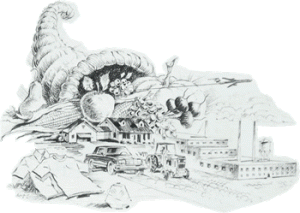
Americans, in the beginning, tried socialism. Like every other people who tried such a non-starter for providing individual incentives, individual freedom, and prosperous economy, they failed. Here is the story:
The Economic Dimension Of Liberty Protected By The Constitution
"Agriculture, manufactures, commerce, and navigation, the four pillars of our prosperity, are the most thriving when left most free to individual enterprise."
- Thomas Jefferson
"The enviable condition of the people of the United States is often too much ascribed to the physical advantages of their soil & climate .... But a just estimate of the happiness of our country will never overlook what belongs to the fertile activity of a free people and the benign influence of a responsible government."
- James Madison
America's Constitution did not mention freedom of enterprise per se, but it did set up a system of laws to secure individual liberty and freedom of choice in keeping with Creator-endowed natural rights. Out of these, free enterprise flourished naturally. Even though the words "free enterprise' are not in the Constitution, the concept was uppermost in the minds of the Founders, typified by the remarks of Jefferson and Madison as quoted above.
Already, in 1787, Americans were enjoying the rewards of individual enterprise and free markets. Their dedication was to securing that freedom for posterity. The learned men drafting America's Constitution understood history - mankind's struggle against poverty and government oppression. And they had studied the ideas of the great thinkers and philosophers.
They were familiar with the near starvation of the early Jamestown settlers under a communal production and distribution system and Governor Bradford's diary account of how all benefited after agreement that each family could do as it wished with the fruits of its own labors.
Later, in 1776, Adam Smith's INQUIRY INTO THE NATURE AND CAUSES OF THE WEALTH OF NATIONS and Say's POLITICAL ECONOMY had come at just the right time and were perfectly compatible with the Founders' own passion for individual liberty. Jefferson said these were the best books to be had for forming governments based on principles of freedom.
They saw a free market economy as the natural result of their ideal of liberty. They feared concentrations of power and the coercion that planners can use in planning other peoples lives; and they valued freedom of choice and acceptance of responsibility of the consequences of such choice as being the very essence of liberty. They envisioned a large and prosperous republic of free people, unhampered by government interference. The Founders believed the American people, possessors of deeply rooted character and values, could prosper if left free to:
Such a free market economy was, to them, the natural result of liberty, carried out in the economic dimension of life. Their philosophy tended to enlarge individual freedom - not to restrict or diminish the individual's right to make choices and to succeed or fail based on those choices. The economic role of their Constitutional government was simply to secure rights and encourage commerce. Through the Constitution, they granted their government some very limited powers to:
- acquire and own property
- have access to free markets
- produce what they wanted
- work for whom and at what they wanted
- travel and live where they would choose
- acquire goods and services which they desired
Adam Smith called it "the system of natural liberty." James Madison referred to it as "the benign influence of a responsible government." Others have called it the free enterprise system. By whatever name it is called, the economic system envisioned by the Founders and encouraged by the Constitution allowed individual enterprise to flourish and triggered the greatest explosion of economic progress in all of history. Americans became the first people truly to realize the economic dimension of liberty.
- assure that the ground rules were fair (a fixed standard of weights and measures)
- encourage initiative and inventiveness (copyright and patent protection laws)
- provide a system of sound currency with an established value (gold and silver coin)
- enforce free trade (free from interfering special interests)
- protect individuals from the harmful acts of others
Footnote: Our Ageless Constitution, W. David Stedman & La Vaughn G. Lewis, Editors (Asheboro, NC, W. David Stedman Associates, 1987) Part III: ISBN 0-937047-01-5
They borrow tactics from the industrial unions - intimidation!
Here in WV the WVEA uses the UMW as a template. Particularly in the southern part of the state.
It’s not just PR. The unions run candidates for the board, and back them with money and “volunteers”.
Here in WV the WVEA uses the UMW as a template.
My state’s (MO) teachers assn. got kicked out of the NEA for not requiring NEA membership. This was around 1970 or so. NEA still has strength in urban areas of the state. On paper teacher strikes are illegal, but they sometimes do occur, again in urban areas.
It’s hard for a lot of parents who have to work and can’t keep their kids at home. But I wrote to our mayor here suggesting we have an emergency summer session to make up for the work the kids have missed (and to keep them off the streets, since juvenile crime has risen here - bored tweens and teen with nothing to do and no place to go). And I heard Then from a recently retired teacher that the teachers’ union wouldn’t let it happen. They’d be happy never having to set foot in a classroom again.
I’d like to know more about those cyber charter schools. Done right, they could spell the end of the government education monopoly.
My grandkids go to one of the most expensive districts filled with highly educated, highly paid professional people.
The children have been out of school since mid-March.
This stellar system could not even manage to get teachers online until last week and then proceeded to give 15 minutes of instruction which is supposed to last for two more weeks.
It is a deliberate action on the part of these “educators.”
...
It happened the last teachers strike here. The serious intimidation tactic incidents that occurred did happen mostly in the coal mining regions of the state. Elsewhere was social ostracism if you didn’t agree that the teachers were as oppressed as the miners at Matewan & Blair Mountain. Many teachers here are sons & daughters of UMW miners, so intimidation tactics seem natural to them to get there way. Not quite the same thing but an example of quickly the very militant WVEA can mobilize things. WVEA brought out the K-12 WVU education students to support the teacher’s strike. You saw them at every crossroads in Morgantown. I am sure the Ed Profs also encouraged it.
This is something I learned since I moved back here after being gone for almost 40 years (I guess I always knew this on some level !) The county-state education system here is very political and in some counties they are the dominate employer. Jobs (teaching, etc.) are often handed out in these counties in a very nepotistic/cronyistic fashion.
In these rural counties certain families occupy seats on the education boards for years. I am told it is slowly changing. Like I said it seems to occur mostly in the more rural & coal mining counites.
Bright note: The state is Right-to-Work for industrial workers now. The last state court challenge was shot down a couple of months ago. It will be interesting to see how that works out and if it effects the WVEA & the state\county employee unions. If it does it will probably take new legislation.
I am not anti-union. Free association and all that. Government employee unions are a bit more complicated, because it’s a way to game the system. Union membership should never be compulsory (freedom of association and all that) and in most cases they could just be ad hoc committees of volunteers to air the ‘grievances’ of employees to management every once in a while. No need to pay dues to a professional class of union bosses.
There may have been a time in history where unions did some good. But these days, with minimum wages, maximum hours, mandatory breaks, workers comp insurance, disability insurance etc all the major issues have been resolved by law.
Can’t sail the boat? Foul the rigging!
Online teaching is similar to TV ads produced by local ad agencies...
Second rates, not as effective and hit and miss... It’s time for kids to have the best minds, best graphics, best AI interactions...
Disclaimer: Opinions posted on Free Republic are those of the individual posters and do not necessarily represent the opinion of Free Republic or its management. All materials posted herein are protected by copyright law and the exemption for fair use of copyrighted works.