Skip to comments.
China's military buildup, global ambitions on collision course with U.S., Pentagon official warns
The Washington Times ^
| Thursday, February 20, 2020
| Bill Gertz
Posted on 02/20/2020 6:43:10 PM PST by E. Pluribus Unum
China’s decadeslong military buildup now poses a threat to U.S. security not just in Asia but also around the globe, and a confrontation with China could emerge at one of several flashpoints, a senior Pentagon official warned Thursday.
Chad Sbragia, deputy assistant defense secretary for China, told a congressional commission that Beijing’s buildup of missiles, warships, aircraft, space weaponry and cybercapabilities has accelerated under President Xi Jinping. He described it as “one of the most ambitious military modernization efforts in recent history.”
“In most of the potential flashpoints in the Indo-Pacific region — the Taiwan Strait, the South China Sea, the Senkaku Islands or the Korean Peninsula — the United States may find itself in a military crisis with China,” Mr. Sbragia told a hearing of the congressionally created United States-China Economic and Security Review Commission. He said the challenge posed by Chinese military and economic expansion requires a Cold War-type response.
While not a replica of the standoff with the Soviet Union in the Cold War, the China threat is “equally as consequential and therefore merits the same concentration of effort as put forth in the past,” he said.
China’s military now boasts 2 million personnel in uniform. The Chinese navy, after decades of building large numbers of warships, is now the world’s largest in terms of total assets, he said.
“China’s military is fielding an increasingly formidable array of ballistic and cruise missiles, modern fighter aircraft, autonomous systems, and a suite of cyber and space capabilities, postured to deny the U.S. military access to the Indo-Pacific theater if called upon,” Mr. Sbragia said.
Military power projection efforts are also linked to China’s expanding economic might through such programs as Mr. Xi’s Belt and Road Initiative and military-civilian fusion...
(Excerpt) Read more at washingtontimes.com ...
TOPICS: News/Current Events
KEYWORDS:
To: E. Pluribus Unum
Bill Gertz bump for later...
2
posted on
02/20/2020 6:44:14 PM PST
by
indthkr
To: E. Pluribus Unum
3
posted on
02/20/2020 6:44:35 PM PST
by
2banana
(My common ground with islamic terrorists - they want to die for allah and we want to kill them.)
To: E. Pluribus Unum
Who couldn’t see this coming except the so called experts that are bought off by the Chicoms.
To: E. Pluribus Unum
This is an issue to be concerned over!!
5
posted on
02/20/2020 6:48:42 PM PST
by
bantam
To: E. Pluribus Unum
Who could have seen that coming?
Only every Conservative on the planet who warned the tech we were handing
out, would be used against us.
6
posted on
02/20/2020 6:51:26 PM PST
by
DoughtyOne
(The DNC has a taxidermist on speed dial for Nancy, Hillary, and Ruth.)
To: E. Pluribus Unum
If Kissinger was such a genius, why did he play the China card against Russia instead of the Russia card against China?
7
posted on
02/20/2020 6:54:58 PM PST
by
omega4412
To: omega4412
Kissinger couldn’t know how effective Americans would be at selling out their own country.
To: E. Pluribus Unum
Seems to me to be the same slant-eyed-threat claptrap that the U.S. heard all during the 1930's...
Hmmm, as I remember it, that never came to anything...Did it?... Snicker...
9
posted on
02/20/2020 7:47:41 PM PST
by
SuperLuminal
(Where is Sam Adams now that we desperately need him)
To: indthkr
Nukes will prevent conflagration
10
posted on
02/20/2020 10:02:52 PM PST
by
Truthoverpower
(The guv mint you get is the Trump winning express !)
To: E. Pluribus Unum
Cut off their access to steel and oil, and pray the Germans don’t bomb Pearl Harbor again...
11
posted on
02/21/2020 1:44:09 AM PST
by
Vendome
(I've Gotta Be Me https://www.youtube.com/watch?v=BB0ndRzaz2o)
To: E. Pluribus Unum
Are there only 10 FReepers who see this as a subject worth commenting on.
China took advantage of the a strength of capitalism, that of providing material, and enriched and strengthened herself by significantly replacing it, and also weakening the industrial might which in part, enabled America to win two world wars.
12
posted on
02/21/2020 2:02:20 AM PST
by
daniel1212
( Trust the risen Lord Jesus to save you as a damned and destitute sinner + be baptized + follow Him)
To: omega4412
If Kissinger was such a genius, why did he play the China card against Russia instead of the Russia card against China? https://en.wikipedia.org/wiki/Sino-Soviet_border_conflict
Probably because the Soviets had been asking the US in back channels if, pretty please, they could nuke China. The US didn't mind a healthy rivalry between China & the Soviets, but a hot war with Nukes? China was not equipped for that. Kissinger was an old-style, balance-of-power statesman. He was always looking to balance-off the stronger power. And in 1969 that was Soviet Russia, not China.
13
posted on
02/21/2020 2:44:34 AM PST
by
Tallguy
(Facts be d@mned! The narrative must be protected at all costs!))
To: omega4412
If Kissinger was such a genius, why did he play the China card against Russia instead of the Russia card against China? The way I see it, as with Korea, Vietnam, Syria, Iran etc. goes back to Roosevelt strengthening Uncle Joe Stalin so much that the USSR become such an advancing army that it go to Berlin first, and some important assets. While infiltrating its "ally" the US so much that it became the 2nd nuke power just 4 years after we did, and become the leading space program as well.
Thus, National Security Council staffer (and later U.S. Ambassador to China) Winston Lord noted:
"First, an opening to China would give us more flexibility on the world scene generally. We wouldn't just be dealing with Moscow."
"Secondly, by opening relations with China we would catch Russia's attention and get more leverage on them through playing this obvious, China card. The idea would be to improve relations with Moscow, hoping to stir a little bit of its paranoia by dealing with China, never getting so engaged with China that we would turn Russia into a hostile enemy but enough to get the attention of the Russians. This effort worked dramatically after Kissinger's secret trip to China."
"Thirdly, Kissinger and Nixon wanted to get help in resolving the Vietnam War. By dealing with Russia and with China we hoped to put pressure on Hanoi to negotiate seriously. At a maximum, we tried to get Russia and China to slow down the provision of aid to North Vietnam somewhat. More realistically and at a minimum, we sought to persuade Russia and China to encourage Hanoi to make a deal with the United States and give Hanoi a sense of isolation because their two, big patrons were dealing with us. Indeed, by their willingness to engage in summit meetings with us, with Nixon going to China in February 1972, and to Moscow in May 1972, the Russians and Chinese were beginning to place a higher priority on their bilateral relations with us than on their dealings with their friends in Hanoi."
Because of this visually televised confirmation that citizens were receiving on the daily national news, presidential approval ratings rose to almost 56 percent. - https://en.wikipedia.org/wiki/Richard_Nixon%27s_1972_visit_to_China
Also,
Disagreements culminate in border skirmishes in March 1969. Moscow replaces Washington as China’s biggest threat, and the Sino-Soviet split contributes to Beijing’s eventual rapprochement with the United States.
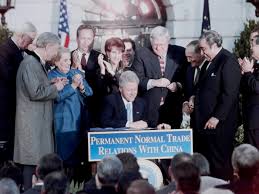
U.S. President Bill Clinton signs the U.S.-China Relations Act of 2000 in October, granting Beijing permanent normal trade relations with the United States and paving the way for China to join the World Trade Organization in 2001. Between 1980 and 2004, U.S.-China trade rises from $5 billion to $231 billion. In 2006, China surpasses Mexico as the United States’ second-biggest trade partner, after Canada.
In March 2007, China announces an 18 percent budget increase in defense spending for 2007, totaling more than $45 billion. Increases in military expenditures average 15 percent a year from 1990 to 2005. During a 2007 tour of Asia, U.S. Vice President Dick Cheney says China’s military buildup is “not consistent” with the country’s stated goal of a “peaceful rise.”
In September 2008, China surpasses Japan to become the largest holder of U.S. debt—or treasuries—at around $600 billion.
China surpasses Japan as the world’s second-largest economy after it is valued at $1.33 trillion for the second quarter of 2010, slightly above Japan’s $1.28 trillion for that year. China is on track to overtake the United States as the world’s number one economy by 2027, according to Goldman Sachs chief economist Jim O’Neill
The U.S. trade deficit with China rises from $273.1 billion in 2010 to an all-time high of $295.5 billion in 2011. The increase accounts for three-quarters of the growth in the U.S. trade deficit for 2011.
February 9, 2017 Trump Affirms One China Policy After Raising Doubts
U.S. President Donald J. Trump says he will honor the One China policy in a call with Chinese President Xi Jinping. https://www.cfr.org/timeline/us-relations-china
14
posted on
02/21/2020 3:03:05 AM PST
by
daniel1212
( Trust the risen Lord Jesus to save you as a damned and destitute sinner + be baptized + follow Him)
To: daniel1212
I think many people see China as a major problem, but if they don’t talk about it, they can deny it for longer.
I’ve always told people here that when China thinks it can conquer North America, they will come. They must figure they aren’t ready yet.
15
posted on
02/21/2020 4:21:46 AM PST
by
Bulwyf
Disclaimer:
Opinions posted on Free Republic are those of the individual
posters and do not necessarily represent the opinion of Free Republic or its
management. All materials posted herein are protected by copyright law and the
exemption for fair use of copyrighted works.
FreeRepublic.com is powered by software copyright 2000-2008 John Robinson