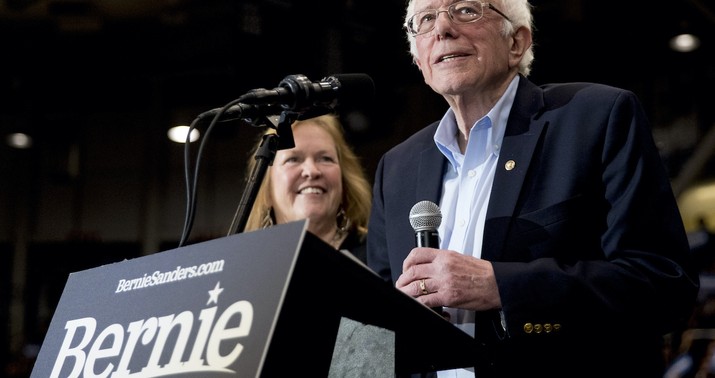
“Landslide” is a relative term, of course. Bernie’s not going to get so much as 50 percent of the vote in Nevada.
But given the photo finish in Iowa and the surprisingly tight margin in New Hampshire, a comfortable win would be impressive and potentially game-changing depending upon just how comfortable it is. Nevada’s apt to be the last state that’s hotly contested by the big four that have dominated the top tier for the past year. Warren will likely be done after the vote and Buttigieg and Klobuchar may be relegated to de facto also-ran status after their moment in the sun in New Hampshire. By his own admission, Biden needs a second-place finish in Nevada in order to build momentum before must-win South Carolina.
Let’s say he gets that — but that he also finishes 20 points behind Sanders on caucus night, a very distant, dismal second. “BERNIE’S FOR REAL,” the papers will scream the next day. South Carolinians may began shifting towards him. In one fell swoop, all of the competition except Bloomberg will have been marginalized: Warren gone, Pete and Amy dismissed as pretenders, Biden denied the good buzz he was counting on. Even Bloomberg, for all his resources, would begin to look small in the face of “Sanders might be unstoppable” narrative. Everyone’s preparing for Bernie to win Nevada, even rival campaigns, but I don’t know that anyone’s prepared for him to win Nevada going away.
Start preparing. New from the left-wing outfit Data for Progress:

Do we trust a progressive poll that has Bernie out to a big lead and the left’s second choice, Elizabeth Warren, conveniently in second place despite performing terribly in New Hampshire? Hmmmm. Data for Progress also finds Sanders taking 66 percent(!) of the Latino vote, which seems unlikely. This new Univision poll of Latino Democrats in Nevada finds his advantage among that group more modest — but still notable:

The last credible poll of Nevada, taken last week, had Sanders leading Biden 25/18, with Warren third at 13 percent. What if her support starts breaking down before Saturday and the lion’s share begins migrating towards Bernie? If you believe the lefty poll above, there’s more than enough of a Warren constituency to pad Sanders’s numbers impressively if they broke ranks. If Bernie wins this race with, say, 40 percent of the vote instead of 25 and ends up 20 points ahead of the second-place finisher, the “Berniemania!” storyline will dominate all the way up to South Carolina.
And then, if he wins there, up to Super Tuesday.
Nate Silver’s model of Nevada gives Sanders a 68 percent chance of winning the caucus, with Biden next at just 17 percent. Almost as notable as his lead in recent polling is the fact that most other candidates are either right around the 15 percent threshold for viability or below it. Nevada isn’t a delegate-rich state but a resounding Sanders win could further feed the “Berniemania” narrative by letting the media focus on just how few delegates went to his rivals, encouraging the perception that he’ll be difficult to catch after Super Tuesday. Silver, in fact, is already gaming out different scenarios for after Super Tuesday that show just how many ways a high-floor-possibly-low-ceiling candidate like Bernie could win the nomination. This one sounds familiar:
Even if the moderate lane consolidated to just one or two alternatives later on in the race — say, at some point in March or April — Sanders would still be in a pretty decent position. He would probably have a head start on the competition by having won a lot of delegates on Super Tuesday and in the first four states while the rest of the field sorted itself out. Contests up to and including Super Tuesday account for 38 percent of all pledged delegates, so this matters a lot…
Making slow-but-steady polling gains was roughly the path that Trump followed in 2016 to win the Republcian nomination, too. True, Trump had one major advantage that Sanders didn’t: the presence of winner-take-all states, especially later on in the race. (All Democratic states use proportional delegate allocation above the 15 percent threshold.) Still, Trump gained ground later in the race once Republican voters realized that they faced a choice between Trump and a contested convention (which might nonetheless have resulted in his nomination). Democratic voters might act similarly. Maybe a voter would prefer Buttigieg to Sanders in the abstract, but if a Buttigieg win would require a contested convention, while a Sanders win would not, she might feel differently.
There might be a runaway Bernie nomination or there might be a slow-and-steady Bernie nomination. There might even be a contested-convention Bernie nomination. But most roads lead to a Bernie nomination. Which path is chosen may be a pure matter of how much money Mike Bloomberg wants to spend.
Here’s Pelosi preaching unity in service to defeating Trump. We’ll see about that.
