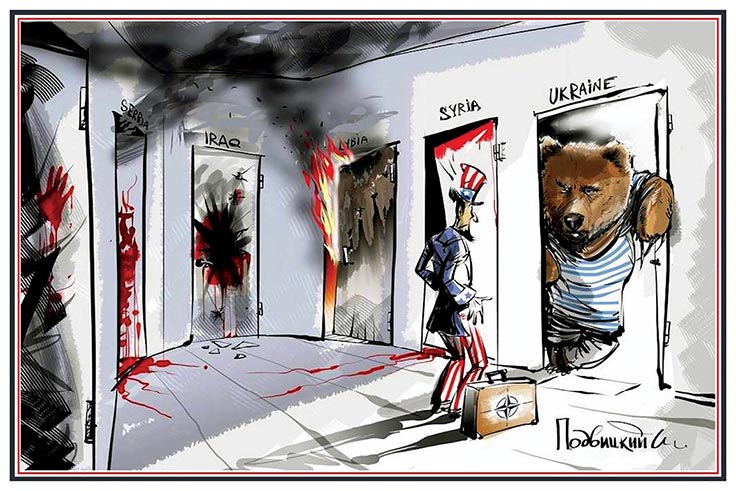
Over the past decade, young Russians have been exposed to a persistent media message that claims their country has been under attack from the West, and the United States in particular
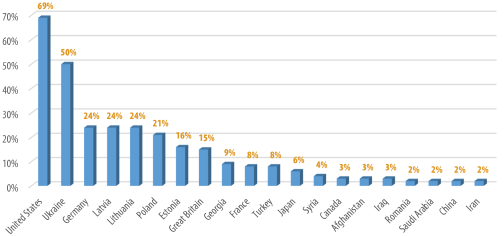
Opinion Poll about Russia’s Top Enemies
Posted on 01/18/2020 5:42:05 AM PST by tlozo
This article focuses on how today’s Russian media portrays the U.S. military. The thesis is relatively straightforward. Over the past decade, the Kremlin-sponsored Russian media have inundated the Russian information space with an anti-American message, particularly anything associated with the U.S. military. They have created a narrative built around the assertion that the United States has been using all of its resources (military, economic, diplomatic, information, etc.) to prevent Russia from regaining its superpower status. Since Russian military personnel are subject to this same anti-American information diet, the Kremlin’s anti-U.S. propaganda campaign has transformed the U.S. military into the primary enemy for the Russian soldier. This article will review some Russian sources of anti-American propaganda and consider a handful of implications that may stem from this negative portrayal.
During the last Russian presidential election (March 2018), members of the Russian military overwhelmingly supported President Vladimir Putin. Indeed, the official news agency Interfax reported that nearly three thousand Russian military personnel in Syria voted unanimously for Putin.1 Minister of Defence of the Russian Federation Gen. Sergei Shoigu further claimed that, overall, military “personnel showed high civic activity and demonstrated unconditional support for the incumbent Russian president, Supreme Commander-in-Chief Vladimir Putin, with 89.7 percent of the servicemen and members of their families voting for him.”2 While it is unclear how Shoigu procured this information, there is no question that Putin is genuinely popular among those in uniform. Russian-military-parade
The Life of a Russian Soldier
Overall living conditions for military personnel have improved since the latest round of reforms, which began in 2008. Officer and contractor pay is largely competitive with other government agencies. Living conditions for one-year draftees (e.g., barracks, food, uniforms, etc.) have become better. The waiting list for adequate housing for military officers has finally shrunk to manageable levels. Discipline within the ranks has improved, and there are far fewer reported cases of hazing. The military continues to develop a noncommissioned officers’ corps to provide training expertise, discipline, and continuity within the contract and draftee ranks.
While a one year conscription period is still a requirement for Russian men (ages eighteen to twenty-seven), the Kremlin has enacted legislation that provides incentives for some young Russian men to fulfill their military obligation while enrolled in college. Select college students will gain credit for military service by working on projects related to the country’s defense industry. Legislation has also been introduced whereby future government service and the right to travel abroad are contingent upon completing some form of military service. This legislation and the improved living conditions for conscripts have helped to both reduce draft evasion and increase the appeal of military service.
There have been similar improvements in the realm of military equipment and training facilities. Significant funding has been allocated toward modernizing everything from the soldier’s basic kit to advanced weapon systems. Russia continues to develop modern combined arms training facilities where military personnel can test the latest tactics and equipment in a realistic training environment. The confusion after the 2008 reform of the military’s education system (where nearly 75 percent of the military schools were closed or consolidated) has subsided, and the reorganization has resulted in greater efficiency and less redundancy. Overall command and control is now exercised by a massive new national military control center in Moscow. On paper at least (and on the virtual screens of the new control center in Moscow), there is much greater unity of effort among the various Russian security forces (e.g., Ministry of Internal Affairs, Federal Security Service, Emergency Ministry, etc.). For a more detailed examination of changes to the Russian military under Putin, see Vladimir Putin and the Russian Military, available at https://community.apan.org/wg/tradoc-g2/fmso/m/fmso-monographs/200392.
The military’s admiration for Putin appears to be well-founded. Over the past decade, the Kremlin leadership has worked diligently both in modernizing the armed forces and in restoring the status and reputation of military personnel. As defenders of the Russian state, soldiers have been returned to their revered pedestal. The Kremlin has been largely able to transform the discredited image of the Russian soldier, which had developed after the collapse of the Union of Soviet Socialist Republics (USSR), into that of proud and professional “polite green man.”
Alongside the general improvements for military personnel in living conditions, pay, training facilities, and equipment, the Kremlin leadership has worked overtime to create a narrative that places primary importance upon the readiness of the country’s armed forces. A critical part of this narrative is the notion that Russia is increasingly surrounded by enemies who are not only working to prevent the country from restoring its superpower status but also have aggressive designs against it. This fear of foreign aggression not only elevates the stature of the Russian military but also tends to dampen domestic concerns regarding the Kremlin’s unique form of “sovereign democracy.” There remains a key linkage between maintaining domestic political legitimacy and the Kremlin’s aggrieved foreign policy narrative. In this narrative, the United States and its military in particular are featured as the paramount adversaries.
Evidence of this negative American portrayal was drawn from both traditional media and from various individual Russian social media sites. It is important to note that since mid-2014, Russian active duty personnel have been forbidden from maintaining a social media presence. Since then, the Russian Ministry of Defence has enacted policies that greatly restrict information flow on social media sites among individual service members. As such, this article relies on the views of Russian journalists who cover military affairs, experts and pundits, retirees, and those not subject to Kremlin media restrictions. It also does not examine non-Russian media sources that requote interesting communications in which Russians express opinions of the American military outside of the negative narrative. Brief Historical Background
Over the past several years, the Kremlin leadership has rewritten the narrative surrounding the collapse of the USSR and what transpired in Russia during the chaotic 1990s. Instead of seeing the collapse and difficult transition to a new state as the result of a failed political and economic system, the Kremlin emphasizes the nefarious role that the United States played in weakening Russia. In its modern rendition, the United States conspired to bring down the USSR and then continued to humiliate and exploit a weakened Russia during the painful decade of the 1990s. From the Kremlin’s perspective, the United States had adopted a unilateral approach toward global security, believing that it could act with impunity wherever it wanted. This sense of humiliation and resentment toward the United States formed the nucleus of the Kremlin’s chronicle of recent history. Whether expanding the North Atlantic Treaty Organization (NATO), sponsoring “color revolutions,” or continuing plans to enhance European defense (e.g., ballistic missile defense systems), Kremlin propaganda has been built around numerous historical examples that illustrate the need to defend Russia from this same American threat.
One key event occurred just prior to Putin’s rise in the Kremlin. Against a background of Russian economic collapse and political paralysis, the United States and other NATO countries began offensive military operations (without a United Nations resolution) against Serbia in March 1999. The argument that Western forces were trying to halt Serbian aggression against ethnic Albanians in Kosovo carried little weight in Moscow. Russians bemoaned this unilateral use of air power against their Serb-Orthodox brothers. For the Russian leadership, this was a cold slap in the face, perhaps best personified by Russian Prime Minister Yevgeny Primakov’s decision to turn his Washington-bound plane around in midair when notified that NATO had started bombing Serb targets. This conflict would prove to be a watershed in Russia’s later foreign and military policy, proving to the Kremlin leadership that Russian concerns would only be heeded if backed by strong and combat-ready military forces.
Control over the Media
One of Putin’s first priorities was regaining control over the major media outlets in Russia, and, over the past decade, he has exploited the strategic heights of the Russian information sphere to transmit an anti-American/anti-Western message. Today, nearly all of the major Russian television, radio, and newspaper outlets are under indirect Kremlin control. The most important sector is television, where upward of 90 percent of Russians still receive some portion of their news. But it also includes the major press outlets: ITAR-TASS and RIA Novosti, which are the rough equivalents to Associated Press and Reuters.
The Kremlin has also developed a robust presence on the internet and within major Russian social media sites. The result is a multivector approach, harnessing everything from morning talk shows to evening newscasts, from pop stars to venerable academics, from blogs to twitter accounts, from blockbuster movies to special documentaries—all continually hammering home, in the widest variety of formats—the Kremlin-approved message. For those who have electricity and are plugged in to the Kremlin’s media, there is the potential for total media saturation. Nor is this crude propaganda. The Kremlin has invested considerable resources into transforming their portion of the Russian information space into a slick, entertaining, often informative landscape that appeals to both young and old.
Besides using their daily news programs to pound this message home, over the past decade, the Kremlin-sponsored media have developed an untold number of talk shows where “experts” discuss and explain what is really happening in the news. These programs are an interesting mix of propaganda, analysis, entertainment, and discussion, and they are designed more to incite emotions and provoke indignation than to inform. Watching these programs, one might believe that Russians enjoy complete freedom of speech; watch for a longer period and one will discover that the Kremlin’s message is merely strengthened under the guise of open debate. Not surprisingly, the United States and its purported “wicked designs” against Russia is a favorite topic of discussion. They have also developed similar programs that address and expound upon general military topics, with the United States and NATO usually depicted as the primary threats.
To reiterate, the Kremlin does not just employ the media to get its message across. It has created an all-encompassing, many-layered strategy that includes using the Russian Orthodox Church, the Academy of Sciences, nongovernmental organizations, the school system, Russian businesses, think-tanks, international conferences, modern movies, popular songs, and militarized youth groups, all designed to transmit and reinforce the Kremlin’s anti-Western rhetoric.
The Russian Military and Social Media
As of mid-2019, the internet in Russia is still largely free of government control, but there are worrying signs. Recent statistics claim the upward of 75 percent of the Russian population are to some degree connected to digital communication. While there have been attempts over the past several years to limit what Russians can post on the web and access on various internet platforms, they are still able to access most sites. Internet anonymity is a different story. Over the past few years, there have been a number of high-profile cases where individual Russian internet users have posted information that the government deemed as harming the country’s national security. The prosecution of these cases has made most Russians wary of posting anything that may be used against them.
This openness toward internet usage and social media does not apply to Russian military personnel. Up until Russia’s armed aggression against Ukraine in early 2014, Russian military personnel were avid users of various social media sites (e.g., VKontake, Odnoklassniki, Facebook, etc.). This usage came to an abrupt halt after foreign researchers were able to demonstrate that Russian soldiers were indeed involved in the fighting in southeast Ukraine, especially after the downing of Malaysia Airlines Flight 17 in mid-July 2014. Thanks to photos and other data posted by Russian military personnel, it was clear that Russian forces were actively involved in the fighting and were partially responsible for the tragedy behind the destruction of the aircraft.
Gauging the Pulse of the Russian Military
While information gleaned from social media sites used by Russian military personnel has largely dried up, there are still a number of other sources that can be exploited to gauge what military personnel are thinking. Besides the sites sponsored by the Russian Ministry of Defence (e.g., Zvezda TV and Krasnaya Zvezda newspaper), there are a number of military-themed programs on major Russian media, as well as websites, blogs, and publications that reflect current Russian military thinking. A considerable portion of the information contained in this paper is derived from these sources.
One source in particular, the Komsomolskaya Pravda Radio program, Voennoye Review (Military Review), provides a good example of current Russian military attitudes. This hour-long program airs nationwide, Monday through Friday, and is hosted by two retired Russian army colonels, Viktor Baranets and Mikhail Tymoshenko. It usually consists of a short introduction on a military-related topic with the remainder of the program devoted to answering questions from the call-in audience. Occasionally, they will host senior military personnel who will also answer questions from the call-in audience. As this program is recorded live, it often captures the raw sentiments of both the hosts and the audience.
Unlike most official Russian sources, Barenets and Tymoshenko have no problem expressing their open disdain and scorn toward the United States and its military. Not only do they constantly repeat the Kremlin’s assertion that Washington is intent upon preventing Russia from recovering its superpower status, but, in nearly every episode, they also find grounds to disparage how the United States conducts military operations. While this particular radio program might not be all that influential within the Russian information space, it may accurately reflect popular sentiments (to include those in the Russian armed forces) toward the U.S. military.
There is likely a generation factor among Russian military personnel and how they view the American military. The older generation who were influenced by Soviet propaganda may be more inclined to embrace the current Kremlin rhetoric. Even though some of these more senior military personnel may see through the current Kremlin propaganda, to speak out could have negative career consequences. While younger military members have been exposed to the same anti-American, patriotic onslaught of past decade, they may be more proficient in relying upon other, less tendentious media sources. Indeed, recent survey data suggests that Russian youth, while claiming to be “patriotic,” are increasingly unwilling to make a genuine sacrifice for their country. However, once a young Russian enters the military, the information diet may change his or her perspective.
For the past few years, the United States has been portrayed in the Russian media as the primary source of much of the world’s instability. According to Kremlin-sponsored pundits, the United States deliberately sows unrest (often under the guise of liberal democracy promotion) to maintain its global hegemony. After its presumed victory at the end of the Cold War, the United States assumed the role of the “indispensable nation,” disregarding the global security structures built after World War II. According to Russian commentators, because the United States controls the global money supply, Washington has been able to convert its economic advantage into sheer military power. The Kremlin leadership often points out the wide discrepancy between how much the United States spends on the military compared to the rest of the world. They see a direct nexus between dominant U.S. military power and the status of the U.S. dollar as the global reserve currency.
Against their aggrieved historical backdrop, the American military has been portrayed in a negative light within the Russian media. According to commentators like Baranets, Russian military leaders are aware that the United States spends considerably more on its military. They use this discrepancy to lobby for additional funding, while at the same time asserting that defense expenditures are not the only barometer of combat readiness (see figure 2). A key theme within much of the Russian information space is the belief that given their long history of repelling foreign invaders, Russia has experience, wisdom, and truth on their side. These Russian leaders would agree with Napoleon who suggested, “In war, moral power is to physical as three parts out of four.” A recent study by Global Firepower has suggested that despite Russia’s much smaller defense budget, it is nearly as powerful (militarily) as the United States.
While the Russian soldier may be impressed with images and videos of drone strikes and some of the other high-tech U.S. arsenal, he or she is likely less overwhelmed with American military strategy. The Russian media have portrayed U.S. operations in Iraq, Afghanistan, Libya, Syria, and elsewhere largely as failures, where the United States has only exacerbated problems in these countries. Every botched American operation, every errant missile strike, every case of torture or criminality perpetrated by U.S. military members, and every scandal or leak that reflects poorly on U.S. Armed Forces receives the widest possible exposure within the Russian media. The Kremlin’s narrative highlights both the seemingly lack of a comprehensive military strategy and what they consider as the hypocrisy of promoting American democracy via military power.
The American military is often portrayed as being over concerned with safety and political correctness, while being soft and dependent upon a huge logistical tail. The American soldier is depicted as unwilling to fight if he or she is not supplied with all the comforts of home. At the official level, Russia remains a very traditional, conservative country, and the population of which regards gender equality, gay rights, and women in combat positions as both weak and decadent. The Russians have coined a derogatory slang term for American soldiers, “пиндосы” [pindosy], using it to mock and belittle Americans in uniform.
The superiority of Russian weapon systems is also a popular topic within the Russian media. The media are constantly claiming that Russian modern, conventional weapon systems “have no analogy in the West.” The same braggadocio exists in the nuclear realm. Over the past few years, the Russian media have repeatedly reminded their audience of the country’s ability to transform the United States into a parking lot or as the head of Rossiya Segodnya news agency Dmitry Kiselyov put it, “radioactive dust.”
Implications for the Russian Soldier
Perhaps the first and most important implication is the belief among Russian soldiers that their country is already at war. Some in the West want to draw a clear distinction between war and peace. The current Kremlin leadership does not see this divide. The message it has portrayed over the past several years is that Russia has been engaged in a defensive “war” against the West/United States, which remains intent upon preventing Russia from regaining its superpower status. Using economic, information, diplomatic, and other means, the Russian soldiers believe that their country has already been “attacked” by the West/United States. Having repeatedly been taught that Russia is engaged in a defensive struggle against U.S./Western aggression, they honestly believe that theirs is a just struggle and that truth and righteousness are on the Russian side.
The prevalent mood in Soviet society after World War II could be summed up as “do everything possible to avoid another war.” That generation had experienced the full horror of modern conflict, and even after the USSR attained superpower status, Soviet society understood that war should be avoided at all costs. In contrast, this sentiment may no longer be prevalent, particularly among the younger generation, who have been taught that war is a viable option. Believing that their country is now under threat from the United States, these young Russians are increasingly prepared to take up arms to fight against the “enemy.”
Among the most prominent current practitioners of the propaganda devices discussed in the adjoining article is RT (formerly named Russia Today), a sophisticated Russian-government-funded international television network that has been developed to convey globally Russian propaganda infused in news bulletins, documentaries, and other conventional Western-style television programming to audiences outside of Russia. As such, it provides both television programming and internet content in multiple languages, including German, French, Arabic, Spanish, and English. Though posing as a legitimate news outlet, RT’s official Russian-government sponsorship is poorly concealed, as its twenty-four-hour per day programming is both relentless in its anti-American and anti-Western orientation as well as in its overt advocacy of Russian-government policy objectives. RT’s editor in chief has reportedly asserted that RT programming is synchronized to support the Russian army and Russian Ministry of Defence in its effort to wage information war against the West.
Over the past decade, young Russians have been exposed to a persistent media message that claims their country has been under attack from the West, and the United States in particular. A portion of these young Russians now wear military uniforms and are prepared to challenge U.S. claims of hegemony (the Pentagon map dividing the world up into American military districts drives Russians crazy). They regard the American military as the primary threat and are increasingly ready to defend their country’s interests.
It is not so much that the Russian soldier regards the United States as an enemy, as the growing belief that in a conflict between Russia and the United States/NATO, Russia would prevail. Up to the highest levels, Russian military personnel may have fallen victim to believing their own propaganda as to the superiority of their military power. Recent poll results suggest that, in a conflict between Russia and the United States/NATO, Russian military personnel believe they would prove victorious. This bellicosity is ever present in the Russian media, where they assert that Russia is increasingly ready for a fight. This growing confidence in their military strength could lead to greater risk taking and, ultimately, could have a catastrophic consequences for both countries.
Implications for the U.S. Military
The U.S. military has already begun to recalibrate and adjust to an increased threat from the Russian military and the Kremlin’s associated information operations. This increased focus on measures to thwart possible Russian aggression needs to be balanced by both an awareness of escalatory dangers and a willingness to cooperate where security interests align. U.S. military personnel should understand that their Russian counterparts’ global narrative is far different from their own. Where Americans might refer to “democracy promotion” or “concern for human rights,” a Russian would see naked aggression or geopolitical maneuvering. U.S. military personnel should understand that their Russian counterparts question U.S. claims of global dominance and will not be intimidated by threats of “shock and awe.”
Should top-level relations between Russia and the United States improve, it is conceivable that the U.S. military will not be portrayed as an adversary. Given the Kremlin’s indirect control over the major Russian media, they could be directed to adopt a more balanced and objective approach toward today’s “enemy.” This agility in changing the prominent Kremlin narrative was on display after Turkish forces downed a Russian aircraft that had briefly violated Turkish airspace in November 2015. Prior to this incident, Turkey and Russia had enjoyed decent relations. The Russian media quickly transformed the image of the Turkish leadership into a cabal of backstabbing cowards. Russia broke off many relations with Turkey (to include tourism) and levied economic sanctions. However, less than a year later, after the Turkish leadership apologized for the incident, the Russian media rhetoric toward Turkey quickly regained its balance. Such a media transformation might occur if Moscow and Washington were to improve relations.
Nevertheless, despite economic challenges, there are currently no signs that the Kremlin leadership has modified its strategic objectives of weakening the United States and NATO. Employing the same rigor and many of the same tools it has used in influencing the mind of its own citizens, the Kremlin remains determined to debilitate the American/Western belief in democracy and the rule of law. The success of the Kremlin’s endeavor will depend not only on developing a realistic strategy to defend against Russian information operations but to a large degree on how well the citizens of the United States and other Western countries can live up to the democratic values they profess. This is doubly true for those who are called upon to defend these values.
Over the past decade, young Russians have been exposed to a persistent media message that claims their country has been under attack from the West, and the United States in particular
Opinion Poll about Russia’s Top Enemies
Thank goodness it's so different here in the US! [/s]
While they sit and prattle against the USA and NATO, the day is fast approaching when their New Best Friends, the Chinese, will waltz in and take Siberia.
And apart from starting a nuclear war, there’s little they could do to stop it.
Karma’s gonna be a bitch.
Yesterday...today...tomorrow...our eternal enemy.
Universally replace “Russia” with ”Progtard DildoCrat” in the article, and it would remain just as truthful.
Looks like they have a point.
Russia is not a superpower and never will be. Russia is not the Soviet Union. It has half the population and it’s population is declining. It’s only significant exports are oil and gas. It has an economy roughly the size of California and Florida combined. Yes those are large states but that’s not even 1/5th of the total US economy.
The Democrats sudden bellicosity toward Russia and claims of Russian conspiracies everywhere are ridiculous. Their nuclear arsenal is probably the only thing that prevents China from swallowing the eastern half of the country.
I’m inclined towards friendliness with Russia precisely because of their traditionalism and resistance to toxic Western social progressivism. But the problem is exactly what’s covered in the article — Russia’s paranoid, propagandistic anti-Americanism coupled with threatening military bravado. They’re like an old friend who’s gone crazy and has a gun.
Not a bad cartoon. I agree with the sentiment.
We were allies in WWII.
Ultimately we will need to be allies against islam.
"Fortunately" the DNC's constant Russia, Russia, Russia propaganda will virtually insure we can't work with them, and therefore a religion of peace's ummah.
Thank you madrassa educated obama, and Iranian-born Valerie Jarrett, and every pedophile in the civilized world who wants to be protected by mohammad's example of marrying a 6 year old...
Russia is a superpower by virtue of its arsenal of nuclear weapons, many of which target the United States.
You must be thinking of that corrupt cesspool of a country next to them, Ukraine.
Russia has nukes but that’s it. They don’t have the conventional military power, they don’t have the economy, they don’t have the population and they don’t have the cultural influence of a superpower. Russia is not comparable to the Soviet Union which had all of those things. They cannot project power any further than their immediate neighborhood and even then, the amount of power they can project is limited.
How’s Putin’s pals doing in Iran..Hezbollah...or S. Yemen?
Wholeheartedly agree!!
I believe they still use conscription as well (at least they did in 90’s).
Lately?
Not well.
Considering Russia didn't fight in Ukraine, I'd say their performance in that fight was just fine.
In fact, one of the reasons NATO rushed in to train up the pathetic Ukie army was how badly they got beaten by the DPR.
Go to You Tube and see the videos.
Their conventional military power has been on display in Syria since 2015, where they helped turn the tide against the CIA sponsored jihadists trying to overthrow the government there.
There's a reason nations around the world today are clamoring for Russian military technology, including our supposed NATO ally Turkey.
Disclaimer: Opinions posted on Free Republic are those of the individual posters and do not necessarily represent the opinion of Free Republic or its management. All materials posted herein are protected by copyright law and the exemption for fair use of copyrighted works.