
Posted on 05/02/2015 4:39:46 AM PDT by Homer_J_Simpson


Winston S. Churchill, Triumph and Tragedy
Editorials – 23-25
The End of Hitler
San Francisco and the Crisis
Closing In on Rangoon
Another Coal Strike
“Adventurers of England"
Topics of the Times
Paraders in Paris Urge Death for Petain; May Day Marchers Hang Him in Effigy – 25
* Here is a sample of Capriccio, mentioned in the article. The final scene, seems fitting.
http://www.etherit.co.uk/month/4/02.htm
May 2nd, 1945 (WEDNESDAY)
UNITED KINGDOM: Frigate HMCS Victoriaville departed Barry, Wales to escort Convoy ON-300.
GERMANY: Soviet forces complete the capture of Berlin, when Soviet units in the north and south of Berlin link up on the Charlottenburg Chaussee. German forces surrender to Marshal Zhukov, who immediately despatches troops to search for the bodies of Hitler and Goebbels.
The German surrender is made by General der Artillerie Helmuth Weidling, CO of LVI Panzer Korps, and last “Kampf-kommandant” of Berlin. he unconditionally surrenders all German forces in the ‘Reichshauptstadt’ of Germany to the forces of the Soviet Red Army.
With over 130,000 men surrendering in Berlin, later that day General Weidling was taken, together with Mohnke, Gunsche, and other survivors from the Bunker, to the airfield at Strausberg (where Zhukov had his field HQ), about 35 km east of the city, where the Russians had established a special holding camp for VIP prisoners. Through O’Donnell’s account, Mohnke has told us that the next day (May 4) Weidling and his staff had to leave the camp in the morning, returning that night. Weidling told him later that he had been taken to the Reichskanzlei where he was filmed coming out of one of the exits to the Voss Strasse from the cellars beneath the ruins of the Reichs Chancellery. Later, the Russians were to use this piece of film as propaganda , saying that it had been taken at Weidling’s headquarters (he had actually directed the battle from Army Headquarters in the Bendlerblock) after he had signed the surrender document.
(Russ Folsom)
US and Soviet troops meet near Barow and Abbendorf.
The British 2nd Army captures Lübeck and Wismar.
Canadian forces take Oldenburg.
16 RAF Mosquito Mk XVIs of No. 608 Squadron, No. 8 Group join Halifaxes of No.100 Group (Nos. 177 and 199 Squadrons) to make the last Bomber Command raid of the Second World War, an attack on Kiel. (22)
There had been no offensive operations by Bomber Command since 26/27 April and most squadrons thought that their war in Europe was over, but it was feared that the Germans were assembling ships at Kiel to transport troops to Norway in order to carry on the war there. A last raid by No 8 Group Mosquitos was thus organized, with a large supporting effort being provided.
16 Mosquito bombers of No 8 Group and 37 Mosquitos of No 100 Group were first dispatched to attack airfields in the Kiel area. A Mosquito of No 169 Squadron, No 100 Group, was lost while carrying out a low-level napalm attack on Jagel airfield; its crew - Flying Officer R Catterall, DFC, and Flight Sergeant DJ Beadle - were killed.
126 Mosquitos of No 8 Group then attacked Kiel in 2 raids, 1 hour apart.
The target area was almost completely cloud-covered but H2S and Oboe were used. Large fires on the ground were seen through the cloud. No Mosquitos were lost on these raids. Towards morning, a large column of military vehicles departed in the direction of Flensburg on the Danish frontier.
‘The upsurge in the population’s morale was indescribable’, comments the town diary. ‘There was a final spasm of fear when explosions were heard from the harbour but these turned out to be all the flak guns and warships in the harbour firing off their ammunition.’ After this, Kiel was declared an open, undefended town. As soon as this happened, all the military stores and some of the civilian ones containing rationed goods were thrown open to the public before Allied troops arrived 36 hours later.
RCAF, RAF, and Norwegian ‘Mosquito’ fighter-bomber a/c from RCAF 404 Sqn, RAF 143, 235, and 248 Sqns and Norwegian 333 (RAF) Sqn, attacked and sank U-2359 in the Kattegat, in position 57.29N, 011.24E. There were no survivors from her crew of 12.
Meanwhile, there had been a final small tragedy for Bomber Command. 89 RCM aircraft of No 100 Group had been sent to support the Mosquito bomber force and 2 Halifaxes from No 199 Squadron, each with 8 men on board, were lost.
The Halifaxes had been part of the Mandrel screen and were also carrying 4,500lb bombs and large quantities of Window. The 2 aircraft crashed at Meimersdorf, just south of Kiel, and it is probable that they collided while on their bomb runs. They were the last Bomber Command aircraft to be lost in the war. There were only 3 survivors. 13 airmen, 12 from the United Kingdom and one from the Irish Republic, mostly second-tour men, died. They were: Warrant Officer WF Bolton; Flight Sergeant AA Bradley; Flight Lieutenant WE Brooks; Sergeant FT Chambers; Flying Officer KNJ Croft; Warrant Officer KAC Gavin; Flight Sergeant D Greenwood; Flying Officer ASJ Holder, DFC; Flight Sergeant JR Lewis; Flight Sergeant J Loth; Pilot Officer WHV Mackay; Warrant Officer RHA Pool; and Flight Sergeant D Wilson. (Ron Babuka)
RAF”>RAF Mitchell light bombers of 2nd T.A.F. make their last mission of the war when 47 aircraft of Nos. 98, 108, 226, 320 and 342 Squadrons bomb railway marshalling yards at Itzehoe. (22)
AUSTRIA: The defenders of Innsbruck begin to sue for peace. The French I Corps reaches Gotzis and Obersdorf.
NORWAY: U-977 sailed from Kristiansand on her final patrol.
ITALY: The German surrender is effective at noon. 490,000 troops become PoW.
A remarkable story of the dangerous intrigue that led up to the surrender of German forces in Italy began to emerge today. It was an SS man, Karl Wolff, who masterminded negotiations in Switzerland and north Italy with Allen Dulles, the representative of the US Office of Strategic Services (OSS) which was formed in 1942 to gather intelligence and aid resistance groups.
The first peace-feelers were put out in December by two SS men concerned with the possibility that Hitler’s threat of a “scorched-earth” policy would destroy much of Italy’s culture. Dulles took a cool view of Wolff’s involvement, but agreed to talk when two Italian partisans were freed as a gesture of good faith.
Negotiations began seriously at Ascona, a resort of Lake Maggiore. Despite Russian objections, two Allied officers, joined Dulles in total secrecy. In grave danger, Wolff was recalled to Berlin but used his charm to escape Hitler’s wrath. Even so, he and his co-conspirators faced death until the surrender was signed at Caserta.
BURMA: Operation Dracula, the capture of Rangoon, which began with a paratrooper drop yesterday continues. The British 26th Indian Division lands for a naval TF which includes 6 escort carriers and BB Queen Elizabeth and Richelieu.
The British IV Corps north of Rangoon at Pagu complete the liberation of Rangoon.
CANADA: Corvette HMCS Cobourg commenced refit Halifax, Nova Scotia.
U.S.A.: Destroyer USS Rupertus laid down.
ATLANTIC OCEAN: Minesweeping trawler HMS Ebor Wyke was torpedoed and sunk by U-979 off Hrafneyri Light, seven miles north of Skagi, Iceland. The only survivor was Coxswain John Milnes.
bttt

"I think you're nuts, but we'll investigate"
The initial response to von Braun's request to surrender to the 324th Regiment Anti-Tank Company.
Pictured: The just captured Werner von Bruan rocket science team. Werner von Braun is prominent with his cast broken left arm. His brother Magnus is the 3rd man to the left of Werner (without a hat) The man in a top hat between the two von Brauns is the feared and hated German staff officer responsible for the V2 rocket program, General Walter Dornberger.
"It was deep in Austria, and with the swift collapse of the German Army, a flood of civilian and Wehrmacht personnel came pouring through the Tyrolean mountain passes seeking to surrender. Suddenly a young German came to members of Anti-tank Company, 324th Infantry and announced that the inventor of the deadly V-2 rocket bomb was a few hundred yards away—and wanted to come through the lines and surrender. The young German's name was Magnus von Braun, and he claimed that his brother Werner, was von braun 44th infantry division the inventor of the V-2 bomb. Pfc Fred Schneikert, Sheboygan, Wis., an interpreter, listened to the tale and said just what the rest of the infantrymen were thinking, 'I think you're nuts,' he told von Braun, 'but we'll investigate.' Then a hectic night of interrogation, plans and counter-proposals followed as the Germans, even in defeat, tried to act like big-shots. Finally Magnus went out and in a short time returned with his brother, Maj. Gen. Walther Dornberger of the German General Staff, and a dozen Fritz scientists. Later developments showed that the party captured by the 324th Anti-tankers had been the key personnel at the great German research center at Peenemunde on the Baltic Sea ... but the dough-boys weren't impressed and their 'distinguished' prisoners were soon cooling their heels in a 44th POW enclosure."
As Hitler's Third Reich was crumbling in January 1945, von Braun made plans to move his team of about 125 leading rocket scientists and engineers of the world, south to surrender to the Americans. Rather than succumb to capture by the long-sworn enemies the Russians, von Braun organized a mass exodus from Peenemunde to surrender to the American troops in Austria. Unknown to von Braun, Hitler had ordered their execution to prevent their capture by the Allies. After a dangerous intrigue filled journey and secure in Austria, they waited for the American arrival. At that time, brother Magnus von Braun journey on a bicycle to meet them. The first soldier that he met was a sentry with the 324th Infantry Regiment, 44th Infantry Division, Private First Class Frederick Schneikert. Magnus was ordered to drop the bicycle and surrender, hands-up. In poor English, Magnus tried to explain his mission. The young soldier was not really sure what think of his claims. He turned the matter over to his commanding officer, First Lieutenant Charles L. Stewart. Stewart at first thought that Magnus was trying to Generalmajor Dr. Walter Robert Dornberger"sell" his brother and the other scientists to the Americans. The contemporary report from the "Mission Accomplished, The Battle History of the 44th" is written with this prospective. The communications were soon cleared up and Lieutenant Stewart gave Magnus passes for the Germans, to ensure their safe passage to the American encampment. On May 2, 1945, von Braun and his rocket team surrendered to the US 44th Infantry Division. Had the Soviets captured von Braun instead, the post WW2 history might have been far different.
General Dornberger was of no value to the Americans. While the von Braun science team was whisked quickly to safety and building America's rocket program, the General was turned over to the British. Eventually Dornberger was tried and acquitted of war crimes for the V2 bombardment of London. He was deeply disliked as a prisoner. One British guard at his internment camp remembered that:
"…..Walter Dornberger was definitely the most hated man in the camp. He was confined to barracks very often. In fact, even his own people hated him - Von Rundstedt would not even talk about him. Only once I ever saw him and that was under guard inside the perimeter exercising. He never went out to the local farms to work like the other prisoners. Many prisoners turned their back on him."
The V-2 is one of the most astounding weapons of WW2. A pure terror weapon and the first long range ballistic missile used in combat, it hurtled a one ton warhead 50 miles high and hundreds of miles down range to its target. No defense existed, once a V2 is launched. The V2 is the second most expensive and technically demanding of all weapon projects of the war, eclipsed only by the 'Manhattan Project', the American atomic bomb program. von Braun and his team successfully delivered the V2 'vengeance weapon' to Hitler in 1944.
Don’t bother to look up “Hitler reacts to his death.” Was the least funny one of the parodies I’ve ever seen and had plenty of foul language.
http://www.pbs.org/weta/americanvalor/stories/bush.html
Congressional Medal of Honor
Robert Bush
Born: October 4, 1926
Tacoma, Washington
War: World War II
Rank: Hospital Apprentice First Class, US Naval Reserve (serving as Medical Corpsman with a rifle company)
Location of action: Okinawa Jima, Ryukyu Islands
Date of action: May 2, 1945
Medal received from: President Harry Truman, October 5, 1945
Official Citation:
For conspicuous gallantry and intrepidity at the risk of his life above and beyond the call of duty while serving as Medical Corpsman with a rifle company, in action against enemy Japanese forces on Okinawa Jima, Ryukyu Islands, 2 May 1945. Fearlessly braving the fury of artillery, mortar, and machinegun fire from strongly entrenched hostile positions, Bush constantly and unhesitatingly moved from one casualty to another to attend the wounded falling under the enemy’s murderous barrages. As the attack passed over a ridge top, Bush was advancing to administer blood plasma to a marine officer lying wounded on the skyline when the Japanese launched a savage counterattack. In this perilously exposed position, he resolutely maintained the flow of life-giving plasma. With the bottle held high in one hand, Bush drew his pistol with the other and fired into the enemy’s ranks until his ammunition was expended. Quickly seizing a discarded carbine, he trained his fire on the Japanese charging pointblank over the hill, accounting for six of the enemy despite his own serious wounds and the loss of one eye suffered during his desperate battle in defense of the helpless man. With the hostile force finally routed, he calmly disregarded his own critical condition to complete his mission, valiantly refusing medical treatment for himself until his officer patient had been evacuated, and collapsing only after attempting to walk to the battle aid station. His daring initiative, great personal valor, and heroic spirit of self-sacrifice in service of others reflect great credit upon Bush and enhance the finest traditions of the U.S. Naval Service.
Bio:
Bob Bush was born in Tacoma, Washington and entered the military in 1943 at age 17. He dropped out of high school and went to Idaho for basic training in the Naval Medical Corps. Less than a year later he was disembarking an amphibious assault vehicle going ashore at Okinawa Japan for what became the longest bloodiest battle in the Pacific theater of WWII. His actions during that battle earned him the Medal of Honor.
Injured in battle, Bush was shipped to Hawaii for treatment and then sent home. He re-entered high school and married his high school sweetheart. At 19-years-old the newlyweds took the train across country to Washington D.C. for Bush to receive the Medal from President Harry S. Truman.
Bush enrolled in classes at the University of Washington and then bought a small lumber company and spent the next 50 years building it in into a multi-million dollar business.
Several monuments have been built in Bush’s honor: a statue depicting him in action located in his hometown of South Bend, Washington; the Robert E. Bush Naval Hospital, located in Twentynine Palms, California and the Bush Health Care Clinic, located in Camp Courtney, Okinawa, Japan.
Of Note:
Tom Brokaw has a chapter about Bob Bush in his book “The Greatest Generation”.
Looks like the curtain’s about to close on the Nazis. V-J day is not quite so near...
http://www.axpow.org/sidlovskyalbert.htm
Ex-POW Albert J.Sidlovsky
Bio:
I was born in Olyphant, PA and graduated Olyphant High School in 1939. At the age of 18, I enlisted PA National Guard. February 17, 1941 inducted into Federal Service with CO. B. 109th Infantry 28th Division. Trained at Indiantown Gap, PA, Camp Livingston, LA., Camp Carabela, FL., and Camp Pickett, VA. Participated in Louisiana and Carolina maneuvers. While bivouacked at A. P. Hill, Manassas, VA, the Japanese told us of the bombing at Pearl Harbor. Departed for E.T.O. October 8, 1943. Landed at Swansea, Wales, stationed at Lantwit Major, Wales.
While stationed at Camp Livingston, LA., General Omar Bradley transferred all non-coms to different companies. I was put in CO. K. 109 INF. Landed in France at Omaha Beach around the third week in July 1944. Engaged in combat with German forces until wounded and captured at the Siegfried Line in Germany, September 17, 1944.
To the best of my knowledge I was hospitalized at Reserve Lazarett Andernach Sept. 19, 1944 to Sept. 21, 1944; Reserve Lazarett Hersfeld Sept. 24, 1944 to Nov. 5, 1944; Reserve Lazarett Obermassfeld Nov. 6, 1944 to Dec. 19, 1944.
From 12-20-44 to a part of January was spent in a hospital run by captured U.S. and British doctors. In early part of January I was taken to Stalag IIB. Advancing Russian troops forced the evacuation of Stalag IIB on January 29, 1945 during blizzard conditions. We were forced to walk westward with no suitable clothing and very little to eat. Most of the nights were spent in barns or under the skies with no adequate covers or clothing to keep us warm. Food was just about non-existent. Destination for 200 of us was Hagenow, Germany. We were put in a stockade and forced to work in and around a military airport from March 1945 until we were liberated May 2, 1945 by the 8th Inf. Div. We were flown to Camp Lucky Strike in France and arrived back in the USA on May 16, 1945. Received 60-day furlough after which one week was spent at Lake Placid, NY for rehabilitation. Reported to Fort Devens, Mass. ad discharged on August 13, 1945.
Married my sweetheart Ann Lazina, who faithfully awaited my return, on June 1, 1946. Our life together lasted 42 years before my lovely wife passed away. We were blessed with two fine children, Albert Jr. and Gailann. They in turn presented us with six beautiful grandchildren. Albert Jr. has one girl and two boys and Gailann has three beautiful girls.
In 1985 I retired after 30 years with the US. Postal Service. Right now I’m enjoying life and taking it one day at a time. With the grace of God I hope to enjoy many more years of happy and healthful times.
Story Of My Captivity
(Timeline)
On September 17, 1944 at the Siegfried Line in Germany, I sustained shrapnel wounds to my thigh and foot. The Germans counter attacked and I was taken prisoner in a pill box that I had taken refuge in. From the first moments of my capture I was under constant fear that I would be put to death by my captors or killed by friendly forces. Being a POW is humiliating and fearful, not knowing what would happen from day to day. Other POW’s carried me to a farmhouse that was being used by the Germans as a place to treat their wounded; here shrapnel was taken from my thigh without any anesthesia. I was then put in a house that was being used as a place to get healed. After six weeks I was put in a hospital run by captured American and English doctors. In the early part of January 1945 I was taken to Stalag 2B in Hammerstein, Germany. Conditions here were terrible. In the dead of winter we suffered terribly, sleeping on board with a little straw, no heat, nothing to keep us warm except the clothes we had worn. We were fed rutabaga soup and black bread about two inches thick that we sliced into very thin slices so that it would last longer. We received no toilet articles and tried to keep clean with cold water. We had outside toilets, which were a torture to use in the winter.
I was at Stalag IIB for about three weeks until we were forced to leave and walk westward to avoid the Russians. This was the middle of a very bad snowstorm. After about 50 days, 200 of us were put in a stockade at a military air base in Hagenow, Germany. Living conditions here were no better but at least we received Red Cross parcels. Here again we were in fear of friendly aircraft from which we were under attack many times while working in and around the airport.
On May 2, 1945 we were liberated by elements of the 8th Infantry Division. Thank God!
My message to anyone reading this is: Freedom cannot be taken for granted, it must be protected and fought for. If you want to know about freedom ask one of us.
Photos taken after War ended
337th & 338th Infantry Regiment
Belluno, Northern Italy, May 1945
According to most general history books on the Italian Campaign, the US forces in Italy stopped pursuing the retreating German just beyond the Po River and never advanced into the Alps. However, the 85th Infantry Division created mobile Task Forces and pursued the Germans all the way to Brenner Pass. The Germans surrendered on May 2, 1945.
Some of the 85th Division remained in the Belluno area and waited for the Army to decide what was next for them. The northern part of Italy was sub-divided into regions and the combat units were assigned to establish peace and round up all the Germans. Even units like the field artillery were given a sector to patrol.
Now that the war was over, most American combat men were ready to relax and sight see. If they had earned enough points, they could go home -or- they would be sent to the Pacific Theater for the invasion of Japan. This was a good time for one last photo of the victorious troops in Italy.
Company C 337th Infantry Regiment This group photo is Company C of the 337 Infantry Regiment of the 85 'Custer' Division. This photo was also taken at Belluno after the Germans surrendered. This building appears to be the same building as shown in the photo below of Company D, but this is the back of the building. This photo seems to be a photo of only the enlistedmen of this company. Most are proudly wearing their ribbons and Combat Infantryman's Badge.
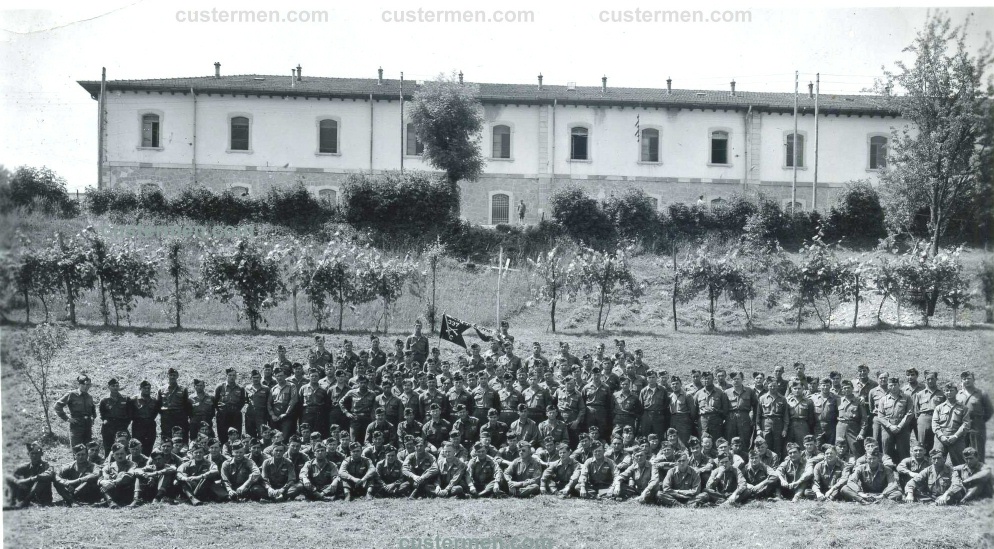
Photo of Company C of 337th Infantry Regiment taken at Enlistedmen's Club in Belluno, Italy.
Photo provided by Don Kochi.
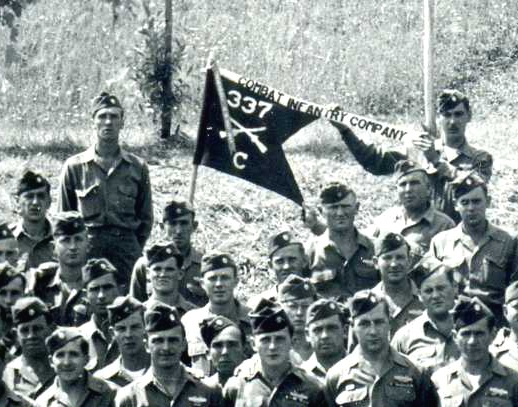
Close-up of Company Guidon with streamer "COMBAT INFANTRY COMPANY".
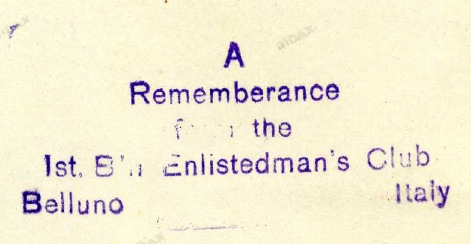
Stamp on Back of Photo:
A Rememberance from the 1st Btn Enlistedman's Club, Belluno Italy
Company D 337th Infantry Regiment
This group photo is Company D of the 337th Infantry Regiment of the 85th 'Custer' Division was taken after the Germans surrendered. The 85 Division chased the Germans into the Alps, where they surrendered on May 2, 1945 at Belluno. Some of the 85 Division remained in the Belluno area of the Alps and waited for the Army to decide what was next for them. If they had earned enough points, they could go home -or- they would be sent to the Pacific Theater for the invasion of Japan. So, I suppose this was a good time for one last photo of the victorious troops in Italy.
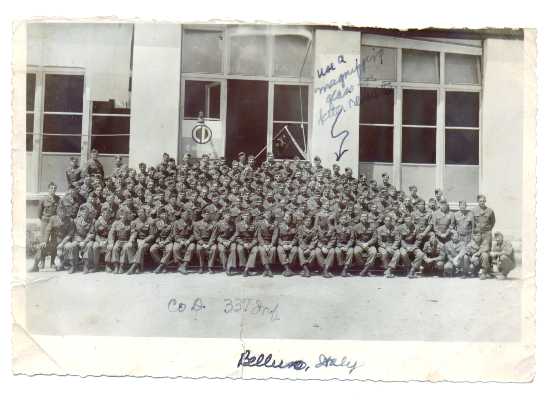
The building in the background has the Custer Division (CD) insignia on the door and underneath is "E-M Club", which stood for "Enlisted Men's Club".
Private Seymour Sarokin drew in an arrow pointing to him with the note: "Use a Magnifying Glass for Better Results".
Company I 338th Infantry Regiment
This group photo is Company I of the 338 Infantry Regiment of the 85 'Custer' Division. This unit in this photo has been identified as the 338 Infantry Regiment but the date and location has not been confirmed. I believe this photo was also taken at Belluno after war in Italy ended. Everything seems to match the above photo of the 337 Regiment. As in the above photo, the soldiers seemed to be relaxed and happy. Most are wearing the Combat Infantryman's Badge and their ribbons.
Note the large sign behind the group. Maybe this is a USO sign or maybe they made it for their unit.
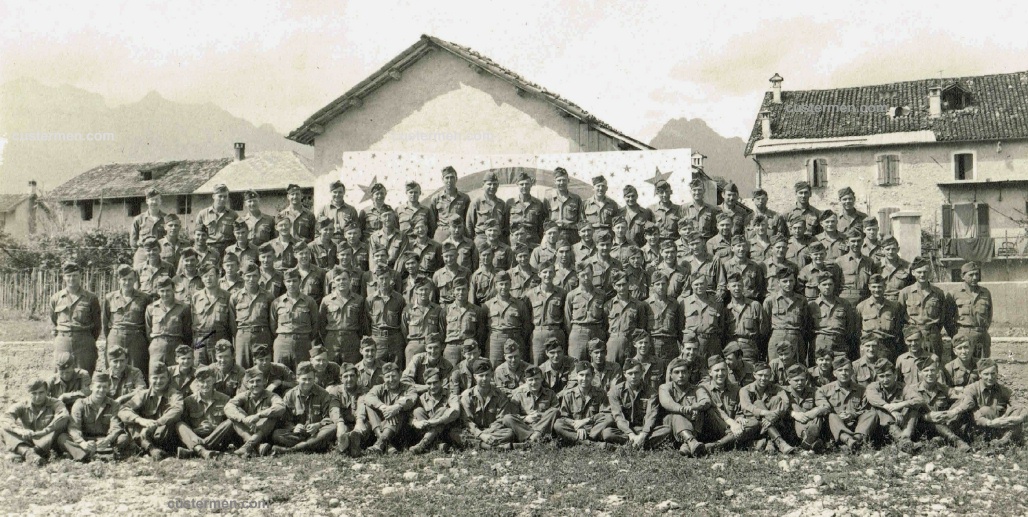
Photo of Company I of 338th Infantry Regiment.
Yep - but it's just about time to pause and take the world's coolest photograph (can't bring myself to shrink the size down, sorry):

Easy Company looks like a bunch of regular guys, like you'd rub elbows with at a neighborhood bar. Think of how many Nazis they killed on the way to drink Hitler's wine at the Eagles Nest.
Great post. I’ve been posting the big pics too, because they have so much more impact.
Disclaimer: Opinions posted on Free Republic are those of the individual posters and do not necessarily represent the opinion of Free Republic or its management. All materials posted herein are protected by copyright law and the exemption for fair use of copyrighted works.


