Posted on 12/12/2014 7:23:15 AM PST by thackney
The recent decline in crude oil prices has created the potential for weaker crude oil production. EIA's Drilling Productivity Report (DPR) includes indicators that provide details on the effect low prices may have on tight oil production, which accounts for 56% of total U.S. oil production. Analyzing these indicators and the changes in oil production following the drop in crude oil prices during the 2008-09 recession may offer some insight into possible near-term oil production trends.
The price of West Texas Intermediate (WTI) crude oil delivered to Cushing, Oklahoma declined more than 31% from June to November 26 and another 7% after the late November announcement of the Organization of the Petroleum Exporting Countries (OPEC) decision to maintain the current production level. At $60 per barrel, the current price of oil is likely approaching or already below the expected per-barrel costs of some of the most expensive U.S. tight oil projects.
Some of the most active production fields in the country are in North Dakota. Indicators tracked by the DPR and North Dakota's Department of Mineral Resources (DMR) cover much of the exploration and production process, from planning to production. These indicators include:
- Permits. Before drilling begins, producers must sign lease contracts and apply for permits to drill exploration and development wells.
- Rig movement. Drilling rigs must be secured and moved to permitted locations.
- Spuds. Spudding is the term for the ground-breaking process of a new drilling project. In North Dakota, the spud count is a count of new wells drilled.
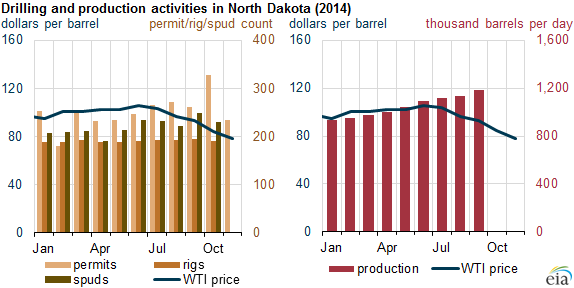
Based on the most recent data released by North Dakota's DMR, drilling and production activities in the state have not slowed, despite the significant decline in domestic crude oil prices since July 2014. Oil production in September 2014—the latest data available—rose 5% from the prior month.
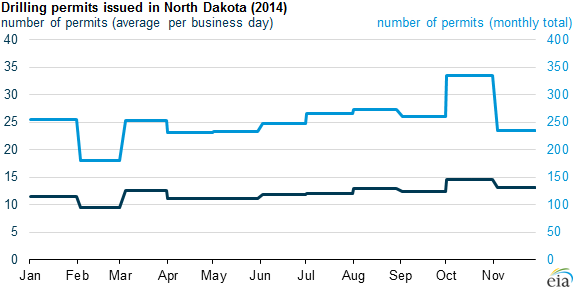
The number of permits issued in October 2014 was 28% above the September level, but it dropped 30% in November. However, when normalized based on the number of business days during those months, October is only 17% above September's level, and November is only 10% lower than October.
Although the current economic situation is fundamentally different from the recession of 2008-09, changes in oil prices, production indicators, and production volumes during the recession may offer insight into what may happen next with U.S. shale oil production.
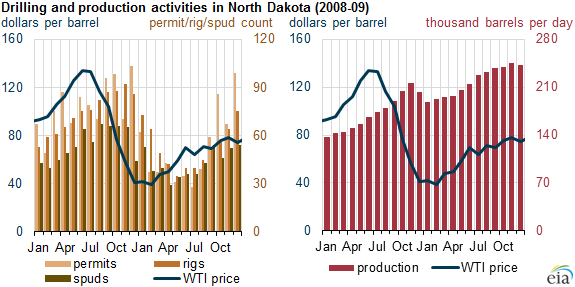
During the 2008-09 recession, monthly average WTI prices fell by 71% to $39.09 per barrel between June 2008 and February 2009. At the time, shale oil production in North Dakota was still in the testing phase and thus relatively expensive. Drilling and production continued to increase until November 2008, when WTI prices dropped below $57 per barrel. Below $57 per barrel, the number of projects that were interrupted increased significantly, with the number of permits declining 73% from December 2008 to July 2009, the number of rigs declining 62% from November 2008 to May 2009, and the number of spuds declining 55% from November 2008 to April 2009. However, the decline in production was not nearly as dramatic, falling only 13% from November 2008 to January 2009, after which time production began increasing.
Looking forward, EIA expects 2015 drilling activity to decline as a result of less-attractive economic returns in some areas of both emerging and mature oil production regions. Many companies will redirect investment away from marginal exploration and research drilling and into core areas of major tight oil plays. However, projected oil prices remain high enough to support development drilling activity in the Bakken, Eagle Ford, Niobrara, and Permian Basin, which contribute the majority of U.S. oil production growth.
EIA expects U.S. crude oil production to average 9.3 million barrels per day (bbl/d) in 2015, up 0.7 million bbl/d from 2014, but down from expected growth of 0.9 million bbl/d in last month's Short-Term Energy Outlook. However, all of the decrease in forecast production growth comes in the second half of 2015. EIA revised production growth downward by 140,000 bbl/d and 270,000 bbl/d in the third and fourth quarters, respectively, compared with the previous forecast. However, this forecast remains particularly sensitive to actual prices available at the wellhead and drilling economics that vary across regions and operators.
The Harleys take premium.
Gonna be a good summer.
:)
Just bought a big honkin’ full sized SUV last weekend.
“US production continues to rise...”
Not if Yahoo has anythign to say about it...
One of the stories that pops up at yahoo mail for the last week is “The Dark Side of Your Low Gas Prices” It is an absolutely insane, bullshit piece about an explosion of oil carrying rail cars in Canada last year, and how American rail is under-regulated, and WE ARE ALL GOING TO DIE IN FIERY OIL EXPLOSIONS, because we have cheap gas and the Feds are simply not regulating enough.
No mention, by the way, of “Hey, let’s build the pipeline, so there is less oil moving on rail.”
I tell ya, I am absolutely paralyzed with horror at the prospect of dying in an oil fire!!!! I say we ditch cheap gas, and go with safer Saudi Oil!!!!
Then there was the yahoo finance story yesterday about our energy production crippling African economies!!! WE CAN’T HAVE THAT!!!!
I laughed at that one. Like they need our help to self destruct.
Typical lib self hate. Anything good for the USA must ipso facto hurt others and consequently be evil.
Yahoo>>Marissa Mayer>>Regime affiliate
Statists fear cheap oil.
Cheap oil facilitates mobility of the masses.
That’s a very bad thing in Statistville.
Yahoo is so left, like you, being informed, their comments make you laugh at how ridiculous they are. But to the uninformed its a fact. Once it is stated it is a fact.
No point in checking, nothing to see here.
We’re refiners.....
More than that, the petrochem industry is sure making a difference in the job market.
Shale boom spurs chemical industry expansion
http://www.freerepublic.com/focus/f-news/3236478/posts
In recent years, more than 215 new production projects worth $135 billion have been announced as companies scramble to take advantage of the cheap U.S. shale gas that gives them a cost advantage over their foreign competitors.
I have an old but good Lincoln Aviator, I am actually driving it now. Swear it would do low fourteens in the 1/4 mile.
Gasoline hit $1.99 in Dallas this AM.
We have a couple in our greater area now as well.
San Antonio area had it a few days ago.
http://www.texasgasprices.com/
http://www.dallasgasprices.com/Dallas_-_Central/index.aspx
Go out an buy a pickup...with a big V8...today
:-)
Good.
I wish I could stockpile the stuff.
Hopefully other prices follow.
Yeah, my hopes for a discounted F250 in the last couple days of the year are gone.
Diesel stores pretty well (be sure to add some biocide because it inhibits the growth of fungus).
Gasoline, not so much.
Ethanol laden gas plain sucks.
Pretty hard to find a cheap truck anywhere in Tx anytime. LOL
High demand.
Disclaimer: Opinions posted on Free Republic are those of the individual posters and do not necessarily represent the opinion of Free Republic or its management. All materials posted herein are protected by copyright law and the exemption for fair use of copyrighted works.