
3-D painting deposits metal powder flying at velocities of up to Mach 4 on precise models to produce and repair jet engine blades, rotors and other components without resorting to machining or welding.
Posted on 11/08/2013 7:05:13 AM PST by null and void
3-D painting deposits metal powder flying at velocities of up to Mach 4 on precise models to produce and repair jet engine blades, rotors and other components without resorting to machining or welding.
Scientists at GE Global Research labs (GRC) have developed a supersonic manufacturing technique called 3-D painting that could make next-generation jet engines lighter and more efficient. 3-D painting deposits metal powder flying at velocities of up to Mach 4 on precise models to produce and repair jet engine blades, rotors and other components without resorting to machining or welding.
“This additive technology is like a fountain of youth for machine parts,” says Anteneh Kebbede, manager of the Coatings and Surface Lab at the GRC.
Kebbede says that 3-D painting is a new take on an older technology called cold spray. Cold spray is using a spray gun to coat parts with a thin layer of material. But 3-D painting can build whole new parts with walls as thick as one inch or more.
“For manufacturers, the potential benefits are enormous,” Kebbede told IdeasLab. “Imagine being able to restore an aging part to its original condition with a tool that looks like spray gun.”
Unlike welding, cold spray does not require heat, which can melt surrounding material and change the mechanical qualities of the part. The 3-D painting gun is using pressurized carrier gas zipping through a de Laval nozzle to accelerate powder particles as small as 5 microns to supersonic velocities. The speed causes localized high energy collisions when the particles hit the surface, the micro version of bullets hitting an I-beam.
“Powder particles slam into the surface and form a diffusion bond with the part,” Kebbede says. “The bond happens on the atomic level. That’s why we are so excited.”
Kebbede and his team are using a computer-controlled robot to manipulate the gun. Like 3-D printers, the computer works with a 3-D image of the part. Engineers program the robot so that it moves in an optimal way to deposit the powder. “All the hard work is in the details,” he says.
“The powder selection, the conditions the powder experiences in the gun, the speed of the gun, the gun distance from the part and its angle relative to the part are just some of the inputs that lead to a good bond. That’s the trick. The same process that can cause build up can also cause erosion.”
In the past, engineers used cold spray to clad everything from electronics to cooking pots with soft materials like copper. But Kebbede’s team is now working with superalloys with applications anywhere from heavy-duty gear boxes for oil and gas machinery, to gas turbine rotors and jet engine blades. Who knows, maybe one day supersonic painting will add a few Machs to the jet engines of the future.
Political power grows out of the nozzle of a 3-D Printer.
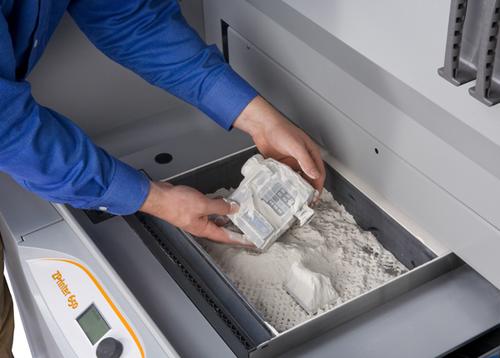
What is that being created? the product looks more like a Star Trek gadget than the Star Trek gadget that created it.
All of this would seem to make space colonization seem so much more possible: Instead of having to deliver every tool needed (at costs of hundreds of thousands of dollars per pound), just send up the tools to make the tools. God knows Mars isn’t lacking in iron ore, carbon dioxide, water or the other essential “ingredients.”
Possibly a tool for tattoo removal in the future.
Like sintered metal? I had a sintered valve rocker explode in a station wagon engine while at speed on the DC beltway. Screw that.
They didn’t say. It looks vaguely gear like to me, or perhaps an impeller?
More like nano-forged.
This could kill the Viagra market!
“The bond happens on the atomic level. That’s why we are so excited.”

One Austin TV station had a report last evening that 3 D printing was now used to reconstruct breasts after mastectomies.
Just oxygen....................
Probably sintered by a heating/compression process. Laser sintering yields MUCH stronger parts...even stronger than machined from "bar" stock. This "paint sintering" will probably fall somewhere between the two, with the bias to the stronger end. The key to strength is how much the deposited material "mingles" with the bulk target substrate.
Just oxygen...
If Mars still had a liquid iron core, it would possess a magnetic field, which would repel the solar wind. We'd be able to terraform that planet by simply introducing plant life which would build up the oxygen in the atmosphere.
Without the protection of a magnetic field, though, it's certain that plant life wouldn't survive the cosmic rays raining down on that place. Perhaps some forms of microbial life could withstand that environment, but I imagine trees and grasses are out of the picture.
>> Just oxygen.................... <<
I thought I mentioned the iron ore, water, carbon dioxide... ;^)
Water + CO2 + seeds -> Plants + O2.
FYI: I did have in mind habitation bubbles, not terraforming.
Disclaimer: Opinions posted on Free Republic are those of the individual posters and do not necessarily represent the opinion of Free Republic or its management. All materials posted herein are protected by copyright law and the exemption for fair use of copyrighted works.