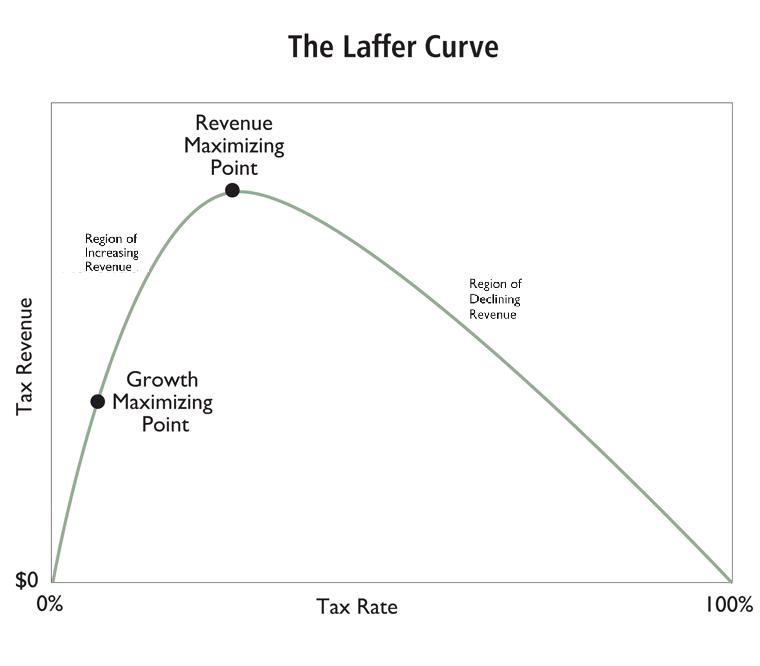
 In other words, bad policy might lead to a turbo-charged version of the Laffer Curve.
Posted on 07/02/2012 6:35:16 AM PDT by Kaslin
Back in 2010, I excoriated the new Prime Minister of the United Kingdom, noting that David Cameron was increasing tax rates and expanding the burden of government spending (including an increase in the capital gains tax!).
I also criticized Cameron for leaving in place the 50 percent income tax rate imposed by his feckless predecessor, and was not surprised when experts began to warn that this class-warfare tax hike might actually result in less revenue because the reduction in taxable income could be more significant than the increase in the tax rate.
In other words, bad policy might lead to a turbo-charged version of the Laffer Curve.
Allow me to elaborate. In most cases, punitive tax hikes do raise revenue, but not as much as politicians predict. As explained in this three-part video series, this is because it takes a very significant reduction in taxable income to offset the revenue-generating impact of the higher tax rate.
But if a tax increase imposes a lot of damage and taxpayers have enough flexibility in their financial affairs, then it’s possible that a tax hike can lose revenue (or, as we saw with Reagan’s “tax cuts for the rich,” a well-designed reduction in tax rates can actually generate higher revenue).
With that background knowledge, let’s now take a closer look at David Cameron’s tax increases. They’ve been in place for a while, so we can look at some real-world data. Allister Heath of City AM has the details.
Something very worrying is happening to the UK’s public finances. Income tax and capital gains tax receipts fell by 7.3 per cent in May compared with a year ago, according to official figures. Over the first two months of the fiscal year, they are down by 0.5 per cent. This is merely the confirmation of a hugely important but largely overlooked trend: income and capital gains tax (CGT) receipts were stagnant in 2011-12, edging up by just £414m to £151.7bn, from £151.3bn, a rise of under 0.3 per cent. By contrast, overall tax receipts rose 3.9 per cent.
Is this because the United Kingdom is cutting tax rates? Nope. As we mentioned in the introduction, Cameron is doing just the opposite.
…overall taxes on labour and capital have been hiked: the 50p tax was introduced from April 2010 (and will fall to a still high 45p in April 2013), those earning above £150,000 have lost their personal allowance, CGT has risen to 28 per cent, many workers have been dragged into higher tax thresholds, and so on. In theory, if one were to believe the traditional static model of tax, beloved of establishment economists, this should have meant higher receipts, not lower revenues.
So what’s the problem? Well, it seems that there’s thing called the Laffer Curve.
…there is a revenue-maximising rate of tax – and that if you set rates too high, you raise less because people work less, find ways of avoiding tax or quit the country. The world isn’t static, it is dynamic; people respond to tax rates, just as they respond to other prices. Laffer told a gathering at the Institute of Economic Affairs that this is definitely true in the UK today – and the struggling tax take revealed in the official numbers suggest that he is right. Tax rates and levels are so high as to be counterproductive: slashing capital gains tax would undoubtedly increase its yield, for example. Many self-employed workers are delaying incomes as much as possible until the new, lower top rate of tax kicks in.
Allister’s column also makes the critical point that not all taxes are created equal.
…higher VAT is also damaging growth, though it is still yielding more. Some taxes can still raise more – but try doing that with income tax, CGT or corporation tax and the result is now clearly counter-productive. These taxes are maxed out; they have been pushed beyond their ability to raise revenues.
Last but not least, he makes an essential point about the role of bad spending policy.
The problem is that spending is too high – central government current expenditure is up by 3.7 per cent year on year in April-May – not that taxes are too low. The result is that the April-May budget deficit reached £30.7bn, some £6.2bn higher than a year ago.
By the way, you won’t be surprised to learn that Paul Krugman has been whining about “spending cuts” in the United Kingdom, even though the burden of the public sector has been climbing. But given his outlandish errors about Estonia, we shouldn’t be surprised.
But that’s not the point of this post. The relevant question is why do politicians pursue bad policy and why do some economists aid and abet bad policy?
For politicians, I think the answer is easy. They simply care about getting elected and holding power. So if they think class-warfare tax policy is the way of achieving those narcissistic goals, they’ll push higher tax rates. Even if it means lower revenue, notwithstanding their usual desire to have more money so they can buy more votes.
I’m more mystified by the behavior of economists. Let’s look at a couple of examples. Justin Wolfers and Mark Thoma recently cited some survey data to claim that the Laffer Curve was universally rejected by the profession.
But as James Pethokoukis of the American Enterprise Institute explained, the survey actually showed just the opposite, with economists by a margin of nearly 5-1 agreeing that lower tax rates could boost GDP (and therefore taxable income).
Those economists did say that a reduction in tax rates, based on current levels, would not cause taxable income to jump by a large enough amount to fully offset the revenue-losing impact of the lower tax rate. But the Laffer Curve says that only happens in extreme circumstances, so there’s zero contradiction.
So why did Wolfers and Thoma create a straw man in an attempt to discredit the Laffer Curve?
I have no idea, but Republican politicians probably deserve some of the blame. Too many of them make silly claims that “all tax cuts pay for themselves,” even when talking about new credits and deductions that have no positive impact on economic performance.
To the extent that Wolfers, Thoma, and others think that’s what the Laffer Curve is all about, then their skepticism is warranted.
But if that’s the case, they should read what Art Laffer actually wrote so they can be more accurate in the future. Or they can watch these three videos.
Part I describes the theory.
Part II describes the evidence.
And Part III explains the sloppy and inaccurate revenue-estimating methodology of the Joint Committee on Taxation.
But if they think I’m too biased or that Art is similarly misguided, then they should look at some of the evidence produced by other economists.
The sooner they get up to speed on these issues, the sooner they can help give politicians good advice so that the Laffer Curve doesn’t cause more unpleasant surprises.
It’s always amused me that the “pro-science” crowd (you know, the worshippers of the God of Anthropomorphic Global Warming) don’t acknowledge this simplest of all economic relastionships.
It’s, dare I say it: “Inconvenient”.
(post Simpsons character pointing here)
Anthropogenic
Throughout history, poverty is the normal condition of man. Advances which permit this norm to be exceeded — here and there, now and then — are the work of an extremely small minority, frequently despised, often condemned, and almost always opposed by all right-thinking people. Whenever this tiny minority is kept from creating, or (as sometimes happens) is driven out of a society, the people then slip back into abject poverty.
This is known as “bad luck.”
- Robert Heinlein
This article is all very well, but I thought Cameron had in fact recently cut the top tax rate from 55% to 50% (and was heavily criticised by the left for doing so).
It makes sense from their worldview - they are humanists, and believe that the elite humans can force anything to happen that they want, given enough power.
The Laffer curve is in opposition of this view, so they reject it. They believe that those at the top with the power can force the economy to work as they will it to.
There’s the dreamland that that sheeperals are living in where they can get free healthcare and the system won’t collapse.
I accepted the 0bamacare ruling as just a step up in the timetable for the whole economic system to collapse. I had already accepted that this collapse is inevitable, this just steps things up a bit.
“This article is all very well, but I thought Cameron had in fact recently cut the top tax rate from 55% to 50% (and was heavily criticised by the left for doing so).”
The article is embarrassingly out of date and misinformed from the start. It keeps refering to Cameron’s tax rises. He hasn’t increased a single tax since coming to office and has been notable in reducing many including the vital corporation tax which was 28% when he came to power and is 24% this year and 23% next year. What is it in the US? Around 34% I think. He’s also raised the level of income one has to earn before one pays any income tax and as you quite rightly thought, he has reduced the top rate of tax from 50% to 45% and intends to reduce it further when economics allow.
The author really ought to try and join the rest of us in 2012 before writing any more insightful atricles like this!

I haven't read any economic literature on this, but I believe that there is a different shape between the long term and short term Laffer Curve. This graph hits at it with the "growth maximizing point" lower than the "revenue maximizing point". People cannot respond to a tax change immediately. If you lower taxes this year there isn't enough time for people to build stores and factories and thus increase production and therefore tax revenue by the end of the year. Similarly, if this year's tax was jacked up (or even made retroactive to the beginning of the year like Clinton did), there isn't time to retire or reduce work to lower income and taxes this year. Thus the liberals latch onto this and state the Laffer Curve is false because often tax revenues go down in the first year of a tax cut (or go up in the first year of a tax increase). Where is the maximum point of the Laffer Curve for the first year? I don't know but I suspect that it is higher than even our current tax rate. But the real power of the Laffer Curve is over many years. Lower taxes this year and you get less revenue this year, a little higher the following year and soon it will be higher than it would have been with the higher rate. I believe that tax rate is lower than we have now.
One other problem I have with the Laffer Curve is that even some proponents seem to believe that the revenue maximizing tax rate is the ideal one. No! That is just the maximum you can squeeze from us, but it is not the best rate for the people. The best rate is significantly below that rate. The ideal rate is the one which maximizes after tax income of the people, not the tax revenue of the government.
Depends on which side of the government paycheck you are standing on.
Chavs cost money.
The Left gets to greedy and irrational when they THINK they can get more money for the state coffers and end up starving the state coffers, but hey then they turn to deficit spending and crash everything later down the road and of course it is the fault of everyone EXCEPT government....
[ Chavs cost money. ]
It is easy to pay for a Welfare state when someone else is protecting your country from the big bad wolf behind the iron curtain.
Heinlein was a fantastic student of the “Human Condition”.
Which is why I remind every idiot that chants “Bush Tax Cuts For The Rich†that Federal Tax Revenues INCREASED 35% from 2003 to 2007.
Fred Thompson mentioned this a few weeks ago. He said he cannot believe that the Republicans don’t use this fact like a club. It eviscerates the DNC mantra.
Which also leads me to remind them of what happened in 2007, the takeover of the House and the Senate by Pelosi and Reid.
Your #9 is a good explanation of their thinking. But they also rely on cultivating the utter stupidity of the students in their care. Economic illiteracy in the govt schools is an enforced norm.
Disclaimer: Opinions posted on Free Republic are those of the individual posters and do not necessarily represent the opinion of Free Republic or its management. All materials posted herein are protected by copyright law and the exemption for fair use of copyrighted works.