Posted on 11/13/2011 10:15:37 PM PST by A.A. Cunningham
U.S. Marine Corps Negotiates Buying Decommissioned British Harriers
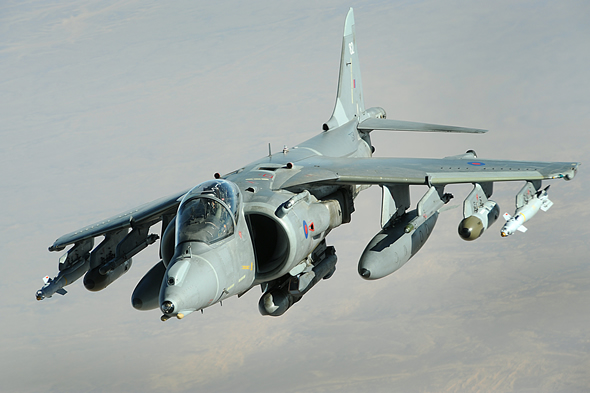
The U.S. Navy and Marine Corps have agreed to buy Britain’s entire decommissioned fleet of 74 Harrier GR-9 and 9A Vertical/Short take off and Landing (V/STOL) fighter jets – a move expected to help the Corps operate Harrier jump jets into the mid-2020s and possibly replace aging two-seat F-18D Hornet strike fighters currently used for night attacks, Navy Times reports. A spokesman for the British Ministry of Defence confirmed the Disposal Services Agency was in talks with the U.S. Navy for the sale of the Harriers, their engines and spare parts. The Corps is planning on phasing out its Harriers by 2025, and the current acquisition could provide an essential stock of spare parts and airframes at bargain price, sustaining the Corps combat air fleet as the service moves through the uncertainty of the current fiscal years.
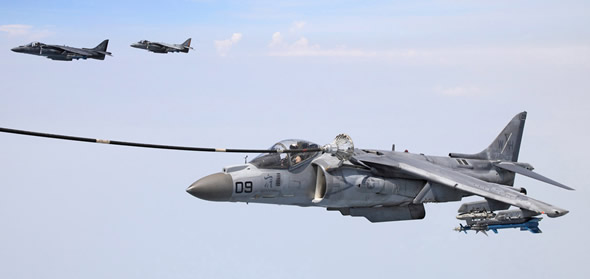
The Marine Corps currently fly the AV-8B, a U.S. variant of the British V/STOL design built by McDonnell Douglas and British Aerospace. Britain retired its entire Harrier GR-9, 9A and Sea Harrier fleet in 2010 under the controversial Strategic Defense & Security Review (SDSR), that mandated deep cuts through all three services. The retired Harriers are stored at Royal Air Force Base Cottesmore, England where they have been maintained in airworthy status. The U.S. will get the entire Harrier’s spares stocks for $50 million. The cost of the aircraft is still being negotiated.
It is not clear yet if the Marine Corps will actually fly the ex. British Harriers or ‘harvest’ their spare parts for the next ten years. A total of 70 Harriers were upgraded in the past 10 years but only 40 were still serviceable to fly when the fleet was axed last year. The latest upgraded model, GR 9A is similar in configuration to the Marines’ AV-8B night attack version. Although the British variants lack the radar carried with the AV-8B, their ground attack capabilities are similar. Furthermore, the 9A shares a common engine with the AV-8B – the Rolls-Royce F402-RR-408.
Selling England by the Pound
ping
With everything going in in Europe, you’d think England would want to keep them...
Probably a smart move. With the F-35B’s future in doubt, the Marines may well have to make due with British “hammies” (hand me downs) to maintain a STOVL capability.
Might as well make good use of them.
Don’t worry, there are at least four left in museums should they be needed.
Regards
Finally somebody in the Dept. of Defense establishment showed some brains. Since the British sold their aircraft carrier to India(?), they had no large platform for the Harriers to take off from in terms of projecting British air power.
The Harrier is the perfect fighter-bomber for desert and mountainous environments where there are no regular airfields. Harriers can land on roads, tennis courts, even rooftops (if they are strong enough to hold them). They are pop-up weapons which means they can be hidden behind sand dunes, trees, hillocks, etc, and then go airborne for a short period of time to fire at tanks, convoys, etc. before ducking back down to the deck.
If we are smart, we should buy the manufacturing technology for the Harriers and let the British continue to build them more cheaply than we can. I’m sure Israel would like a couple air-wings of them for use in Lebanon and Syria.
Call me old fashioned, but when you have a winning fighter, you keep it (esp. the A10 Warthog).
From June of 2011:
Harrier jump-jets sold to U.S. 'for peanuts'
Since the British sold their aircraft carrier to India(?), they had no large platform for the Harriers to take off from in terms of projecting British air power.
HMS Ark Royal wasn't sold to India, it has yet to be disposed of. HMS Illustrious was converted to a helicopter carrier.
If we are smart, we should buy the manufacturing technology for the Harriers and let the British continue to build them more cheaply than we can.
Any idea how many AV-8Bs were built at the McDonnell Douglas plant in St. Louis?
Total production of AV-8B for USMC and Spain (does not count British Harrier II production). Italian Harriers are from USMC stock.
1. AV-8B Day Attack — 166 (1983-1989)
2. AV-8B Night Attack — 66 + 1 conversion (1989-1993)
3. AV-8B Harrier II Plus — 46 new + 72 converted (1993-1997)
4. TAV-8B trainer — 27 built.
5. EAV-8B Matador II (Spain) — 12 built.
6. EAV-8B Matador II Plus — 11 conversion + 9 new.
7. Italian Navy has 14 AV-8B Plus and 2 TAV-8B from USMC stock (2010).
Harrier II production and conversion work ended in 2003. Total of 305 AV-8B and TAV-8B built for USMC, 21 for Spanish Navy.

Indeed. England is selling assets to pay debt. Crazy, crazy stuff. Don’t they have a printing press?
I never understood why Marines have fixed wing aircraft now. The Army does fine with its rotary-wing gunships and transport. The AF handles the faster assets.
With today’s Joint Force stratgey and tactics, make the need even more puzzling now.
(Overhead cover in place. Fire when ready.)

Click on pic for past Navair pings. Post or FReepmail me if you wish to be enlisted in or discharged from the Navair Pinglist. The only requirement for inclusion in the Navair Pinglist is an interest in Naval Aviation. This is a medium to low volume pinglist.
It iscoming here sooner than than people think.Te 2012 election results will tell whether we will be able to avoid it or not. I personally believe that the voters will continue to vote themselves paychecks, thus sealing our fate. I hope not but time will tell.
Our pilots will no doubt have to be retrained to fly on the “right” side of the airways..
Because the Marines don’t trust the Air Force with the ground support mission for their guys. There are a lot of good historical reasons for this, even though at the moment the Air Force is pretty good at it.
Maybe this is a bit off-topic, but 60-70 years ago, all airway navigation was done on "beams", which were narrow low-frequency radio "legs" stretching across country. "On the beam", pilots received a constant audio tone signal. To one side, a Morse "N" (dah-dit") was heard, and on the other side "A" (dit-dah). Airline pilots usually made a habit of keeping to the "right" side of the beam, to avoid risk of a midair collision in case controllers made a mistake or some illegal IFR traffic was coming from the opposite direction.
Disclaimer: Opinions posted on Free Republic are those of the individual posters and do not necessarily represent the opinion of Free Republic or its management. All materials posted herein are protected by copyright law and the exemption for fair use of copyrighted works.