Posted on 06/24/2011 12:33:44 AM PDT by neverdem
A team in Canada has made a device that could be implanted behind the eye to release drugs on demand to treat retinal damage caused by diabetes.
Diabetic retinopathy can lead to blindness. A current treatment is laser therapy, which is destructive and results in side effects, such as diminished side and night vision, and unwanted laser burns. Another therapy is to administer antiproliferative drugs, such as docetaxel (normally a cancer drug), but the compounds clear from the blood quickly, so high doses are needed to produce the desired effect, which increases toxicity to other tissues.
Mu Chiao and colleagues from the University of British Columbia in Vancouver have made a device to be implanted behind the eye that releases drugs when triggered by an external magnet. This means that the device doesn't need a battery and lower doses can be used. Implantable devices have been made before but drug release is done by diffusion and the release rates can't be controlled, which is a problem if the dosage rate needs to be adjusted when a patient's condition changes.
|
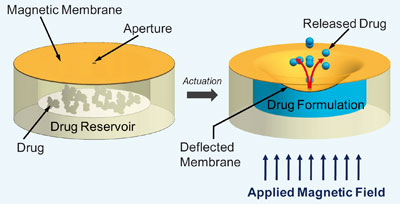
The device is loaded with a drug then sealed with a polydimethylsiloxane membrane. Applying a magnetic field causes the membrane to deform, triggering the release of the drug.
|
The team made the device from a reservoir loaded with the drug, sealed by an elastic magnetic polydimethylsiloxane membrane. Applying a magnetic field causes the membrane to deform, triggering the release of the drug.
The team loaded the device with docetaxel at a dosage suitable for treating diabetic retinopathy over 35 days and found that background leakage of the drug was negligible. They also monitored the drug's biological activity over time by testing it against two cell lines, including prostate cancer cells. They found that they were able to achieve reproducible release rates and the docetaxel retained its pharmacological efficacy for more than two months in the device.
'The device is intended to improve the quality of life for patients suffering from chronic diseases,' says Chiao whose motivation was personal as he has family members that have diabetic retinopathy.
'This is an interesting approach towards developing therapeutically useful ophthalmic delivery systems,' says John Tsibouklis who studies biomaterials and drug delivery at the University of Portsmouth in the UK. 'It represents a significant advance towards device based drug delivery.'
Chiao hopes to pin down the exact medical applications for the device so that he can tailor the mechanical design to particular diseases. However, he does envisage challenges ahead, involving biocompatibility, performance optimisation and degree of controllability.
On-demand controlled release of docetaxel from a battery-less MEMS drug delivery device
Fatemeh Nazly Pirmoradi, John K. Jackson, Helen M. Burt and Mu Chiao, Lab Chip, 2011
DOI: 10.1039/c1lc20134d


Ugh!
Innovative!
(Thanks, neverdem!)
Cheers!
save
Cool! Thanks for the ping.
There are already implantable pumps on the market that are more controllable and have made it through FDA. They would just need to verify the pump is compatible with the drug and how to implant the catheter close to the eye.
>> “A team in Canada has made a device that could be implanted behind the eye to release drugs on demand to treat retinal damage caused by diabetes.” <<
.
But why not use effective treatments to cure the retnal problem (there are several, from nutritional to FSM therapy) instead of the invasive approach?
ping
I searched "FSM therapy" "diabetic retinopathy" on Yahoo.
Nada. Ditto Google.
Facts About Diabetic Retinopathy A pretty good primer on the topic
For example, researchers are studying drugs that may stop the retina from sending signals to the body to grow new blood vessels. Someday, these drugs may help people control their diabetic retinopathy and reduce the need for laser surgery.If they can't block the retinal signal, then maybe they can find an inhibitor of endothelial stem cells to block angiogenesis. As it looks now, all they have is lasers to fry the blood vessels and surgery for vitrectomy, IMHO.
You do lose a lot of your night vision (and the color "blue") with the laser treatment ~ and a couple of other types of treatments.
All treatments don't work with all causes.
Doc... you sure have a way of getting me excited over all of this new stuff.
On the diabetes ping list, why would I address any other kind?
Because even diabetics can have hereditary macular degeneration.
Disclaimer: Opinions posted on Free Republic are those of the individual posters and do not necessarily represent the opinion of Free Republic or its management. All materials posted herein are protected by copyright law and the exemption for fair use of copyrighted works.