Posted on 11/10/2010 7:44:44 PM PST by blam
Why Commodities Are Rallying As Currencies Decline
By Eric Fry
11/10/10 Laguna Beach, California – Cotton…silver…palladium…nickel…corn.
What do these things have in common?
Answer: They are not a dollar bill. And neither are they a euro (EUR) or a renminbi (CNY) or a rupee (INR)…or any of the other currencies that central bankers around the world are aggressively debasing.
“It’s not just our own Federal Reserve that wants to destroy its currency,” observes Chris Mayer, editor of Capital & Crisis. “It seems everybody is doing it. As Eric Sprott, a great investor hailing from the Great White North, recently noted in his Markets at a Glance letter:
‘By our count, no less than 23 separate countries have now intervened in the foreign exchange market in some way since Sept. 21, 2010. The goal for all is to increase the supply of their respective paper currencies in order to drive them down in value.’
“Investors, though, aren’t dummies – at least not always. That’s why real assets are rallying.”
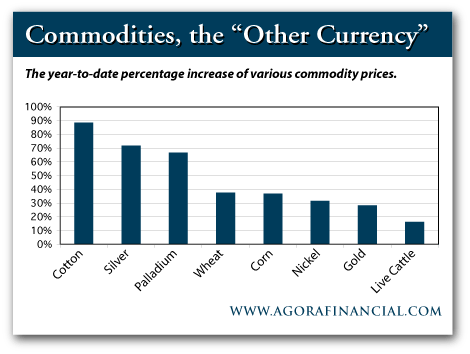
The nearby chart tells the tale. Commodities, as an asset class, have become quasi-currencies. From gold to coffee to cattle, commodities of all types have been soaring in price, ever since the Federal Reserve publicly declared its war on deflation. General Bernanke vowed to conduct this war aggressively and to utilize a battlefield tactic he called “quantitative easing.”
The war has been underway for several months, but victory is nowhere in sight. Instead the battlefield is littered with the remains of dollar bills that once seemed so powerful and full of potential.
Seeing the results of this campaign, investors are growing increasingly fearful of taking sides with the US dollar. Instead, they are placing their security in the hands of gold, silver, platinum and numerous other commodities. As such, every major commodity has outperformed the S&P 500’s 8.8% gain for the year to date. Only zinc and cocoa trail behind.
In a world where every major paper currency is suspect, gold is a compelling alternative. But it is not the only alternative. As reliable stores of value, a bale of cotton or a bushel of wheat also seemed preferable to paper currencies.
“And, as if [commodities] needed another reason to rally,” co-editor, Joel Bowman, observed earlier this week, “China is betting on ‘stuff’ over ‘paper.’
“Reports Barron’s: ‘This year, for the first time ever, China has been investing more overseas in assets like iron, oil and copper than it puts into US government bonds.
“‘China in this year’s first half spent $31 billion on hard assets,’ the journal continues, ‘compared with $23 billion on Treasuries and other US government bonds. Experts say China’s investments in each of these asset classes will total about $55 billion for the full year. But even a tie marks a major turnaround from China’s previous practices. For many years, the mainland spent next to nothing on hard assets abroad, while its purchases of US government debt ranged as high as $100 billion a year.’”
Monetary tastes and habits – like culinary tastes and habits – do not change overnight. But once these habits begin to change, they rarely regress to their previous condition. General Bernanke would be unwise to ignore this tendency of human behavior.
McDonald’s opened its first restaurant in China in 1990 – trying to sell hamburgers to rice- and chicken-eaters. Twenty years later, 1,100 McDonald’s restaurants dot the Chinese landscape…and 1,000 more will open by 2014. Tastes rarely change quickly, but when they do change, they usually change forever.
The Chinese, the world’s largest buyers of Treasury debt, are slowly changing their monetary tastes and habits – preferring hard assets over US paper. Likewise, global commodity markets are telling us loud and clear that many, many investors around the world are also changing their monetary tastes and habits – also preferring hard assets over US paper.
But in the midst of these evolving long-term trends, short-term counter-trends sporadically arrive – usually with a surprising fury and intensity. Yesterday was one of those moments. Gold, silver and platinum, along with almost every other major commodity traced out what chartists call an “outside day reversal.” In other words, these commodities advanced strongly early in the trading session to exceed the prior day’s highs, but then reversed later in the trading session to finish the day below the prior day’s lows. And most of these commodities performed this volatile feat on extremely high volume. Net-net, a classic outside day reversal – the kind of pattern that usually signals the end of the rally, at least temporarily.

“This could be a blowoff day for the precious metals,” options pro, Jay Shartsis remarked during yesterday’s trading session. “I note the SLV (IShares Silver Trust) is trading huge volume. It opened at $27.80 and hit $28.30. If it closes near the bottom of the day, a sharp drop seems likely. First hint will be a decline below the opening of $27.80…I am buying puts on Pan American Silver”
Three hours after Jay’s missive, SLV closed the trading session at $26.18, thereby confirming his bearish expectation.
So the red-hot precious metals sector has decided to take a well-deserved breather. In all likelihood this breather will last a while – a few days at least, a few weeks perhaps. But the long-term trend for silver, gold and most other commodities remains unchanged. As long as the Fed and 22 other like-minded central bankers are racing one another to devalue their currencies, commodities will remain “well bid.”
“If you are worried about gold tanking, you shouldn’t be,” says Chris Mayer. “Gold has lots of room to move higher. It is a metal whose value depends on the dilution of paper currencies. As the central banks of the world have expressly told us that they intend to dilute their currencies, you should have few worries about gold’s price…and natural resources should still be a good sandbox to play in to make a lot of money and protect your wealth against inflation.”
Cotton at civil war highs.
You didn’t get the memo? All FReepers agree commodity price increases are caused by ethanol!
1) The clock says 10:36pm so how did you post 8 minutes into the future?
2) I brought 3 Palladium Stillwater 1oz coins and two Palladium 1 oz Pamp Suisse when Palladium was $280/oz, dam I should have brought that 10oz bar
3) Whatever happened to Jiggyboy? Anyone going to do the Goldbug pinglist?
I believe many agricultural commodities are about to crash, and crash hard. Farmers are going to use their produce directly, under the collapsing currencies.
currency is declining. Dollars represent continually declining value thus it takes continually more of them to buy a given amount of commodities. One does not need an entire essay to say that.
Bad sign - and it's gonna get worse.
Sometimes it reaches a point where the middleman gets cut out of the equation.
Currency is nothing more than the government’s promise to pay on demand.
When did you last believe in that promise?
“3) Whatever happened to Jiggyboy? Anyone going to do the Goldbug pinglist?”
He is Mysterioso.
Why aren't we growing tomatoes in Hondorus and shipping them in with the bananas?
Not to mention they are now using corn to make kitty litter.
I don't know.
Strange things happen with my computer clock...It changes time and date whenever it wants.
Being an old chip-maker, you'd think I'd care but I don't.
I have zero schedules...time and date mean nothing.
If I remember correctly, cotton was also used in explosives for the “real war”, not just to make clothing.
I am beginning to wonder if this QE2 from the Fed is really aimed at sending a fresh transfer payment to foreign “investors”/speculators. That is what happened with a great deal of the TARP. It went offshore and did nothing for the U.S. economy.
The immediate effect of QE2 will be to destroy the value of the exchange rate on the dollar. But if the price of oil imports go up as much as the dollar falls, who are we enriching? Saudia Arabia and other ME nations? They say we are not because the dollar is worth less, but if they invest the larger amounts of dollars in U.S. industry when things are bad will they not get some real bargains? I smell a rat in this, surely the Fed knows better. But it does not appear to.
I am convinced this is another scam by Obozo to destroy the nation. His chief aim since he slept at 1600 Penn. Ave.
Someone tell me why I am wrong.......
Someone tell me why I am wrong.......
You are wrong because zero is too much of a dimwit to come up with a scam on his own. He is a tool of globalist banksters -- Rothchild family's latest pet monkey, nothing more.
Obama is just the puppet.
It often happens if you do not prepare and make hay when the sun shines.
I contracted corn for May delivery for $6.07.
The US government is wall streets pet monkey via GS!
Disclaimer: Opinions posted on Free Republic are those of the individual posters and do not necessarily represent the opinion of Free Republic or its management. All materials posted herein are protected by copyright law and the exemption for fair use of copyrighted works.