Posted on 12/14/2009 10:07:27 PM PST by blam
Agri-Food's And The Global Warming Research Dollars Ponzi Scam
Commodities / Agricultural Commodities
Dec 14, 2009 - 03:34 PM
By: Ned_W_Schmidt
The Global Warming Scam may finally be on its way to well-deserved oblivion. Take your pick of discrediting events, the snow storms that hit the Midwestern U.S., snow at the start of the Australian Summer, -40 degree temps in Western Canada, or Climategate.
The Global Warming Scam appears now to have been nothing more than a giant research dollar Ponzi-like scheme.
Researchers would take research dollars, cook some numbers, discard other data, and exchange dubious research for more funding from other sources.
Rather than useful research that might help us understand what effect tomorrow’s climate might have on global Agri-Food production, we got subterfuge and intimidation of nonbelievers.
Across the Midwestern U.S. snow storms have wreaked havoc with the corn harvest. Iowa was hit with the worst snow storm since the 1950s. Estimates of that corn remaining in the U.S. fields, now awaiting Spring to be harvested, varies from 6% to 25% to 40%, depending on location.
Estimated losses of that corn remaining in the field till Spring range from 25% to 40%. Thus far this situation has not caused stress on Agri-Food prices as the new U.S. corn crop was indeed large, and had just arrived.
However, as Spring unfolds, we will know more fully how much of the U.S. corn crop has been damaged. A fair bet would be that the real economic U.S. corn crop, including the light weight of the harvested crop and that not already damaged by wet conditions or lost due to still being in the field, will be a lot less than the forecast numbers suggest.
The real economic value of corn is not the volume in bushels, but the usable food content of the corn. And do remember, corn is not produced in a factory. A new crop of corn will not arrive in North America till Fall of 2010.
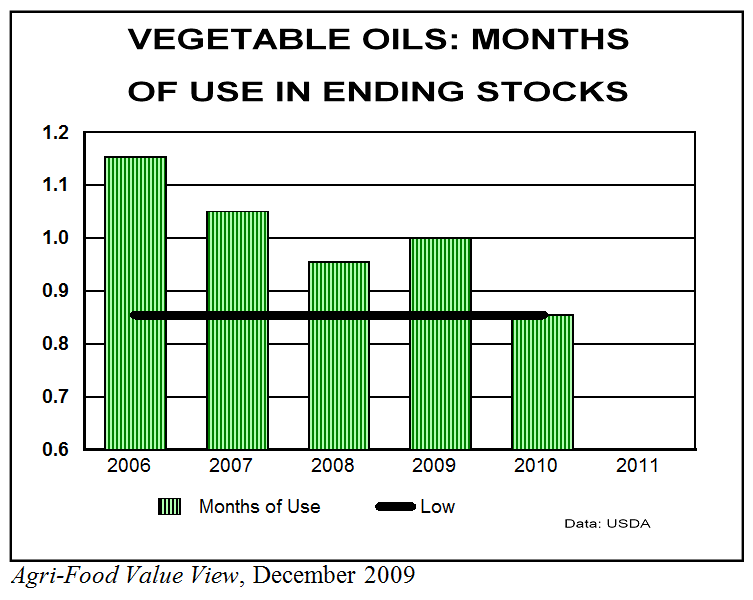
One of the many uses of grains like corn is portrayed in the chart above. Plotted in that chart is months of vegetable oil consumption, or usage, represented by stocks at the end of the relevant crop year.
Vegetable oil is a critical component of Agri-Food consumption. As is readily apparent in that graph the world’s inventory of vegetable oil, in terms of months of consumption, has been declining for years.
The USDA forecasts that the world is moving toward having less than one month of vegetable oil in inventory.
As that is somewhat of an average, some parts of the world have less than one month of vegetable oil available. Largest components of global vegetable oil production are palm oil at 33%, and soybean of about 27%.
[snip]
Disclaimer: Opinions posted on Free Republic are those of the individual posters and do not necessarily represent the opinion of Free Republic or its management. All materials posted herein are protected by copyright law and the exemption for fair use of copyrighted works.

