Posted on 10/03/2009 2:09:18 PM PDT by neverdem
Five years after the high-profile withdrawal of Merck & Co's arthritis drug Vioxx from the market, French pharmaceutical company NicOx is trying to wow the regulators with its first-in-class anti-inflammatory drug naproxcinod.
The Sophia Antipolis-based firm has submitted a new drug application to the US Food and Drug Administration (FDA) for its cyclooxygenase (Cox)-inhibiting nitric oxide-donating osteoarthritis drug, which it hopes will be the first anti-inflammatory to be given the regulatory thumbs up since the Vioxx withdrawal.
Traditional non-steroidal anti-inflammatories (NSAIDs) such as aspirin work by blocking both the Cox-1 and Cox-2 enzymes, and for a time it was believed that while blocking Cox-2 interrupted the pain and inflammation pathway, blocking Cox-1 damaged the mucosal layer of the gut and caused ulceration.
Selective Cox-2 inhibitors were therefore developed in an attempt to reduce the gastrointestinal (GI) side effects. However, while virtually all NSAIDs can cause cardiovascular (CV) problems, selective Cox-2 inhibitors were linked to increased risk of blood clotting and the associated risk of heart attack and stroke - leading to the withdrawal of Merck's Vioxx and Pfizer's Bextra from the market, leaving only one selective Cox-2 inhibitor on the market - Pfizer's Celebrex.
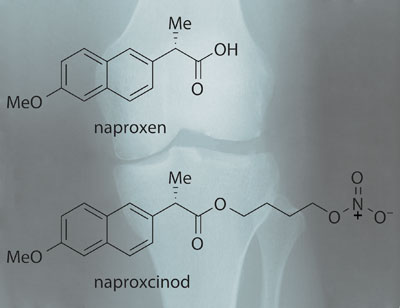
NicOx has tried to find away around these problems by developing a dual-action drug that combines the well known and well tolerated Cox-1 and -2 inhibiting NSAID naproxen with a blood pressure-reducing nitric oxide donating moiety. 'The drug is administered as a capsule, and when it reaches the GI tract it is released and the link between the NSAID and NO donating moiety is cut by esterase enzymes,' says Pascal Pfister, chief scientific officer of NicOx.
|
NicOx have developed the dual action drug naproxcinod which negates many of the side effects of naproxen while maintaining its efficacy
|
'The biology of NO is fantastic,' Pfister adds. 'Not only does NO dilate blood vessels and reduce blood pressure, but it also reduces platelet aggregation.'
This is important, he says, because those suffering with osteoarthritis tend to be over 50 years old so are also more likely to be at an increased risk of suffering cardiovascular problems. Indeed, Pfister says that 40 to 50 per cent of the patients in the Phase III trials of naproxcinod had hypertension and that while the control group taking naproxen had increased blood pressure compared to placebo, those taking naproxcinod had similar blood pressures to the placebo group.
'Traditional NSAIDs still dominate the osteoarthritis market, with naproxen accounting for 19 per cent of all prescriptions. Ibuprofen accounts for 31 per cent, which is frightening as it actually increases blood pressure the most,' says Pfister. 'The benefits to the patient of receiving naproxcinod is that they will receive the same anti-inflammatory and pain reduction efficacy as naproxen while their risk of increasing blood pressure will be lowered.' Pfister also notes that preclinical trials have indicated that NO has anti-inflammatory properties, and that during Phase I and II trials naproxcinod reduced the occurence of certain GI side effects.
'There is a need for new NSAIDs, especially for musculoskeletal pain - while the older drugs are very effective they have been hampered by toxicity to the GI tract,' says Robert Moots, professor of rheumatology at the University of Liverpool and a spokesman for UK charity Arthritis Research Campaign. 'NSAIDs are among the biggest selling drugs by market share in the world and this drug holds significant promise for those patients that are unable to use other drugs that would be useful for them but can't due to concerns about the side effects.'

Cyclooxygenase-2 inhibitors enhance shear stress-induced platelet aggregation.
So, cox-2 inhibitors did not reversibly inhibit platelet aggregation like earlier NSAIDS such as naproxen, which interfered with aspirin's irreversible inhibition of platelet aggregation.
Why did I expect this to have something to do with Letterman?
LOL!
Cox inhibitors.
One for the rooster?
Cox inhibitors = Michelle Obama?

Here's a better cox inhibitor!
I’ll volunteer for free samples.
Well, this will have some side effects that will be appreciated by elderly gentlemen, lol. A pain reliever and an erectile dysfunction drug all rolled into one.
It won’t inhibit another variety.
My best friend was hit by a car and spent time in rehab. He was taking Vioxx and then couldn’t get it. He said it was the only drugh that worked on the pain and didn’t care if it would kill him, the benefit exceeded the small chance of death.
Vioxx worked great. I wasn’t happy my doctor took me off it long before the problems were made public, but I’m glad he did. Very glad, since I have a heredity clotting factor (Factor V Leiden) and have had a clot.
If this new drug works as well as Vioxx without the clotting dangers it sounds wonderful!
When heated, high-fructose corn syrup can be dangerous
Aspirin Misuse May Have Made 1918 Flu Pandemic Worse
FReepmail me if you want on or off my health and science ping list.
I wouldn't expect much difference from naproxen.
Thanks,...very interesting from a personal standpoint.
Depending on the levels of NO that the drug produces it may have the same effect.
I think I’ve dated a few of these.
G.M. pingworthy? ;’)
Disclaimer: Opinions posted on Free Republic are those of the individual posters and do not necessarily represent the opinion of Free Republic or its management. All materials posted herein are protected by copyright law and the exemption for fair use of copyrighted works.

