
An artist's concept of the heliosphere, a magnetic bubble that partially protects the solar system from cosmic rays.
Posted on 10/03/2009 11:14:12 AM PDT by ETL
"We're experiencing the deepest solar minimum in nearly a century," says Dean Pesnell of the Goddard Space Flight Center, "so it is no surprise that cosmic rays are at record levels for the Space Age [i.e. past 50+ years or so -etl]."
Galactic cosmic rays come from outside the solar system. They are subatomic particles--mainly protons but also some heavy nuclei--accelerated to almost light speed by distant supernova explosions. Cosmic rays cause "air showers" of secondary particles when they hit Earth's atmosphere; they pose a health hazard to astronauts; and a single cosmic ray can disable a satellite if it hits an unlucky integrated circuit.
The sun's magnetic field is our first line of defense against these highly-charged, energetic particles. The entire solar system from Mercury to Pluto and beyond is surrounded by a bubble of magnetism called "the heliosphere." It springs from the sun's inner magnetic dynamo and is inflated to gargantuan proportions by the solar wind. When a cosmic ray tries to enter the solar system, it must fight through the heliosphere's outer layers; and if it makes it inside, there is a thicket of magnetic fields waiting to scatter and deflect the intruder.
An artist's concept of the heliosphere, a magnetic bubble that partially protects the solar system from cosmic rays.
"At times of low solar activity, this natural shielding is weakened, and more cosmic rays are able to reach the inner solar system," explains Pesnell."
Although sunspot cycle 24 is VERY slow to get underway (decades-long records are being broken for low minimum period activity), over the course of the past 80-100 years sunspot numbers have actually been through the roof (during *peak periods* of the 11-year solar activity cycle throughout this 80-100 yr period). Cycle-24 is not expected to get really busy for a few more years yet, possibly not until around 2013 they're saying now. Will the high level of sunspot activity continue when the peak finally arrives?. We will see. -etl
If you look at the chart below, you will see that sunspot activity (during solar maxes--the individual peaks every apprx 11 yrs) has been relatively high since about 1900 and almost non-existent for the period between about 1625 and 1725. This period is known as the Maunder (sunspot) Minimum or "Little Ice Age".-etl

____________________________________________________
From BBC News [yr: 2004]:
"A new [2004] analysis shows that the Sun is more active now than it has been at anytime in the previous 1,000 years. Scientists based at the Institute for Astronomy in Zurich used ice cores from Greenland to construct a picture of our star's activity in the past. They say that over the last century the number of sunspots rose at the same time that the Earth's climate became steadily warmer."..."In particular, it has been noted that between about 1645 and 1715, few sunspots were seen on the Sun's surface.
This period is called the Maunder Minimum after the English astronomer who studied it. It coincided with a spell of prolonged cold weather often referred to as the "Little Ice Age". Solar scientists strongly suspect there is a link between the two events - but the exact mechanism remains elusive."
http://news.bbc.co.uk/1/hi/sci/tech/3869753.stm
____________________________________________________
It's really hard to imagine how this little ball of fire could have any impact on our climate at all. /s
But the main arguments being made for a solar-climate connection is not so much to do with the heat of the Sun (the sun isn't necessarily getting warmer, although that may be happening as well) but rather with its magnetic cycles. When the Sun is more magnetically active (typically around the peak of the 11-year sunspot cycle --we are a few yrs away at the moment), the Sun's magnetic field is better able to deflect away incoming galactic cosmic rays (highly energetic charged particles coming from outside the solar system). The GCRs are thought to help in the formation of low-level cumulus clouds -the type of clouds that BLOCK sunlight and help cool the Earth. So when the Sun's MF is acting up (not like now -the next sunspot max is expected in about 2013, according to the latest predictions), less GCRs reach the Earth's atmosphere, less low level, sunlight-blocking clouds form, and more sunlight gets through to warm the Earth's surface...naturally. Clouds are basically made up of tiny water droplets. When minute particles in the atmosphere become ionized by incoming GCRs they become very 'attractive' to water molecules, in a purely chemical sense of the word. The process by which the Sun's increased magnetic field deflects incoming cosmic rays is very similar to the way magnetic fields steer electrons in a cathode ray tube (old-time television tube) or electrons and other charged particles around the ring of a subatomic particle accelerator.-etl
____________________________________________________
From NASA's Solar and Heliospheric Observatory's "Not So Frequently Asked Questions" section:
Q-Does the number of sunspots have any effect on the climate here on Earth?
A-Sunspots are slightly cooler areas on the surface of the Sun, due to the intense magnetic fields, so they radiate a little less energy than the surroundings. However, there are usually nearby areas associated with the sunspots that are a little hotter (called falculae), and they more than compensate. The result is that there is a little bit more radiation coming from the Sun when it has more sunspots, but the effect is so small that it has very little impact on the weather and climate on Earth.
However, there are more important indirect effects: sunspots are associated with what we call "active regions", with large magnetic structures containing very hot material (being held in place by the magnetism). This causes more ultraviolet (or UV) radiation (the rays that give you a suntan or sunburn), and extreme ultraviolet radiation (EUV). These types of radiation have an impact on the chemistry of the upper atmosphere (e.g. producing ozone). Since some of these products act as greenhouse gases, the number of sunspots (through association with active regions) may influence the climate in this way.
Many active regions produce giant outflows of material that are called Coronal Mass Ejections. These ejections drag with them some of the more intense magnetic fields that are found in the active regions. The magnetic fields act as a shield for high-energy particles coming from various sources in our galaxy (outside the solar system). These "cosmic rays" (CRs) cause ionization of molecules in the atmosphere, and thereby can cause clouds to form (because the ionized molecules or dust particle can act as "seeds" for drop formation).
If clouds are formed very high in the atmosphere, the net result is a heating of the Earth - it acts as a "blanket" that keeps warmth in.
If clouds are formed lower down in the atmosphere, they reflect sunlight better than they keep heat inside, so the net result is cooling.
Which processes are dominant is still a matter of research.
http://sohowww.nascom.nasa.gov/classroom/notsofaq.html#SUNSPOT_CLIMATE
____________________________________________________
NASA graph of sunspot activity over the past 400 years [note the profound lack of sunspot activity during the "Little Ice Age" period (apprx 1650-1720), AND the sharp INCREASE particularly during the past 60 years:

http://science.nasa.gov/ssl/pad/solar/images/ssn_yearly.jpg
____________________________________________________
Astronomers who count sunspots have announced that 2008 is now the "blankest year" of the Space Age
As of Sept. 27, 2008, the sun had been blank, i.e., had no visible sunspots, on 200 days of the year. To find a year with more blank suns, you have to go back to 1954, three years before the launch of Sputnik, when the sun was blank 241 times.
"Sunspot counts are at a 50-year low," says solar physicist David Hathaway of the NASA Marshall Space Flight Center. "We're experiencing a deep minimum of the solar cycle."
And it is a very quiet time. If solar activity continues as low as it has been, 2008 could rack up a whopping 290 spotless days by the end of December, making it a century-level year in terms of spotlessness.
Hathaway cautions that this development may sound more exciting than it actually is: "While the solar minimum of 2008 is shaping up to be the deepest of the Space Age, it is still unremarkable compared to the long and deep solar minima of the late 19th and early 20th centuries." Those earlier minima routinely racked up 200 to 300 spotless days per year.
Some solar physicists are welcoming the lull.
"This gives us a chance to study the sun without the complications of sunspots," says Dean Pesnell of the Goddard Space Flight Center. "Right now we have the best instrumentation in history looking at the sun. There is a whole fleet of spacecraft devoted to solar physics--SOHO, Hinode, ACE, STEREO and others. We're bound to learn new things during this long solar minimum."
As an example he offers helioseismology: "By monitoring the sun's vibrating surface, helioseismologists can probe the stellar interior in much the same way geologists use earthquakes to probe inside Earth. With sunspots out of the way, we gain a better view of the sun's subsurface winds and inner magnetic dynamo."
"There is also the matter of solar irradiance," adds Pesnell. "Researchers are now seeing the dimmest sun in their records. The change is small, just a fraction of a percent, but significant. Questions about effects on climate are natural if the sun continues to dim."
Pesnell is NASA's project scientist for the Solar Dynamics Observatory (SDO), a new spacecraft equipped to study both solar irradiance and helioseismic waves. Construction of SDO is complete, he says, and it has passed pre-launch vibration and thermal testing. "We are ready to launch! Solar minimum is a great time to go."
Coinciding with the string of blank suns is a 50-year record low in solar wind pressure, a recent discovery of the Ulysses spacecraft. (See the Science@NASA story Solar Wind Loses Pressure.) The pressure drop began years before the current minimum, so it is unclear how the two phenomena are connected, if at all. This is another mystery for SDO and the others.
Who knew the blank sun could be so interesting?
More to come...
http://science.nasa.gov/headlines/y2008/30sep_blankyear.htm
Related article:
Solar Wind Loses Power, Hits 50-year Low - Sept. 23, 2008
http://science.nasa.gov/headlines/y2008/23sep_solarwind.htm
____________________________________________________
From NASA.gov, September 30, 2008:
Coinciding with the string of blank suns is a 50-year record low in solar wind pressure, a recent discovery of the Ulysses spacecraft. (See the Science@NASA story Solar Wind Loses Pressure.) The pressure drop began years before the current minimum, so it is unclear how the two phenomena are connected, if at all. This is another mystery for SDO and the others. ..."
"There is also the matter of solar irradiance," adds Pesnell. "Researchers are now seeing the dimmest sun in their records. The change is small, just a fraction of a percent, but significant. Questions about effects on climate are natural if the sun continues to dim."
Article:
Spotless Sun: Blankest Year of the Space Age [50 years]:
http://science.nasa.gov/headlines/y2008/30sep_blankyear.htm
____________________________________________________

100,000-Year Climate Pattern Linked To Sun's Magnetic Cycles:
ScienceDaily (Jun. 7, 2002) HANOVER, N.H.
Thanks to new calculations by a Dartmouth geochemist, scientists are now looking at the earth's climate history in a new light. Mukul Sharma, Assistant Professor of Earth Sciences at Dartmouth, examined existing sets of geophysical data and noticed something remarkable: the sun's magnetic activity is varying in 100,000-year cycles, a much longer time span than previously thought, and this solar activity, in turn, may likely cause the 100,000-year climate cycles on earth. This research helps scientists understand past climate trends and prepare for future ones.
http://www.sciencedaily.com/releases/2002/06/020607073439.htm
____________________________________________________
From a well-referenced wikipedia.com column (see wiki link for ref 14):
"Sunspot numbers over the past 11,400 years have been reconstructed using dendrochronologically dated radiocarbon concentrations. The level of solar activity during the past 70 years is exceptional — the last period of similar magnitude occurred over 8,000 years ago. The Sun was at a similarly high level of magnetic activity for only ~10% of the past 11,400 years, and almost all of the earlier high-activity periods were shorter than the present episode.[14]"
[14] ^Solanki, Sami K.; Usoskin, Ilya G.; Kromer, Bernd; Schüssler, Manfred & Beer, Jürg (2004), “Unusual activity of the Sun during recent decades compared to the previous 11,000 years”, Nature 431: 1084–1087, doi:10.1038/nature02995, . Retrieved on 17 April 2007 , "11,000 Year Sunspot Number Reconstruction". Global Change Master Directory. Retrieved on 2005-03-11.
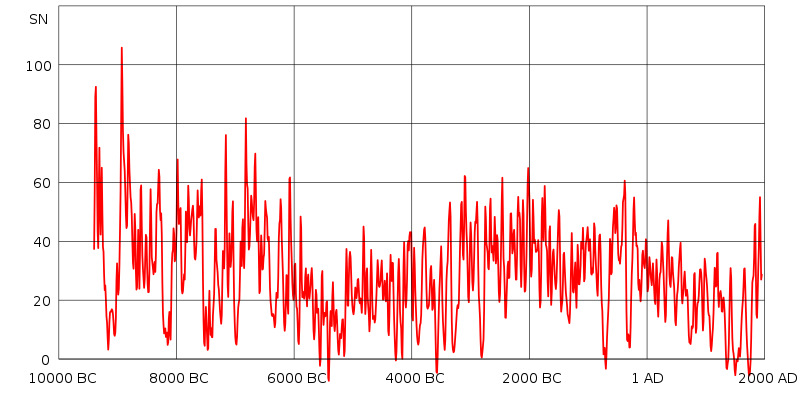
"Reconstruction of solar activity over 11,400 years. Period of equally high activity over 8,000 years ago marked.
Present period is on [the right]. Values since 1900 not shown."
http://en.wikipedia.org/wiki/Solar_variation
______________________________________________________

The Center for Sun-Climate Research at the DNSC (Danish National Space Center) investigates the connection between variations in the intensity of cosmic rays and climatic changes on Earth. This field of research has been given the name 'cosmoclimatology'"..."Cosmic ray intensities – and therefore cloudiness – keep changing because the Sun's magnetic field varies in its ability to repel cosmic rays coming from the Galaxy, before they can reach the Earth." :
http://www.spacecenter.dk/research/sun-climate
____________________________________________________
Climate debate and FAQ:
What is climate research at the DNSC? [Danish National Space Center]
The Earth’s climate is always changing. This has been the case in the geological and historical time and even during the last 150 years, where systematic climate measurements have been made, we have seen clear climate changes.
Climate changes have both a scientific and a social perspective. The social perspective is associated with the range of climate change that can be attributed to the increasing human induced contribution. The scientific perspective is an endeavour to understand the full complex system of the various sources of climate change and their mutual interactions.
The Danish National Space Center, DNSC, comprises the country's largest collected expertise in the scientific disciplines that play a major and documented role in the understanding of climate change both in geological and historical time, namely variations in solar activity. DNSC regards it essential that this collected expertise is being used in an attempt to understand the natural causes of climate change in order to evaluate the contribution of natural causes to global change. Taking into account the large uncertainty associated with the estimated human contribution, a good research based estimate of the range of natural climate variations is an essential information.
DNSC is basing its effort in this area on own scientific results – observational, experimental, and theoretical. The scientific results have been published internationally and indicate that the varying activity of the Sun is indeed the largest and most systematic contributor to natural climate variations. The effect goes through solar modulation of the cosmic radiation, which affects the formation of aerosols and thereby also the formation of clouds. Even though a physical mechanism connecting cosmic rays to aerosol formation has been found experimentally, no climate model has yet made an attempt to include such an effect.
That there exists a significant contribution from solar activity variations to global temperature increase does not, however, exclude other contributions to the rising global temperature, natural as well as human. DNSC, however, is focused on establishing the best possible and scientifically based evaluation of the size of solar induced effects on climate.
Why is the climate changing?
Climate is subject to influences by both natural and human forces, including greenhouse gases, aerosols, solar activity, and land use change. The climate system is extremely complex and any estimate of the human contribution to climate change is very uncertain.
What are the natural causes to climate change?
Changes in the Sun contribute to climate change. Solar activity has been exceptionally high in the 20th century compared to the last 400 years and possibly compared to the past 8,000 years. When solar activity is high, the flux of galactic cosmic rays is reduced due to increased magnetic shielding by the Sun. The cosmic rays may influence Earths climate through formation of low lying clouds.
How can cosmic rays influence cloud formation?
Cosmic rays ionize the atmosphere and an experiment performed at the Danish National Space Center has found that the production of aerosols in a sample atmosphere with condensable gases (such as sulphuric acid and water vapor) depends on the amount of ionization. Since aerosols work as precursors for formation of cloud droplets, this is an indication that cosmic rays affect climate.
Climate models only include the effects of the small variations in the direct solar radiation (infrared, visible and UV). The effects of cosmic rays on clouds are not included in models and the models do a rather poor job of simulating clouds in the present climate. Since cloud feedbacks are a large source of uncertainty, this is a reason for concern when viewing climate model predictions.
http://www.spacecenter.dk/research/sun-climate/climate-debate-and-faq
______________________________________________________
Here's an excellent ~new book out on the subject titled "The Chilling Stars, 2nd Edition: A Cosmic View of Climate Change". It's written by one of the top scientists advancing the theory (Henrik Svensmark, of the above mentioned Danish National Space Center/DNSC).
"The authors explain their theory that sub-atomic particles from exploded stars have more effect on the climate than manmade CO2."
http://www.sciencedaily.com/books/t/1840468157-the_chilling_stars_the_new_theory_of_climate_change.htm

Amazon Books: "The Chilling Stars, 2nd Edition: A Cosmic View of Climate Change"
http://www.amazon.com/Chilling-Stars-2nd-Cosmic-Climate/dp/1840468661 zs90]
Ping.
Ping
Bush’s fault.
Women and minorities hardest hit.
You’re right. We certainly didn’t contribute to warming on those planets. Applying logic, perhaps the warming on THIS planet might also be related to the warming on the other two? So what has the extra human generated carbon harmed?
BTW, nice handle to be commenting with on this particular thread!

ping
bump
Why does your first figure show “red x” points prior to about 1750, and a blue line after 1750?
I love your map. Glaciers cover over half of N. America, but the coastlines are unchanged.
With all the talk about us potentially entering a new Little Ice Age, why the automatic assumption we’re not entering a new Big Ice Age?
We’re past the average length of past interglacial periods, yet almost nobody brings up the possibility of a real Ice Age.
Good question. I looked it up and found this...

"This figure summarizes the 400 years of regular sunspot number observations. Since ~1749, continuous monthly averages of sunspot activity have been available and are shown here as reported by the Solar Influences Data Analysis Center, World Data Center for the Sunspot Index, at the Royal Observatory of Belgium. These figure are based on an average of measurements from many different observatories around the world. Prior to 1749, sporadic observations of sunspots are available. These were compiled and placed on consistent monthly framework by Hoyt & Schatten (1998a, 1998b)."
I don’t have the exact answer, but, I can make an educated guess at this.
The Red ‘x’s are data from a time before truly reliable observations were made and the Sun studied. Counts were made of sunspots before, but, the technology was lacking back then. Also, data can be lost due to wars and other events.
Oddly enough, you can also trace sunspot activity by measuring the length of women’s dress’ hemlines. The longer the dress, the cooler the weather. The shorter, the warmer. There is an 11 year cycle to the length that corresponds to the dress length.
It's just an illustration. I suppose the present-day coastlines were shown to make the land masses more recognizable to people.
I realize that. I just thought the idea that we could put a couple miles of ice on top of North America and Eurasia without affecting the present-day location of coastlines was funny.
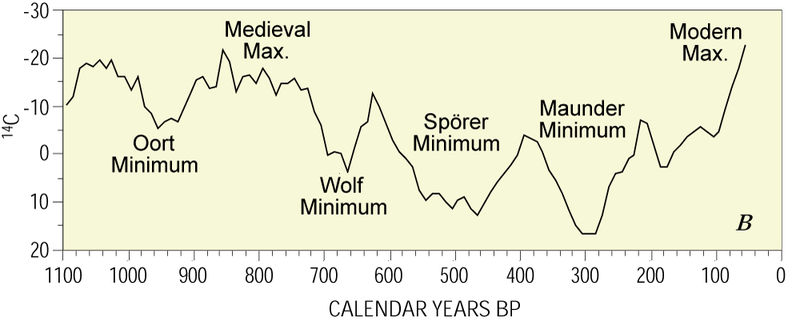
"Changes in carbon-14 concentration in the Earth's atmosphere, which serves as a long term proxy of solar activity. Note the present day is on the left-hand side of this figure."
Thanks.
I had a very vague recollection that it was something like that.
Disclaimer: Opinions posted on Free Republic are those of the individual posters and do not necessarily represent the opinion of Free Republic or its management. All materials posted herein are protected by copyright law and the exemption for fair use of copyrighted works.
