Skip to comments.
Mass. health model inspires key senator (Democrats want Mitt Romney Care)
http://www.boston.com ^
| May 13, 2009
| By Lisa Wangsness
Posted on 05/13/2009 8:44:57 PM PDT by Maelstorm
WASHINGTON - A key Senate leader appears to be leaning toward proposing a new tax on employer-provided insurance benefits and creating a new federal agency modeled on one in Massachusetts to make it easier for individuals and small groups to buy insurance.
The Senate Finance Committee is discussing a series of policy options for sweeping healthcare legislation scheduled to be completed by mid-June. On Monday, the committee released options for insuring the nation's 47 million uninsured, including expanding Medicaid, subsidizing private insurance for low-income people, and creating a public insurance plan - an idea Republicans have flatly rejected.
Yesterday, the committee debated how to pay for subsidizing insurance for the uninsured, which could cost as much as $1.4 trillion over 10 years. The panel's chairman, Senator Max Baucus of Montana, a Democrat, pointed to the tax exclusion, a rich source of cash. Senators will also consider other options, including "sin" taxes on soda and alcohol and limiting tax breaks for other health benefits, such as tax-preferred health accounts.
"The reforms that we are planning are not cheap," Baucus said.
Senator Charles Grassley of Iowa, the ranking Republican on the Finance Committee, said lawmakers should try to eliminate wasteful spending before imposing new taxes.
And starting to tax the health benefits the vast majority of Americans get through their workplace could set the stage for a battle with the White House; President Obama spent millions of dollars during the campaign attacking his Republican rival, John McCain, for proposing to end the tax exclusion, which Obama said amounted to taxing health insurance.
Baucus said yesterday that he does not believe the benefit should be eliminated, but that it should be fairer and less regressive. Under current law, those with the most expensive insurance get the largest benefit.
...
(Excerpt) Read more at boston.com ...
TOPICS: Culture/Society; News/Current Events; Politics/Elections
KEYWORDS: health; healthcare; hillarycare; massachusetts; rino; rinoromney; romney; romneycare; romneytruthfile; scare
How is costing those who have private health care more expanding care? We must defeat the left on this issue. The fate of this country hangs in the balance.
1
posted on
05/13/2009 8:44:57 PM PDT
by
Maelstorm
To: Maelstorm
2
posted on
05/13/2009 9:27:57 PM PDT
by
lowbridge
(It's not that liberals are ignorant, it's that they know so much that isn't so - Ronald Reagan)
To: Maelstorm
Mandatory Health Insurance: Wrong for Massachusetts, Wrong for America
The Results in Massachusetts
Although advocates of the Massachusetts plan claimed that it would lower health care costs and achieve universal coverage, it has done neither. Instead, the plan has increased costs for individuals and the state, reduced revenues for doctors and hospitals, and left Massachusetts officials in the awkward position of having to admit that their “universal coverage is not likely to be universal any time soon.”14
Costs have risen for individuals because, under this plan, as under any mandatory insurance scheme, the government must define what constitutes an acceptable insurance policy. As a result, special interest groups have been given both the incentive and the means to lobby politicians to include their pet benefits as part of the government-approved plan. Consequently, the state government requires all patients to purchase “benefits” that are useless to many of them—benefits they would never voluntarily choose to purchase in a free market. For example, Massachusetts currently requires insurance plans to include forty-three mandatory benefits, including in vitro fertilization, blood lead poisoning treatment, and chiropractor services—whether or not customers want them. Residents must purchase alcoholism therapy benefits, even if they are teetotalers. These mandated benefits have raised the costs of health insurance in Massachusetts by 23 to 56 percent.15
Costs to the state government have skyrocketed and are projected to run hundreds of millions of dollars over budget.16 Because the mandated insurance is so expensive, the government has had to subsidize the costs of the premiums not only for lower-income residents, but also for residents with incomes as high as $60,000 for a family of four—which is three times the Federal Poverty Level.17 The state had expected a “significant drop in spending . . . for the uninsured” but has since acknowledged that this “is not going to happen to any large extent in 2009.”18 Instead, overall costs to the state have risen by more than $400 million, 85 percent more than originally projected.19
Because of its own rising costs, the state government has cut payments to doctors and hospitals. According to family physician Dr. Katherine Atkinson, the state insurance reimbursements often do not cover her expenses: “[E]very time I have a Medicaid patient it’s like handing them a $20 bill when they leave.”20
As a result of these rising costs and falling revenues, access to medical care has dwindled for many patients. Fewer doctors are willing to take on new patients for fear of losing even more money. Lee Sampson, a 47-year old medical transcriptionist, had to call fifty doctors’ offices before she could find one that would take her as a new patient.21 Tamar Lewis, a 24-year old hair stylist, called more than two dozen primary care doctors for a checkup. All of them turned her down, leaving her with no choice but to rely on the community free clinic.22 Patients face long waits for basic medical care—in some cases more than a year for a routine physical exam.23 These long waits are not due to a shortage of doctors. As the New England Journal of Medicine notes, Massachusetts “has the highest physician-to-population ratio of any state, in primary care as well as overall.”24 The waits are due to a government policy that discourages physicians from seeing patients—a policy under which seeing patients can mean that physicians lose rather than make money.
http://www.theobjectivestandard.com/issues/2008-fall/mandatory-health-insurance.asp
3
posted on
05/13/2009 9:28:51 PM PDT
by
lowbridge
(It's not that liberals are ignorant, it's that they know so much that isn't so - Ronald Reagan)
To: lowbridge
4
posted on
05/13/2009 9:54:21 PM PDT
by
lowbridge
(It's not that liberals are ignorant, it's that they know so much that isn't so - Ronald Reagan)
To: lowbridge
The cost of health insurance in Mass is very high. Ours has gone up $6000 every year. I just got the new bill for this year and it is $2,500 a month for our family. We are self-employed.
To: lowbridge
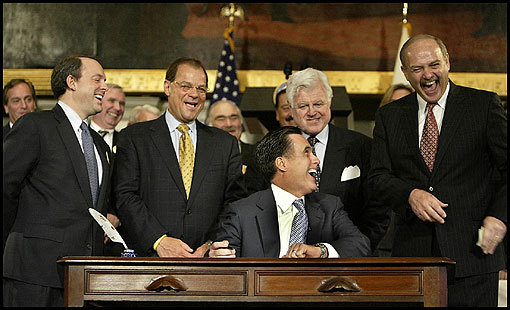
Election2008 Spoiler Mitt Romney chortles,
as he inflicts his socialized medicine (HillaryCARE=ROmneyCARE)
upon the Massachusetts citizens without any of their votes.

"Hospital patients 'left in agony'"
"Patients were allegedly left screaming in pain and drinking from flower vases on a nightmare hospital ward.
Between 400 and 1,200 more people died than would have been expected at Mid Staffordshire NHS Foundation Trust over three years, a damning Healthcare Commission report said.
The watchdog's investigation found inadequately trained staff who were too few in number, junior doctors left alone in charge at night and patients left without food, drink or medication as their operations were repeatedly cancelled.
Patients were left in pain or forced to sit in soiled bedding for hours at a time and were not given their regular medication, the Commission heard.
Receptionists with no medical training were expected to assess patients coming in to A&E, some of whom needed urgent care.
Sir Bruce Keogh, medical director of the NHS, said there had been a "gross and terrible breach" of patients' trust and a "complete failure of leadership".
The Healthcare Commission's chairman Sir Ian Kennedy said the investigation followed concerns about a higher than normal death rate at the Trust, which senior managers could not explain.
He said: "The resulting report is a shocking story. Our report tells a story of appalling standards of care and chaotic systems for looking after patients. These are words I have not previously used in any report.
"There were inadequacies in almost every stage of caring for patients. There was no doubt that patients will have suffered and some of them will have died as a result."
Julie Bailey, 47, was so concerned about the care being given to her 86-year-old mother Bella at Stafford Hospital that she and her relatives slept in a chair at her bedside for eight weeks.
She said: "We saw patients drinking out of..."
"Paramedics told: 'Let accident victims die if they want to' in new row over patient rights (UK)"
Health Service paramedics have been told not to resuscitate terminally-ill patients who register on a controversial new database to say they want to die.
It has been set up by the ambulance service in London for hundreds of people who have only a few months to live so that they may register their 'death wishes' in advance.
It is believed to be the first in the country, but other trusts around the country are expected to follow suit to comply with Government guidelines which state that patients' wishes should be taken into account, even at the point of death.
Patients' groups and doctors have welcomed the scheme, but it has met opposition from pro-life groups who say it violates the sanctity of life.
The system would come into play if a cancer patient, for example, was in serious pain and rang 999 for help to alleviate the suffering.
But if the paramedics arrived and the patient was close to death, he or she would not be resuscitated if such a request was registered on the database.
This would also be the case if a patient on the database was being transferred between hospitals, and had a heart attack.
Dominica Roberts from the Pro-Life Alliance said: 'This is very sad and very dangerous. It's another step along the slippery slope, at the bottom of which is euthanasia as we see in Holland. 'Paramedics should be there to save lives. They should not be there to let patients die. The medical profession should not agree with someone's belief that their life is worthless.'"
"National Health Preview - The Massachusetts debacle, coming soon to your neighborhood."
"Three years ago, the former Massachusetts Governor had the inadvertent good sense to create the "universal" health-care program that the White House and Congress now want to inflict on the entire country.
It is proving to be instructive, as Mr. Romney's foresight previews what President Obama, Max Baucus, Ted Kennedy and Pete Stark are cooking up for everyone else.
In Massachusetts's latest crisis, Governor Deval Patrick and his Democratic colleagues are starting to move down the path that government health plans always follow when spending collides with reality -- i.e., price controls.
As costs continue to rise, the inevitable results are coverage restrictions and waiting periods. It was only a matter of time.
They're trying to manage the huge costs of the subsidized middle-class insurance program that is gradually swallowing the state budget.
The program provides low- or no-cost coverage to about 165,000 residents, or three-fifths of the newly insured, and is budgeted at $880 million for 2010, a 7.3% single-year increase that is likely to be optimistic.
The state's overall costs on health programs have increased by 42% (!) since 2006.
What really whipped along RomneyCare were claims that health care would be less expensive if everyone were covered.
But reducing costs while increasing access are irreconcilable issues.
Mr. Romney should have known better before signing on to this not-so-grand experiment, especially since the state's "free market" reforms that he boasts about have proven to be irrelevant when not fictional.
Only 21,000 people have used the "connector" that was supposed to link individuals to private insurers."
A Very Sick Health Plan; Bay State’s ‘Grand Experiment’ Fails [RomneyCare]
"The Daily News Record, Harrisonburg, Va. - 2009-03-31 "
"For folks increasingly leery of President Obama’s plan to radically overhaul America’s health-care system,
or 17 percent of the nation’s economy, all this could hardly have come at a better time —
that is, fiscal troubles aplenty within Repubican Mitt Romney’s brainchild, Massachusetts’ “grand experiment” in “universal” health care."
"Initiated on Mr. Romney’s gubernatorial watch in 2006, this “experiment” has fallen on hard times, and predictably so.
Even though the Bay State commenced its program with a far smaller percentage of uninsured residents than exists nationwide,
“RomneyCare” is threatening to bankrupt the state. Budgeted for Fiscal Year 2010 at $880 million,
or 7.3 percent more than a year ago, this plan, aimed at providing low- or no-cost health coverage to roughly 165,000 residents,
has caused Massachusetts’ overall expenditures on all health-related programs to jump an astounding 42 percent since 2006.
So what does Mr. Romney’s successor, Democratic Gov. Deval Patrick, propose as a remedy for these skyrocketing costs?
Well, whaddya think? The standard litany of prescriptions (no pun intended) — price controls and spending caps, for a start, and then, again predictably, waiting periods and limitations on coverage.
As in Europe and Canada, so too in Massachusetts. And, we feel certain, everyone from Mr. Romney to Mr. Patrick said, “It would never happen here.”
But then, such things are inevitable when best-laid plans, with all their monstrous costs, run smack-dab into fiscal reality.
"Dem Congresswoman Admits Obama Health Care Plan Will Destroy Private Health Insurance Industry"
Thousands of patients with terminal cancer were dealt a blow last night after a decision was made to deny them life prolonging drugs.
The Government's rationing body said two drugs for advanced breast cancer and a rare form of stomach cancer were too expensive for the NHS.
The National Institute for Health and Clinical Excellence is expected to confirm guidance in the next few weeks that will effectively ban their use.
The move comes despite a pledge by Nice to be more flexible in giving life-extending drugs
to terminally-ill cancer patients after a public outcry last year over 'death sentence' decisions."
6
posted on
05/14/2009 8:40:33 AM PDT
by
Diogenesis
(Igitur qui desiderat pacem, praeparet bellum)
To: Maelstorm
On a related note, from 2006, though I don't think the situation's improved...
Demographics: Elders in Massachusetts Migration of the Older Population in Massachusetts
The net loss of 14,434 individuals aged 65 and over during this time interval is significant not only numerically; the loss also has implications for population composition of seniors living in the state. Within the senior population, Massachusetts disproportionately loses through migration individuals who are younger and wealthier than those who remain in the state. In contrast, those moving to Massachusetts from other states, many of whom are return migrants, are older, poorer, and more disabled than the seniors who are already here. Together, these trends contribute to an older population that is aging more rapidly, in poorer health, and with fewer financial resources than would occur in the absence of migration. These migration patterns potentially place a burden on Massachusetts' safety net programs, especially on Medicaid ( Massachusetts provides half of the financing for Medicaid, with the federal government providing the rest). High-income elders, who might contribute to the funding of these programs through the payment of taxes, are disproportionately lost through migration. In contrast, given their income and disability profiles, a disproportionate share of elders coming to Massachusetts from other states is likely to be dependent on health and long-term care services financed through Medicaid.
7
posted on
05/14/2009 8:50:15 AM PDT
by
mewzilla
(In politics the middle way is none at all. John Adams)
To: cookiedough
I just got the new bill for this year and it is $2,500 a month for our family. That's INSANE! What, do you have 19 kids? Is it even conceivable that in normal, healthy life, people would spend that much a month on doctors? I really hate the way "preventative care" has morphed from common sense taking-care-of-yourself by embracing healthy habits, to having to undergo incredibly expensive screenings on high-tech machines that cost bundles. I often wonder how often those things "caught" in screenings would never develop into problems, and really only serve to scare the hell out of the person being screened, add stress to their lives, and result in more vulnerability to illness? I bet the number is high.
The worst part of this is that people are staying in jobs they hate, which is bad for ALL concerned -- their own mental health, their families, their employers, their co-workers, their customers -- ONLY to hang on to the health insurace. THAT is the most damaging, ugly, horrible thing imaginable.
People should be allowed to live as healthily or unhealthily as they please, pay cash to see the doctor and see the doctor when they want or need to and no other time, and churches and charity (that's you and me, of our own volition and compassion) and kind doctors should be the ones to take care of the poor.
It is sad to see how many people, including conservatives and Republicans, allow themselves sheep-like to be drawn into the ridiculous notion that health care and health insurance have to take priority over everything else in life. My folks raised five kids -- four of them boys -- without health insurance; we paid cash to our family doc. We came out fine, broken arms, flus, and emergencies notwithstanding.
8
posted on
05/14/2009 10:31:49 AM PDT
by
Finny
("Raise hell. Vote smart." -- Ted Nugent.)
To: long hard slogger; FormerACLUmember; Harrius Magnus; hocndoc; parousia; Hydroshock; skippermd; ...
Socialized Medicine aka Universal Health Care PING LIST
FReepmail me if you want to be added to or removed from this ping list.
9
posted on
05/14/2009 11:18:23 AM PDT
by
socialismisinsidious
( The socialist income tax system turns US citizens into beggars or quitters!)
Disclaimer:
Opinions posted on Free Republic are those of the individual
posters and do not necessarily represent the opinion of Free Republic or its
management. All materials posted herein are protected by copyright law and the
exemption for fair use of copyrighted works.
FreeRepublic.com is powered by software copyright 2000-2008 John Robinson