
Posted on 03/20/2009 7:30:00 AM PDT by SeekAndFind
The markets have had a much-welcomed rally over the last two weeks. From the minute the Obama Administration took control of the reins of the executive branch, the equity markets have been in a free fall. The consensus seems to be forming that this is what Wall Street calls a ‘dead cat bounce.’ But is it? Can the market form a bottom that provides for a sustainable recovery in the face of still risk-averse credit markets?
In truth, there is a lot more reason for optimism today than at any time within the past 18 months. The bottom is not merely a technical trading range. A bottom is formed when market participants become hopeful that government policy is going to be decidedly friendlier, or at least, not harmful. Because it is government policy first and foremost that can force the economy to its knees, it is likewise government inaction or pro-growth policies that can make markets soar. Government is the one wildcard that can exert an exogenous force on an entire economy. And in the last couple of weeks, even while the equity indices continued to fall, developments in Washington have indicated that markets may soon be turning in a positive direction for good.
The dramatic decline in share prices over the last quarter has been directly attributable to the absolutely frightening disrespect for the markets shown by the Administration. Consider that on January 18th, shortly before his boss took the oath of office, David Axelrod oafishly told the press that President Obama has a strong message for banks: “Start lending.” This statement echoed similar sentiment in Washington from Congressional Democrats. Embedded in this edict was the failure of U.S. political leadership to understand that attractive risk opportunities drive the lending business, not the other way around.
Then on February 12th, in an interview with the Washington Post, Axelrod was asked about the stock market and its daily drop. Paraphrasing, Axelrod said ‘Well, it can drive a White House. It may not drive ours. We don't care what's going on in the stock market. That's not our plan.’ While this sounds like a nice long term perspective in the private equity world, it is an absolute killer to the stock market.
Then, yet again, in his Senate confirmation hearings, Treasury secretary Geithner was asked directly if he thought raising taxes on savings and investment would be harmful or helpful to the economy. His tepid response was that it would be premature to speculate on those provisions of the Bush tax cuts until 2010 -- not exactly a convincing response to investors that must make subjective investment decisions in part based on their cost of capital. But at least it was the typical Obama response from his campaign that left wiggle room for negotiation. The budget that was unveiled on February 26th, however, went in exactly the opposite direction, aggressively seeking an acceleration of the expiration of the Bush tax cuts.
Now, contextualize these comments leading up to what we all hope is the bottom on March 9th. What changed? In this writer’s opinion, a flurry of good news from the policymaking front has given investors hope.
After the President’s budget was unveiled, a few Democrats started to openly question it. Senator Conrad said essentially that the cap and trade provision in the budget would be very hard to pass without some sort of help to the energy producers forced to bear the costs of such a system. While being unsure what help can exactly be extended to energy companies that would compensate for such a punitive regulatory system, words must be parsed here. While not as frontal as Dick Gephardt once telling the press in 1993 that ‘the House takes its orders from America’s houses, not the White House’, clearly the proposal was going to have difficulty. A few days later, on March 11th, Conrad told Energy Secretary Chu that the cap and trade system was tantamount to a tax on the consumer in the midst of a recession.
The President ran into more trouble with his budget from congressional Democrats who immediately took issue with scaling back charitable contributions. Charles Rangel and Max Baucus were quick to point out the absurdity of limiting charitable contributions in a downturn. There were, however, not exactly forthcoming statements from either that indicated support for the other planks of the tax-hiking budget. Furthermore, Obama told the Business Round Table that a corporate tax cut was on the table in exchange for support for his health care initiatives. Charles Rangel has for some time been an advocate for reducing this tax to a level that makes the U.S. competitive with its foreign competitors. In an era of Sarbanes–Oxley, this is an imperative.
But the most positive signal yet from the Obama administration is the desire to eliminate some capital gains taxes for small businesses. There are ultimately problems with this proposal as it has been posited so far. For one, God only knows how ‘small business’ will be defined. This is significant for the obvious reason in that it could potentially establish a nice constituency for zero capital gains taxes and be expanded at a later date, in particular if the exemption can be expanded to the capital providers to small businesses who can reap the potential rewards.
The Obama administration appears to be moving toward a more market-friendly approach. The seeds of a conversion seem to be in place. When Bill Clinton took office, he is said to have realized that the success of his presidency depended on the Federal Reserve and a bunch of bond traders. Implicit in this exchange was Clinton’s realization that markets do ultimately determine the fate of presidencies. Obama would be wise to do the same.
Furthermore, given the initial opposition to his budget by some of his own party members, markets should be hopeful that consolidated Democratic control will not overstep early on, as in the early years of the Clinton administration. If developments in Washington continue on their present course of the last couple of weeks, we just might be looking back on March 9th as the bottom of the bear market.
I like to look at bear bottoms.
>In this writer’s opinion, a flurry of good news from the policymaking front has given investors hope. <
uh duh.
RECEPTIONIST: "Mr Johnson, the ballerina is on line 3!"

Just briefly scanned the article but my interpretation:
“a flurry of good news from the policymaking front has given investors hope” = Open warfare on the anti-business Marxist’s destructive, socialist policies, (including from some elements of his own diseased party).
There is definitely an inflationary component to the recent rally. Fundamentals have not changed - the economy is still in the dumps, however the printing of money pushes commodities higher and eventually stocks.
So far, Obama has crapped away a trillion of dollars in programs that would do a darn thing except create some tempory job that will disappear as soon as the funds run out. Instead of giving insentives to stimulate job creation and economic activity, Obama just threw all this money at government jobs and infrastructure that is unsubstainable. The way out of this was to create real jobs in the private sector, that can continue to produce once the government trough is gone. These jobs could have been created at a fraction of the cost of government jobs and infrastructure, and would have been long-term instead of short term jobs. Obama shot his wad on a bandaid fix.
Unfortunatly due to minor financial difficulties Obungler will have to delay some of the freebies to his moocher minions. I am starting to hear the “Q” word. As in Quadrillions of dollars of debt. Look out below!!!
Bear bottom? Nope.
Bearly(get it?) nothing has changed - just the rhetoric of the government. All of sudden the economy is “sound,” when two and a half weeks ago it was a “crisis” and a “catastrophe.”
Lots of stuff is broken - most all the banks. Lots more bad news will be forthcoming from them(when they’re ready to admit it).
Bear market rallies are regular occurrences in bear markets. That’s what we’ve seen in recent days.
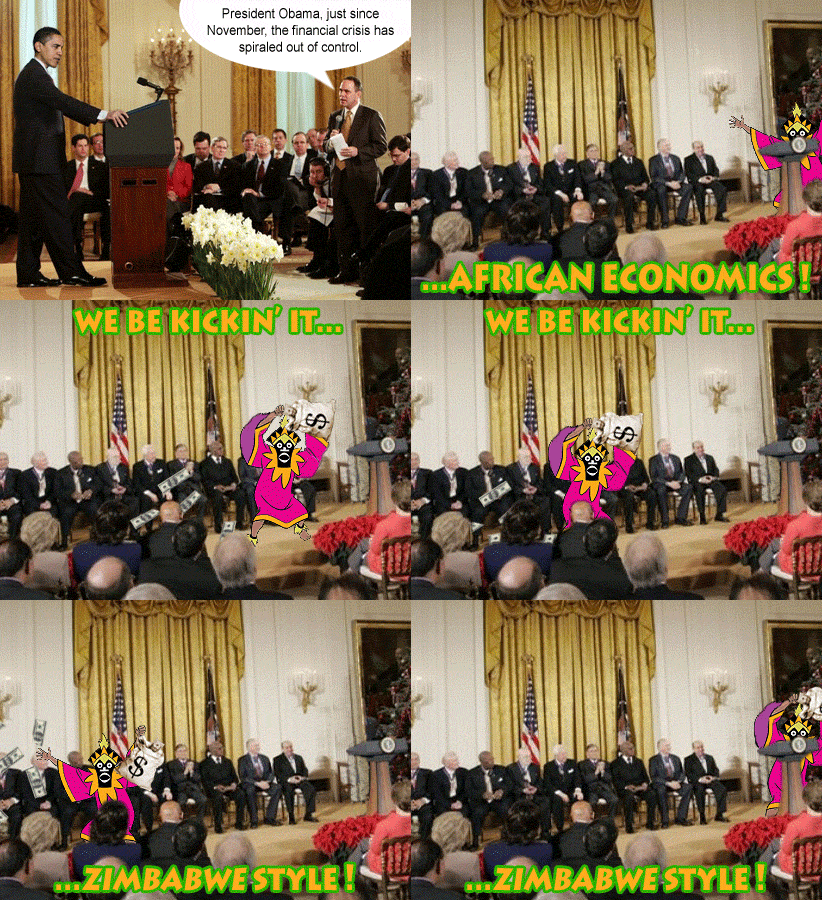

Long story short, this is the beginning of the end where short sellers use swaps and rating companies to destroy companies and put people out of work.
What congress should do is declare all swaps null in void and watch the bitches who are trying to destroy wealth and our economy blow their brains out!
Good point. Bears repeating. And the wad has to get paid for by printing or borrowing. The borrowing comes from the private sector which could have been used to finance real growth.
” I am starting to hear the “Q” word. As in Quadrillions of dollars of debt “
Hmmmmm
‘Quadrillion’ — as in ‘a thousand trillion’??
Don’t think that’s likely — all four of my ex-wives put together couldn’t spend a Quadrillion dollars....
agreed
However, I expect inflation to kick up significantly as these give-away programs hit the market from the middle of the year. There will be some segments of the economy simply flush with cash.
Of course, with that, inflation may run rampant and probably will. In true economist speak though, on the other hand maybe not if the economy is down as bad as it is.
Yes. 1,000 trillion. It is over 70 trillion now. Only 930 trillion to go. With Obungler that should not take long.
Disclaimer: Opinions posted on Free Republic are those of the individual posters and do not necessarily represent the opinion of Free Republic or its management. All materials posted herein are protected by copyright law and the exemption for fair use of copyrighted works.