
Posted on 03/04/2009 9:37:43 AM PST by AreaMan
|
|
|
March/April 2009
TR10: Traveling-Wave Reactor
A new reactor design could make nuclear power safer and cheaper, says John Gilleland.
By Matt Wald
Enriching the uranium for reactor fuel and opening the reactor periodically to refuel it are among the most cumbersome and expensive steps in running a nuclear plant. And after spent fuel is removed from the reactor, reprocessing it to recover usable materials has the same drawbacks, plus two more: the risks of nuclear-weapons proliferation and environmental pollution. These problems are mostly accepted as a given, but not by a group of researchers at Intellectual Ventures, an invention and investment company in Bellevue, WA. The scientists there have come up with a preliminary design for a reactor that requires only a small amount of enriched fuel--that is, the kind whose atoms can easily be split in a chain reaction. It's called a traveling-wave reactor. And while government researchers intermittently bring out new reactor designs, the traveling-wave reactor is noteworthy for having come from something that barely exists in the nuclear industry: a privately funded research company. As it runs, the core in a traveling-wave reactor gradually converts nonfissile material into the fuel it needs. Nuclear reactors based on such designs "theoretically could run for a couple of hundred years" without refueling, says John Gilleland, manager of nuclear programs at Intellectual Ventures. Gilleland's aim is to run a nuclear reactor on what is now waste. Conventional reactors use uranium-235, which splits easily to carry on a chain reaction but is scarce and expensive; it must be separated from the more common, nonfissile uranium-238 in special enrichment plants. Every 18 to 24 months, the reactor must be opened, hundreds of fuel bundles removed, hundreds added, and the remainder reshuffled to supply all the fissile uranium needed for the next run. This raises proliferation concerns, since an enrichment plant designed to make low-enriched uranium for a power reactor differs trivially from one that makes highly enriched material for a bomb. But the traveling-wave reactor needs only a thin layer of enriched U-235. Most of the core is U-238, millions of pounds of which are stockpiled around the world as leftovers from natural uranium after the U-235 has been scavenged. The design provides "the simplest possible fuel cycle," says Charles W. Forsberg, executive director of the Nuclear Fuel Cycle Project at MIT, "and it requires only one uranium enrichment plant per planet."
The trick is that the reactor itself will convert the uranium-238 into a usable fuel, plutonium-239. Conventional reactors also produce P-239, but using it requires removing the spent fuel, chopping it up, and chemically extracting the plutonium--a dirty, expensive process that is also a major step toward building an atomic bomb. The traveling-wave reactor produces plutonium and uses it at once, eliminating the possibility of its being diverted for weapons. An active region less than a meter thick moves along the reactor core, breeding new plutonium in front of it. The traveling-wave idea dates to the early 1990s. However, Gilleland's team is the first to develop a practical design. Intellectual Ventures has patented the technology; the company says it is in licensing discussions with reactor manufacturers but won't name them. Although there are still some basic design issues to be worked out--for instance, precise models of how the reactor would behave under accident conditions--Gilleland thinks a commercial unit could be running by the early 2020s. While Intellectual Ventures has caught the attention of academics, the commercial industry--hoping to stimulate interest in an energy source that doesn't contribute to global warming--is focused on selling its first reactors in the U.S. in 30 years. The designs it's proposing, however, are essentially updates on the models operating today. Intellectual Ventures thinks that the traveling-wave design will have more appeal a bit further down the road, when a nuclear renaissance is fully under way and fuel supplies look tight. "We need a little excitement in the nuclear field," says Forsberg. "We have too many people working on 1/10th of 1 percent change." |
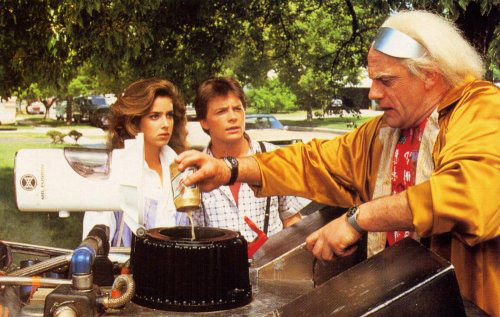
IIRC, Mr. Fusion is only six years away, right?
Well the design will certainly be going to China and India which will help these countries provide cheap, safe, clean power to help their economies grow and flourish.
And it will be seen in the United States .... NEVER because of the luddite movement which wants us to live in trees and eat grubs and bark.
The so called energy crisis is a man made problem designed to keep you where you supposedly belong, controlled.
It is on an 50 Year back-order. BTW Also forget the traveling wave reactor the RATs will outlaw it goes against their inbred unproductive inefficient Genetics.
Uh.
Was that eat grubs and eat bark, or eat grubs and bark?
woof! woof!
Sounds good, therefore the Dim-wits will oppose it.
In other words, this isn't going to happen.
“And it will be seen in the United States .... NEVER”
Yep. We have a perfect power source, but that isn’t what the left wants. They want control. They want to keep tabs on the peasants. There is no other explanation for what they continually do to roadblock everything related to any realistic energy production, such as comletely stopping the Yucca Mountain project.
They do not want any solutions to America’s problems. Just keep us all on a tether.
They want to impose desperate measures.
Desperate measures need desperate times.
I am BY NO MEANS an expert on this but the only thing that gave me pause in the article is when they mentioned the use of liquid sodium as a coolant.
Liquid irradiated sodium....yikes. Pressurized water reactors (even with the dirty primary coolant) seem like a safer design but I hope I am wrong and this is a better design.
They haven't figured out how to attach a wind turbine or solar panel to it to make it "green"
What’s that old (probably ancient Chinese...yeah, that’s it) proverb?
Ah, yes. Never allow a crisis to go to waste.
“No coal! No nukes!” “No coal! No nukes!” “No coal! No nukes!” “No coal! No nukes!”
I think a promising design is thorium reactors.
you using that 'traveling-wave reactor' will make Claudia Wells' Jennifer be replaced by Elisabeth Shue's Jennifer in the two sequels and that will be the only bad side effect, right?
Sounds like a reasonable idea scientifically, and would be a breakthrough for nuclear power if practical.
“They want control. They want to keep tabs on the peasants.”
#####
Well they are, after all, highly knowlegable lawyers, mostly from “prestigious” universities, who of course know everything about well....everything.
Some of them even went to ....gasp...Ivy League schools. Thus, they are clearly our betters.
This design is basically a fast breeder reactor. Which has been a viable reactor type for nearly half a century and several small prototypes have been successfully demonstrated.
India is presently very active in the development of breeder reactor technology. The idea of breeder reactors was rejected by the US public in the 1960s due to misconceptions about the production of plutonium in such reactors.
Disclaimer: Opinions posted on Free Republic are those of the individual posters and do not necessarily represent the opinion of Free Republic or its management. All materials posted herein are protected by copyright law and the exemption for fair use of copyrighted works.
