
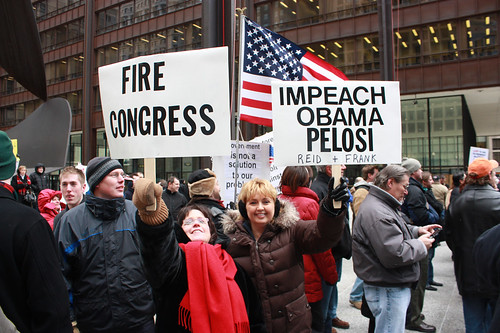

Chicago Tea Party, Chicago chapter.
Posted on 03/01/2009 7:02:20 PM PST by fight_truth_decay
One evening in the 1930s, a 13-year-old named William Troeller hanged himself from the transom of his bedroom in Greenpoint, Brooklyn.
William's father was laid up in Kings County Hospital awaiting surgery for an injury he'd suffered on the job at Brooklyn Edison. A federal jobs program was paying William's older brother Harold for temporary work. But the amount wasn't nearly enough to make ends meet. Gas and electricity to the family's apartment had been shut off for half a year. Harold told a New York Times reporter that both hunger and modesty had driven William to act. "He was reluctant about asking for food," read the headline in the paper.
The surprising part of this story is not that it happened; most Americans know that after the 1929 stock-market crash, hard times sometimes led to suicide. The surprising part is that William Troeller killed himself not in 1930, when Herbert Hoover was president, but in 1937, in Franklin D. Roosevelt's second term. The New Deal was almost five years old, but the economy was not back. In fact, the country seemed farther from recovery than before. A new sense of futility was overcoming Americans. The British magazine the Economist sneered that the United States "seemed to have forgotten, for the moment, how to grow."
The date matters, because our new president has made it clear that his model is Roosevelt. Barack Obama has spoken of creating 3 million jobs with his stimulus plan. As a new president in 1933, Roosevelt spoke of creating "one million jobs by October 1" through his spending packages. At about $850 billion, Obama's stimulus represents about 5.9 percent of gross domestic product. The spending programs of Roosevelt's National Recovery Administration amounted to almost precisely the same share. Then as now, the country was in what we might call an "illions" moment, when a nation contemplates federal spending of a magnitude previously unimaginable. The only difference is that today, we're discussing trillions instead of billions.
It's reasonable that a new executive in a downturn would want to evoke Roosevelt the leader. Like no other president, Roosevelt inspired those in despair. He kindled hope with his fireside chats on a then-young medium, radio. The new president gives radio talks, but they are also made available on this era's young medium, the Internet.
But Roosevelt the economist is unworthy of emulation. His first goal was to reduce unemployment. Of his own great stimulus package, the National Industrial Recovery Act, he said: "The law I have just signed was passed to put people back to work." Here, FDR failed abysmally. In the 1920s, unemployment had averaged below 5 percent. Blundering when they knew better, Herbert Hoover, his Treasury, the Federal Reserve and Congress drove that rate up to 25 percent. Roosevelt pulled unemployment down, but nowhere near enough to claim sustained recovery. From 1933 to 1940, FDR's first two terms, it averaged in the high teens. Even if you add in all the work relief jobs, as some economists do, Roosevelt-era unemployment averages well above 10 percent. That's a level Obama has referred to once or twice -- as a nightmare.
The second goal of the New Deal was to stimulate the private sector. Instead, it supplanted it. To justify their own work, New Dealers attacked not merely those guilty of white-collar crimes but the entire business community -- the "princes of property," FDR called them. Washington's policy evolved into a lethal combo of spending and retribution. Never did either U.S. investors or foreigners get a sense that the United States was now open for business. As a result, the Depression lasted half a decade longer than it had to, from 1929 to 1940 rather than, say, 1929 to 1936. The Dow Jones industrial average didn't return to its summer 1929 high until 1954. The monetary shock of the first years of the Depression was immense, but it was this duration that made the Depression Great.
This outcome is worth reviewing, component by component, for what it suggests about individual Obama administration projects. The first of these would be ambitious spending on infrastructure. Obama has said that he wants to "put people to work repairing crumbling roads, bridges and schools." In addition, he would like to modernize 75 percent of government buildings, as well as equip tens of thousands of schools with new technology.
Roosevelt, too, proceeded boldly on infrastructure. The budget of his Public Works Administration was so large that it shocked even the man who ran it, Interior Secretary Harold Ickes. Sounding a bit like Republicans today, Ickes said of his $3.3 billion allowance: "It helped me to estimate its size by figuring that if we had it all in currency and should load it into trucks, we could set out with it from Washington for the Pacific Coast, shovel off one million dollars at every milepost and still have enough left to build a fleet of battleships."
New Deal public-works spending did have a short-term effect, creating jobs and economic activity during Roosevelt's first term. Americans took heart at the sight of schools, swimming pools and auditoriums rising in nearly every county in the country. FDR so pumped up the federal government that 1936 was the first peacetime year when it spent more than states and towns. A master of timing, he even managed to get unemployment down to a low of 13.9 percent in November of that year, the month of the presidential election. The voters rewarded him by giving him 46 of 48 states.
But many of the jobs that the early New Deal produced were not merely temporary but also limited in economic value. It was in these years that the political term "boondoggle," to describe costly make-work, was coined. It came from "boondoggling," the word for leather craft projects subsidized by New Deal work-relief programs. As was the case for the Troeller brothers, work-relief earnings were usually not sufficient to offset other Depression losses.
After the 1936 election, Roosevelt found himself appalled at the budgetary deficit he had run up and turned frugal. Infrastructure spending slowed. Monetary authorities feared inflation and doubled reserve requirements at banks. The "Depression within the Depression" of the Troellers' time began. This cynical cycle -- spend on construction, hold election, tighten, confront new joblessness -- is familiar nowadays, especially in Latin America. But then, to Americans, it came as a bitter surprise.
Another similarity also stirs concern. Obama is focusing on our country's most promising innovation, one that is among the most likely to generate recovery jobs -- the Internet. He wants to use stimulus dollars to give poorer Americans access to that technology. Specifically, the president wants to achieve the goal of "expanding broadband across America." The listener gets the impression that Obama wouldn't mind if the federal government ran some of this business if such involvement is what it takes to get universal access. Equity first.
In Roosevelt's day, there was also an appealing new technology: electricity. Power was the industry that symbolized growth -- the Dow Jones utilities average was expected to lead the old industrial average into recovery. After all, access to electricity was so desirable that power companies' operating revenue rose even during the Depression. There were also private companies ready to supply power to the rural unwired. One was the Commonwealth and Southern Corp., fashioned by venture capitalists and industry leaders explicitly to raise the vast sums of capital necessary to light the South.
Here Roosevelt, too, combined a stimulus project with his goals for social equity. He created the Rural Electrification Administration to wire the countryside. He also created the Tennessee Valley Authority to provide hydropower. One can picture private and public working together, and that's what Commonwealth and Southern imagined, too, at first. At a tense meeting at Washington's Cosmos Club in 1933, the company's chief executive, Wendell Willkie, begged a TVA officer, David Lilienthal, to strengthen public-private cooperation. Instead, Lilienthal waged war on Willkie, using the TVA's tax-free status to compete for customers and fighting Commonwealth and Southern in the courts. In 1935, Roosevelt signed a utilities law that so restricted private capital raising that it was known as the "Death Sentence Act."
At the time, observers told themselves that the shift caused no economic loss. But the stock indexes told the real story. Instead of matching or outperforming the industrial average, the Dow Jones utilities average lagged behind. The great "stimulator," government, had emerged as an opponent. The effect, beyond the tragic unemployment, was to slow down the creation of new companies. Even the New Dealers despaired. "We have tried spending money," Treasury Secretary Henry Morgenthau said to the House Ways and Means Committee in the late 1930s. "We are spending more than we have ever spent before and it does not work. . . . I say, after eight years of this administration, we have just as much unemployment as when we started . . . and an enormous debt to boot."
What the New Deal record tells us is that it's worthwhile imagining an alternate Washington program. A program that's merely about budget balancing is wrong in an hour when banks are wildly deleveraging. But Obama could put market reform before spending. It's time to keep plans to strengthen the regulation of markets and widen regulators' mandate so that they monitor most of what's traded and derivatives don't slip through the cracks.
What about spending? The Depression tells us that public works are probably less effective than improving the environment for entrepreneurs and new companies. The president has already put forward a big tax cut for lower earners. He might offer a commensurate one for higher earners. He might expand the tax advantages he is currently offering to companies -- wider expensing of losses, for example -- and make them permanent. A discussion that permits the word "trillion" might also include the possibility of bringing down U.S. corporate taxes, taxes on interest, dividend and capital gains -- again, permanently. The cash that a relatively competitive United States draws from abroad will move the country forward faster than any stimulus.
So the Depression and the New Deal are both worth going back to, but for different reasons than many suspect. We may rely on the best of the New Deal, the matter-of-fact bravery our parents and grandparents showed then, to help us through today's unexpected challenges. But we don't have to repeat New Deal stimulus experiments, because we know that they didn't work.
This article appears in full on CFR.org by permission of its original publisher. It was originally available here
If you like fascists.
Amity has a bad habit of using the adjective great inappropriately.
He was a great leader- interning over 100,000 Americans for the duration of the war. It is such a shame GWB interred less than 1000 terrorists caught on the battlefield, violating their constitutional rights and all....
bump to that
The left refuses to learn from history, or even to acknowledge it’s existance, so one must assume that they don’t give a damn whether their discredited ideas work or not. They just want power...
FDR was a horrible leader.
Roosevelt?
I thought it was Lincoln.
Or was it JFK?
Reagan?
Who the hell can keep track?
fdr:
another rich kid attacking the “princes of property”.
Either FDR was a socialist right from the beginning or he moved in that direction once he was elected.
Of course back in those times it was even fashionable to be a communist in this country unlike today.
But Obambi is taking this country in that direction and it is a slippery slope and the Obambi administration is covering that slope with grease.
President for life.
Of course, there are differences between Hitler and Roosevelt;
Hitler died in the arms of his wife. Roosevelt died in the arms of his mistress.
This is psy-ops 101, FReepers.
He was guilty by association before (Ayers, Wright, etc.) now you’re letting him jump the train of past leaders—GREATNESS BY ASSOCIATION.
I’m Abe Lincoln, I’m JFK, I’m FDR, JUST LOOK AT ALL THESE FLAGS BEHIND ME, LOOK, GEORGE WASHINGTON’S PORTRAIT IS OVER MY SHOULDER—BS!
PROPAGANDA!
ONE BIG PSY-OP HEAD-F***!
Hitler was also a maniac who murdered millions of people. I’m not saying FDR was a saint (and certainly they had similar political and economic views), but he wasn’t a mass murderer.
I’m gonna go with my grandfather’s explanation of the FDR administration. He was there and lived through it.
My grandfather claimed that people were so mad and so ready for civil war that somebody HAD to do something. Even though it was the wrong thing, FDR’s action at least staved off civil war and the inevitable pure communism that would’ve resulted. So in a way, he saved america. He did it by convincing the ignorant masses that he was saving them...even though he didn’t have a clue what his tinkering would do to the economy. Once the masses were calmed down, the greatest threat to america was thwarted.
I think this is what obama thinks he can do for america. The difference between then and now is that america has way more educated people than is did then, and the experts know more about how the economy works now than they did then.
And Eleanor was in another’s arm. Hummm, what was her name?
But not the best - I'm sure someone like Obama (or "Hillary!") could have done a better job...

***I think this is what obama thinks he can do for america. The difference between then and now is that america has way more educated people than is did then, and the experts know more about how the economy works now than they did then.***
No, the experts know less. Ludwig Von Mises of the Austrian school was one of the few to predict the Crash due to the massive increase in the money supply during the 20’s and his prescription was for the government to do nothing as in the recession of 1920 (which ended in a year). His work as well as that of Hayek and Rothbard have all but been forgotten in today’s economics.
Disclaimer: Opinions posted on Free Republic are those of the individual posters and do not necessarily represent the opinion of Free Republic or its management. All materials posted herein are protected by copyright law and the exemption for fair use of copyrighted works.