|
January 09, 2009, 2:30 p.m.
Brute Force
Krulak was a visionary Marines Corps leader.
By Mackubin Thomas Owens
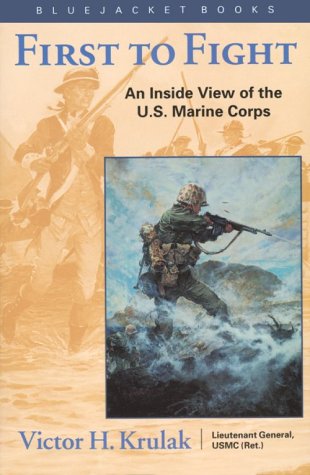
The country lost a storied Marine when retired Lt. Gen. Victor “Brute” Krulak died in his sleep on December 29 at the age of 95. Krulak was a thinker as well as a fighter, and in both capacities, he left his imprint on the Corps.
Krulak was not universally loved throughout the service. Asked to describe his leadership style, he replied that cultivating a reputation for being “a son of a bitch” has its advantages. Even so, many Marines were surprised when Lyndon Johnson did not select Krulak to be commandant in 1968. Perhaps it had to do with his persistent criticism of the strategy the U.S. was pursuing in Vietnam. (Krulak was, of course, immensely pleased when his son, Charles Krulak, became the 31st commandant of the Marine Corps in July of 1995.)
Krulak’s cadet nickname, “Brute,” was given to him in mockery of his diminutive stature: At 5’4” he had to petition for special dispensation to receive a commission. After graduating from the Naval Academy in 1934, he served aboard the battleship Arizona, and then with the 4th Marine Regiment in China from 1937 to 1939. During the latter assignment, Krulak — at the time a first lieutenant and an intelligence officer — made one of his first and most important contributions to the Marine Corps: observing and clandestinely photographing a Japanese amphibious operation against Chinese positions.
Based on his observations, Krulak prepared a report with photographs of shallow-draft Japanese landing craft capable of transporting men and heavy equipment directly onto the beach. He forwarded a copy of his report to the Navy Department in Washington, where it was at first dismissed as the “work of some nut in China.” With the help of another legendary Marine, Gen. Holland M. “Howlin’ Mad” Smith, Krulak got a model of what he had seen in China in front of the commandant. The result was that the Department of the Navy eventually deployed a landing craft similar to that observed by Krulak, the venerable “Higgins Boat” that delivered troops to beaches across the globe during World War II.
During the years before World War II, Krulak suffered two embarrassing setbacks that could have been career-enders. The first one occurred on the Arizona when the anchor chain came loose and the anchor itself was lost. The second happened in 1940 when Krulak, who had by then risen to the rank of captain, persuaded an admiral in dress uniform to inspect one of his projects — only to end up stranded on a coral reef some distance from shore, in three and a half feet of water. The two had to wade ashore, and the admiral was livid, asking Krulak, "Captain, have you ever considered a career as a civilian?"
Fortunately, Krulak’s career survived both incidents.
During the Second World War, Krulak commanded the 2nd Marine Parachute Battalion and in November 1943 led a diversionary action on the island of Choiseul. Krulak was wounded but refused to relinquish command of his battalion and be evacuated. After the diversion had achieved its intended effect, Krulak was transported away on a PT boat skippered by a young lieutenant named John F. Kennedy, whose path he would cross again years later. Krulak was awarded a Navy Cross for his actions on Choiseul. He also served on the staff of the Sixth Marine Division during the battle of Okinawa.
After the war, Krulak played a major role in the inter-service battles that characterized the period. Although the services still frequently disagree about roles, missions, and budgets, people today may not appreciate how vicious those earlier fights were. The Marine Corps was especially vulnerable: Despite its performance during the war, many players — including Harry Truman — wanted to abolish the service. Because many Marines naively believed that their war record would ensure the survival of the Corps, the day-to-day struggle for its future was waged by a small group that came to be known as the Little Men’s Chowder and Marching Society. Krulak was an integral part of that effort.
Having helped secure the survival of the Marine Corps, Krulak served in Korea as chief of staff of the 1st Marine Division. During the 1950s, he played a role in the development of the use of helicopters to transport Marines from ship to shore as part of amphibious operations. During this period he also contributed to the Marine Corps’s reinvention of itself as a “force in readiness.”
In 1962, former PT boat skipper President Kennedy directed the services to emphasize counterinsurgency training, and Krulak played a central role in implementing the president’s directive. During this period, Krulak met several times with Sir Robert Thompson, the architect of the British victory over the guerrillas in Malaya. From Thompson he absorbed a set of basic counterinsurgency principles that the Marines subsequently sought to apply in Vietnam. As Krulak observed, “The more [aware I became] of the situation facing the Vietnamese government and the Vietnamese Army, the more convinced I became . . . that our success in the counterinsurgency conflict would depend on a complete and intimate understanding by all ranks from top to bottom of the principles Thompson had articulated.”
In 1963, Krulak became involved in a controversy that persists to the present day. In the late summer of that year, President Kennedy dispatched Krulak and the State Department’s Joseph Mendenhall to Vietnam. Their mission was to assess the regime of Ngo Dinh Diem, the president of the Republic of Vietnam. Both Krulak and Mendenhall briefed President Kennedy on September 10. Krulak concluded that the war was going well, while Mendenhall predicted that the Diem government would either fall to the Viet Cong or that the country would descend into a religious civil war. So opposed were their conclusions that the president quipped, “The two of you did visit the same country, didn’t you?”
But the two had taken very different itineraries in Vietnam. Krulak visited some ten locations across the country and extensively interviewed U.S. advisers to the Vietnamese army. Mendenhall, who had been recommended to the president by Averill Harriman and Roger Hillsman, longtime advocates of replacing Diem, visited three South Vietnamese cities where he spoke primarily to opponents of the South Vietnamese president.
On March 1, 1964, Krulak became commanding general of the Pacific Fleet Marine Force. By this time, the State Department view had prevailed and the United States had acquiesced in a coup against Diem. The deteriorating situation in the country led the United States to commit ground troops.
The Marines’ approach in Vietnam included three elements, according to Krulak: emphasis on pacification of the coastal areas in which 80 percent of the people lived; degradation of the ability of the North Vietnamese to fight by cutting off supplies before they left northern ports of entry; and engaging the Peoples Army of Vietnam (PAVN) and Viet Cong (VC) on terms favorable to American forces.
Krulak was responsible for the readiness, training, equipping, and supplying of all the Marines in the Pacific, but he had no authority over their operational employment in Vietnam. That was the purview of the Army’s William Westmoreland. Gen. Westmoreland’s approach to the war differed considerably from the counterinsurgency approach favored by the Marines and, as a result, the Marines soon came into conflict with him over how to fight the war.
Westmoreland believed that the Marines “should have been trying to find the enemy’s main forces and bring them to battle, thereby putting them on the run and reducing the threat they posed to the population.” Westmoreland’s view was informed by the battle of Ia Drang in November 1965, when an outnumbered U.S. force had spoiled an enemy operation and sent a major PAVN force reeling back in defeat. But Krulak believed that Ia Drang was a case of fighting the enemy’s war, one that North Vietnamese Gen. Vo Nguyen Giap predicted would be “a protracted war of attrition.” As Krulak observed, Giap was right: a “war of attrition it turned out to be . . . [by] 1972, we had managed to reduce the enemy’s manpower pool by perhaps 25 percent at a cost of over 220,000 U.S. and South Vietnamese dead. Of these, 59,000 were Americans.”
Interestingly, Westmoreland’s successor, Gen. Creighton Abrams, abandoned the former’s operational strategy, which emphasized the attrition of PAVN forces in a “war of the big battalions,” and instead adopted an approach akin to the one that Krulak preferred. This approach emphasized the protection of the South Vietnamese population by controlling key areas rather than the destruction of enemy forces per se. In addition, rather than ignoring the insurgency and pushing the South Vietnamese aside as Westmoreland had done, Abrams followed a “one war” policy, integrating all aspects of the struggle against the Communists. This achieved the military and political conditions necessary for South Vietnam’s survival as a viable political entity.
The Marines’ expeditionary mindset and adaptability — and Krulak’s willingness to roll the dice — is illustrated by an event that occurred in April of 1966. At a meeting in Honolulu attended by the secretaries of defense and state, the U.S. ambassador to Vietnam, and the principal U.S. military commanders, the group discussed how long it would take to build an airfield at Chu La, to supplement the overworked field at Da Nang. The conservative estimate was eleven months. But the Marines had developed the ability to deploy an expeditionary airfield consisting of aluminum planking along with mobile bulk-fuel systems and arresting gear. Krulak told the skeptical attendees at the Honolulu meeting that the Marines could have a runway in operation within 25 days. Secretary of Defense Robert McNamara gave the go-ahead but was not convinced that it could be done. The overall commander of U.S. forces in the Pacific, Adm. U.S. Sharp, told Krulak, “You know your neck is out a mile.”
By the 25th day, planes were flying sorties from a 4,000-foot field.
When he was not selected as commandant, Krulak retired but continued to devote himself to the nation’s defense as a journalist. In this capacity, he served as a vice president of the Copley Newspaper Corporation and president of its news service while writing a regular column for many years.
“Brute” Krulak was a true visionary. He will be missed but, fortunately, he has inspired many who follow him.
— Mackubin Thomas Owens is editor of Orbis and professor of national-security affairs at the Naval War College in Newport, R.I. He is writing a history of U.S. civil-military relations, and his study of Lincoln’s wartime leadership will be published in early 2009 by the Foreign Policy Research Institute. |