Skip to comments.
World’s First Image Taking of the Moon by HDTV (HD Luna)
Japan Aerospace Exploration Agency ^
| 11/10/07
| JAXA
Posted on 11/10/2007 7:54:30 PM PST by NormsRevenge
The Japan Aerospace Exploration Agency (JAXA) and NHK (Japan Broadcasting Corporation) have successfully performed the world's first high-definition image taking by the lunar explorer "KAGUYA" (SELENE,) which was injected into a lunar orbit at an altitude of about 100 km on October 18, 2007, (Japan Standard Time. Following times and dates are all JST.)
The image shooting was carried out by the onboard high definition television (HDTV) of the KAGUYA, and it is the world's first high definition image data acquisition of the Moon from an altitude about 100 kilometers away from the Moon.
The image taking was performed twice on October 31. Both were eight-fold speed intermittent shooting (eight minutes is converged to one minute.) The first shooting covered from the northern area of the "Oceanus Procellarum" toward the center of the North Pole, then the second one was from the south to the north on the western side of the "Oceanus Procellarum." The moving image data acquired by the KAGUYA was received at the JAXA Usuda Deep Space Center, and processed by NHK.
The satellite was confirmed to be in good health through telemetry data received at the Usuda station.
TOPICS: Japan; Your Opinion/Questions
KEYWORDS: hdtv; image; jaxa; kaguya; moon; taking
Navigation: use the links below to view more comments.
first 1-20, 21-28 next last
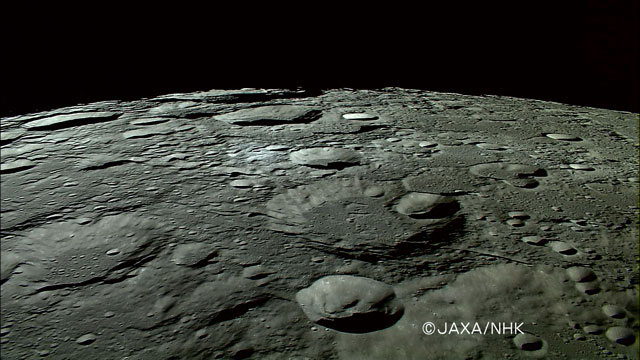
North Pole Area (still image cut out from the first image shooting)
This is a still image taken out from the first moving image shooting when the KAGUYA flew from the northern area of the "Oceanus Procellarum"(*1) to the center of the North Pole.
As the altitude near the North Pole is high, the angle of the coming sunlight was lower, thus the shade of the crater topography looks long in the image.
The moving image was taken at 4:07 a.m. on October 31, 2007 (JST) by eight-fold speed intermittent shooting (eight minutes is converged to one minute) from the KAGUYA, and the data was received at the JAXA Usuda Deep Space Center on the same day.
(*1) Oceanus Procellarum: The dark area on the Moon's surface called "ocean." It is located at the left end of the northern hemisphere on the front side of the Moon when we look up at it from the Earth.
2
posted on
11/10/2007 7:56:34 PM PST
by
NormsRevenge
(Semper Fi ... Godspeed ... ICE’s toll-free tip hotline —1-866-DHS-2-ICE ... 9/11 .. Never FoRGeT)
To: NormsRevenge
Are there preferential trajectories for impacts on the moon or was the bombardment about the same from all directions?
3
posted on
11/10/2007 7:58:06 PM PST
by
aruanan
To: NormsRevenge
Yeah right. There’s no space program! It’s all filmed in a studio on Okinawa!
(SARC/)
4
posted on
11/10/2007 7:58:20 PM PST
by
Grizzled Bear
("Does not play well with others.")
To: aruanan
beats me.. looks like it got it pretty good all over
5
posted on
11/10/2007 7:59:24 PM PST
by
NormsRevenge
(Semper Fi ... Godspeed ... ICE’s toll-free tip hotline —1-866-DHS-2-ICE ... 9/11 .. Never FoRGeT)
To: NormsRevenge
It looks computer generated to me.
6
posted on
11/10/2007 8:00:36 PM PST
by
wastedyears
(One Marine vs. 550 consultants. Sounds like good odds to me.)
To: NormsRevenge
The reason I ask is because if most of the stuff hitting the moon is coming in on the ecliptic, then you’d expect more elongated impacts in the polar regions.
7
posted on
11/10/2007 8:02:06 PM PST
by
aruanan
To: NormsRevenge
8
posted on
11/10/2007 8:02:21 PM PST
by
sit-rep
To: aruanan
good question tho,, considering that some could be the result of swarms of cosmic debris , some at random , others not quite so.. the moon doesn't rotate so I'll be curious if they can get shots of the alien bases on the back side. ;-) pretty good little device..

The High Definition Television (prior to loading on the KAGUYA)
9
posted on
11/10/2007 8:03:12 PM PST
by
NormsRevenge
(Semper Fi ... Godspeed ... ICE’s toll-free tip hotline —1-866-DHS-2-ICE ... 9/11 .. Never FoRGeT)
To: wastedyears
Pretty high quality stuff, huh?
10
posted on
11/10/2007 8:03:46 PM PST
by
NormsRevenge
(Semper Fi ... Godspeed ... ICE’s toll-free tip hotline —1-866-DHS-2-ICE ... 9/11 .. Never FoRGeT)
To: NormsRevenge
I saw a program that studied meteors. The idea was to figure out why earth’s surface wasn’t pelted like the moon. Aside from the atmosphere, there actually are all sorts of craters on earth. It’s just that vegetation and erosion wipe it way, make it less noticeable. Everything on the moon, is permanent, without an atmosphere.
To: NormsRevenge
Very cool...thanks for posting it.
12
posted on
11/10/2007 8:25:51 PM PST
by
rlmorel
(Liberals: If the Truth would help them, they would use it.)
To: NormsRevenge
I would have been shocked if there were audio.
And no, I’m not Richard Hoagland or Muhammad Ali.
13
posted on
11/10/2007 8:26:35 PM PST
by
steve86
(Acerbic by nature, not nurture ™)
To: NormsRevenge
“the moon doesn’t rotate “
Actually it does rotate approximately once per month.
14
posted on
11/10/2007 8:28:16 PM PST
by
Kirkwood
To: Kirkwood
yur kidding? I never noticed. I stand corrected. Thanks!
15
posted on
11/10/2007 8:35:11 PM PST
by
NormsRevenge
(Semper Fi ... Godspeed ... ICE’s toll-free tip hotline —1-866-DHS-2-ICE ... 9/11 .. Never FoRGeT)
To: aruanan
The craters on the moon are largest and most numerous facing the earth, and are fairly "young", because they do not show a advanced "crater creep", the gradual crumbling and flattening out of crater walls. The craters on the other side are much smaller and fewer. Why this is is covered here:
fountains of the deep
To: Kirkwood
sure it rotates, but the side facing the earth always faces the earth.
To: NormsRevenge
"I'll be curious if they can get shots of the alien bases on the back side. ;-) pretty good little device.. Oh Oh! Superman's ice castle will be discovered.
To: Professional
erosion occurs on the moon as well, but at a different rate.
If you look closely you can see newer, smaller craters on the moon beside the larger older ones.
The earth has far less craters on it. Nasa has some good pics which shows them.
A theory for why the moon has more craters on it facing the earth is because the stuff that made them came from the earth to begin with, during a catastrophic event. The earth is quite easily capable of producing the power needed to propel very large chunks of it’s surface crust to escape velocities.
To: Nathan Zachary
“The earth is quite easily capable of producing the power needed to propel very large chunks of it’s surface crust to escape velocities.”
EXCUSE ME!! Since when did the Earth acquire this ability? Anytime recent?
Navigation: use the links below to view more comments.
first 1-20, 21-28 next last
Disclaimer:
Opinions posted on Free Republic are those of the individual
posters and do not necessarily represent the opinion of Free Republic or its
management. All materials posted herein are protected by copyright law and the
exemption for fair use of copyrighted works.
FreeRepublic.com is powered by software copyright 2000-2008 John Robinson