 The church I was raised in had an American flag. . .
 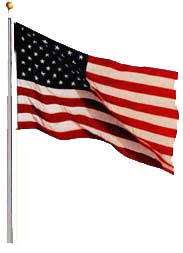 . . . on one side and on elike this . . .
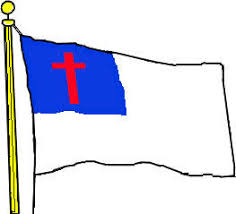 . . . on the other.
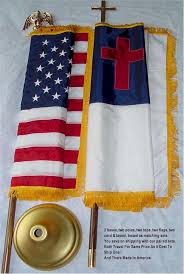 They are sold in sets!
Posted on 05/21/2006 6:54:53 AM PDT by Androcles
Sacerdotal Flagism: Should the Flag Be Permanently Displayed in Church Sanctuaries Or Other Explicitly Christian Environments?
"My house will be called a house of prayer for all peoples."—Mk 11:17
The question is not "What must be done?" The question is "How to do it," without dividing a Church that has been subject to mis-evangelization for decades. Bishops throughout this country must know the issue. In their hearts they must be aware that it is not a trivial concern before God. They certainly must be conscious of what their own rules and regulations dictate on the matter. But they also know that, as clear as the truth is, they often are forced to walk through a political-economic gauntlet in order to resolve the conflict. So the whole mess is "put on the back burner" with unacceptable consistency.
After Vatican II it was thought that the best pastoral strategy was to pursue the task of liturgical renewal and theological updating in an orderly fashion and this particular problem would take care of itself as part of the overall process. It has not worked out that way. So now the matter must be explicitly addressed, or else all signs indicate it will continue to spread as a spiritual pathogen within the United States Catholic Church and to fuel potentially detrimental consequences for other sections of the worldwide Catholic Church. The issue of which I am speaking is the liturgically incorrect and pastorally wrong practice of sacerdotal flagism—installing the national flag as a permanent part of the environment of worship and proclamation in the local Catholic Church.
History: Started During WWII
Perhaps a bit of history might be beneficial. The placing of the U.S. flag inside a Catholic Church was not a widespread practice until World War II. At that time manipulative mechanisms were employed by the government to "encourage" the public display of flags in various surroundings, including Churches. It was not only the U.S. government that latched onto this ploy to heat-up and divinize nationalistic emotions during these war years. But, it was only U.S. Catholicism that acquiesced so totally to governmental pressure to display the flag as part of the permanent Church atmosphere. In the majority of countries, the permanentizing of a national flag in a Catholic Church was looked upon as so utterly inappropriate that governments were simply unable, for the most part, to finesse this piece of their war-time agenda into the sanctuary and other Church environments. After the War in countries outside the U.S. where governments had been temporarily successful in introducing a flag into Catholic Churches, Church authorities rapidly removed them. In the U.S. Catholic Church, however, sacerdotal flagism paraded on into the post-war, anti-communism, Joe McCarthy, Korean War years without missing a step until Vatican II. This is not to say that the practice in U.S. Catholicism ever became universal or was ever formally mandated by Church authorities. In the parish in which I lived during World War II and after, there was never a flag in the House of God, upstairs or down. When occasionally the Monsignor was asked—or interrogated—"Why is there no flag in our Church?" his answer, delivered with a pre-Vatican II measured and stern preciseness, was always the same: "This is a Catholic Church."
The Mass: Completely Catholic
The Catholic Mass is 100% Catholic. It knows no national, ethnic or political boundaries. A Catholic man or woman from Japan is as welcome at a Catholic Eucharist in a Catholic Church in Dublin or Berlin as any Irish or German Catholic is. This is absolute—and it is very, very good in a humanity thoroughly nurtured from the cradle onward into anti-Gospel parochial prejudice. In a Church of over a billion people, from every nation on earth, it attests to a significant achievement in human history. The question that arises from this magnificent planetary accomplishment is this: "Does a non-Japanese Catholic have a right to go to a Catholic Church in Japan and not be "set-up" to have to genuflect, kneel or pray in the presence of the Japanese flag?" To ask the same question a second way: "Do over three-quarters of a billion non-U.S. Catholics have a right to kneel in the Eucharistic Presence in a Catholic Church in the U.S. without having to kneel in the presence of the U.S. flag?" To put this a third way: "Is a local pastor really placing the welfare of the universal Catholic Church first when he permanently ornaments the Church with a flag of the local nation-state?"
Flag: Sign of the Ephemeral
Symbolically, a national flag in a Catholic Church is as out of place as a crucifix in city hall or a tabernacle in the State Capitol building. The flag is a sign of the temporal, the totally passing, the utterly perishable. The state is not an object of redemption in the New Testament. Its existence is as fleeting as a cloud—here today, extinct tomorrow. Contrary to this, the altar, the cross, the Eucharist, the Stations, the Icons and the statutes of the saints are symbols of the imperishable, the universal, the everlasting, the death-conquering Redeemer and His Way of Eternal Life.Beyond the fact that every state is as transient as the cloth of the flag that represents it, a large number of the values that a state flag stands for are not the values that the Gospel teaches as being in conformity with the will of God as revealed by Jesus. For two examples of this difference, from among many, consider first, the Christ-like love of enemies that is taught by Jesus, and then consider that the Gospel proclaims Jesus to be the incarnation and definitive revelation of the true God and His will.
Click to purchase, proceeds to Houston Catholic Worker Available Now
Love of Enemies
As regards the first, it is incontestable that Jesus taught love of enemies modeled on His example. It is equally incontestable that no state accepts this or comes within light-years of practicing it. Therefore no state flag can possibly be symbolically presenting Jesus’ understanding of existence and God’s will. Indeed, if the truth be told, the Constitution of the United States demands an understanding of existence in direct contradiction to that of Jesus. Article III, section 3 of the U.S. Constitution makes it a crime to love your enemies as Jesus loved his enemies. It makes it a crime to follow Jesus. Article III, Section 3 states as part of the fundamental and foundational law of the United States that, "Treason against the United States shall consist only in levying war against them, or in adhering to their enemies, giving them aid or comfort." Indeed, loving one’s enemies as Jesus loved His enemies is the only crime explicitly mentioned in the U.S. Constitution! As recently as this year this provision has been applied by the U.S. Government to punish those Christians who were bringing food and medical supplies to the Iraqi people during the time of the savage sanctions that were imposed on them by the Clinton administration through the United Nations.
A symbol, that explicitly announces that a Christian cannot love his/her enemies as Jesus does, has absolutely no place in a Christian environment. An icon or statute in a Christian environment picturing Jesus with a machine gun mowing down His lethal enemies would be a spiritual abomination—grave false witness. Yet, a national flag in such a Christian setting communicates, not only that a Christian is forbidden to love enemies as Jesus does, but also says loud and clear that a Christian may mow down his or her enemies and still be following Jesus. The flag then, displayed in a precisely designated Christian space, is de facto an anti-Christ symbol, contradicting not only an indisputably authentic teaching of Jesus but also contradicting the symbol of the cross on which Jesus loves His enemies up to the very moment of His death.
"Put Up Your Sword"
Picking up one’s cross daily and following Jesus is precisely what the Christian is called to do. "Giving aid and comfort to the enemy" is exactly what "If your enemy is hungry give him to eat, if he is thirsty give him to drink" means. It is exactly what "Father forgive them for they know not what they do" means. It is exactly what "Put up your sword" means. It is exactly what Jesus’ healing the severed ear of the armed servant of the high priest, who has come to the Garden of Gethsemane to take Him to His death, means! "Love your enemies," is not for the Christian some philosophically arrived at truth based on some process of human reasoning, which he or she then is at liberty to change or ignore as they see fit. "Love your enemies," is the very will of God as revealed by Jesus, the incarnation of God. For the Christian it is that to which he or she owes total, wholehearted, unreserved allegiance. Any symbol or symbolic activity that would in any way suggest or imply that a Christian could do otherwise has absolutely no place in a Christian life, Church or environment.
No Syncretism
As regards the second point raised above: the U.S. flag is a sign of Constitutionally endorsed syncretism, or possibly Constitutionally endorsed agnosticism. ("I don’t care what kind of God you believe in, just so long as you believe in God," is Dwight D. Eisenhower speaking—not Jesus Christ.) The flag gives equal value, rights, privileges and standing to all ideas of God, whether they conform to the teachings of Jesus or whether they contradict the teachings of Jesus. The U.S. flag, as a symbol, relegates Jesus Christ, the Second Person of the Holy Trinity, the Messiah of Israel, the Savior of the world to the status of any and all others gods. This may be acceptable as a practical method of operation for a theologically pluralistic grouping of people, but the Church’s entire meaning rests on a foundational truth that is 100% contradictory of this. The Church unequivocally teaches that Jesus Christ is the Only-Begotten Son and the Word of God, is the Lord and Savior to whom is given that which is due to God alone, namely, latria, adoration. The U.S. flag, to the contrary, is the symbolic supporter of any and every god that comes down the theological highway.
Our Flag is the Cross
My point is only this: spiritually, aesthetically, logically and theologically, it is improper to perpetually station a secular flag—let alone pledge allegiance to it—within any explicit Church facility or overt Christian environment, and most especially where the Eucharistic Presence of the one true God (Jesus) abides or is continually taught and celebrated. It is for all of these reasons—and more than likely for many others—that Pope John Paul II said, when questioned as to why there were no flags in St. Peter’s, "Our flag is the cross."
U.S. Bishops on Symbols
In fact, the pastoral leadership of at least the U.S. Catholic Church realizes this. The U.S. Catholic Bishops in their document, Environment and Art in Catholic Worship, state:
Although the art and decoration of the liturgical space will be that of the local culture, identifying symbols of particular cultures, groups or nations are not appropriate as permanent parts of the liturgical environment. While such symbols might be used for a particular occasion or holiday, they should not regularly constitute a part of the environment of common prayer.
Not Just a Catholic Problem
But, or course, this problem is not limited to the Catholic Church in the U.S. Other U.S. Churches are equally ensnared. Some non-Catholic Churches in the U.S. and in other parts of the world are as deep into the spiritual emptiness of sacerdotal flagism as is the Catholic Church in the United States. But, it must be remembered—and I say this without any demeaning intent—that the largest of the Protestant churches, the Anglican-Episcopal Communion, is only one-tenth the size of the Catholic Church and, as is the case with all Protestant Churches, much more geographically limited than the Catholic Church. As regards the Orthodox Church, one need look no further than the words of the most renowned Orthodox spiritual writer in the in the second half of the 20th Century, Bishop Kallistos Ware:
"Nationalism has been the bane of Orthodoxy for the last ten centuries."
Here nationalistic symbolism (not just flags) and symbolic activity so abounds, that the many Orthodox Churches have lost their sense of universality and instead have operationally become nationalistic and/or ethnic clubs.
I mention all this not in order to denigrate Protestant or Orthodox Churches, but only to emphatically note that our task as Catholics is to first clean up our own House of Prayer. I mention this to suggest that the local Catholic bishop or pastor cannot take his cue on this matter from his local patriotic Protestant counterpart or from the nationalistic Orthodox hierarch or priest in his area. Less still, can he take it from the TV evangelist with the highest media ratings. Catholic pastors, and I would venture to say all Protestant and Orthodox pastors as well, must always in conscience consider two facts vis · vis this matter of sacerdotal flagism: the planetary scope of the Church they are serving and the catholicity of the message of the Gospel, as both of these relate to the eternal well-being of each and all of the Father’s beloved sons and daughters.Advice to Pastors
My "how-to" advice to pastors of all ranks in all Churches is this: It will be far less painful and divisive and far more intelligently informative of the Christian consciousness of the community if it is openly explained what must be done and why---as has already been accomplished in the Church by requiring a white pall, symbolic of the person’s Baptism into Christ, on a casket instead of the flag during the funeral liturgy. Certainly this is pastorally superior to the practice of sneaking the flag out of the church at midnight during refurbishing. It really is not that difficult to rationally communicate that a flag has its place, for example, in a public park, in city hall or even at a Burger King—but its place is not as a permanent fixture in a Church environment where the Risen Immortal Presence of our Lord, God and Savior Jesus Christ is celebrated and/or reserved and/or proclaimed for the whole Church—indeed for all humanity.
A House of Worship
Lest we forget, Jesus said, "My house will be called a house of prayer for all peoples" (Mk 11:17). It is therefore important, that Christians possessed of patriotic fervor, whether they be hierarchs, clerics or laity, be aware and take to heart two matters of eternal consequence. First, operationally de-catholicizing or parochializing the Church, Jesus and God can never be a service to the Church, to humanity, to the Christian conscience, to the process of eternal salvation brought to the world by Jesus Christ or to the one true God revealed by Jesus, who is "Father of all, over all, through all and within all" (Eph 4:6). Second, no image of any kind, that in any way obscures, confuses or contradicts the image of God and His will as revealed by Jesus, has any place in a Church, or in any environment that is explicitly defined as Christian—the locally nurtured emotions of nationalistic patriotism notwithstanding.
All comments welcome. Forgive me if I'm slow responding - the time difference means I'm off to bed shortly...
I know this post is about flags being displayed permanently in a church, but when my father died, the priest would not allow us to have his flag draped coffin in the church.
I wasn't involved with that, or else I would have raised a stink. I think my poor mom was just overwhelmed and didn't protest.
But he had his ceremony down in Arlington...:)
Well I can't see any valid objection to something important to the deceased or their famiy unless it was a Swastika or similar! And I know tha civil liberties types will argue that you can't draw the line but priests have the right to if they're conducting the service. A flag draped coffin doesn't fit that bill though - some priests forget the impact that their beliefs can have on those in the midst of tragedy.
Hmm, and whatever happened to the vaunted "separation fo Church and State" (which incidentally, is no such thing -- we merely have no governmental recognition or political control of a particular church, nor is membership in an established religion a pre-requisite for the holding of public office, unlike the old Anglican church in Britain).
Then again, whatever happened to "Render unto Caesar...?"
I think the individual churches themselves should make this decision, and not the government.
Naturally, in some cases, the display of the flag is appropriate: when one of our war dead comes home and is eulogized in his hometown church, when we remember the sacrifice of millions on Memorial Day or similar holidays, but so long as such displays do not interfere with any established doctrinal process or teaching, I don't see why this shouldn't be a decision left to the churches themselves.
Exactly so.
I'm less worried about flags and other symbols than WHAT GOES ON IN CHURCHES. This is a clear case of symbolism over substance.
This is a matter for the local church. No one else's business.
And I'M WORRIED ABOUT POOR USE OF caps lock by freeREPUBLIC POSters!
Post a thread re what goes on in churches if you want, this one is designed to eleicit info re an intriguing difference of a very specific nature.
There definitely is a time for appropriate displays. If I attend the funeral of a war vet, etc. I expect to see the flag unless they or their family chose otherwise.
Um, not for the Catholic church...they aren't run on a "Locals make the decisions" basis. Also, as this is designed to find the rationale behind such decisions I'm interested to see why rthey are there. I believe funerals should have flags as required, as already noted, but the idea of a national flag up behind or near the altar startles me no matter the country.
Um, no. While I personally don't have strong views on this, your determined tone makes me take the view that those nations should not show their national emblems in the place where thanks and devotion is given to Him - those places don't belong to them, they belong to Him.
A discreet flag outside (in normal circumstances) is appropriate. A fla within is not.
The church I was raised in had an American flag. . . . . . on one side and on elike this . . . . . . on the other.
They are sold in sets!
But WHY should they have them? I'm keen to hear good reasons for the practise.
Sadly . . . true.
Were you ever in the Boy Scouts?
If the flag is viewed as competing loyalty, I accept your view. If the flag is viewed as an offatory, denoting humble submission to a greater rule, then it becomes an acknowlegemnt of who bestows the ultimate power.
Disclaimer: Opinions posted on Free Republic are those of the individual posters and do not necessarily represent the opinion of Free Republic or its management. All materials posted herein are protected by copyright law and the exemption for fair use of copyrighted works.