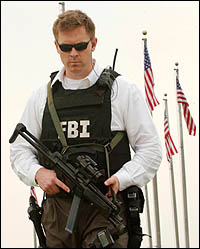
"HALT! FBI! Hey, you got any munchies, bro?"
Posted on 10/09/2005 4:10:26 PM PDT by Brilliant
WASHINGTON - The FBI, famous for its straight-laced crime-fighting image, is considering whether to relax its hiring rules over how often applicants could have used marijuana or other illegal drugs earlier in life.
Some senior FBI managers have been deeply frustrated that they could not hire applicants who acknowledged occasional marijuana use in college, but in some cases already perform top-secret work at other government agencies, such as the CIA or State Department.
FBI Director Robert Mueller will make the final decision. "We can't say when or if this is going to happen, but we are exploring the possibility," spokesman Stephen Kodak said
The change would ease limits about how often — and how many years ago — applicants for jobs such as intelligence analysts, linguists, computer specialists, accountants and others had used illegal drugs.
The rules, however, would not be relaxed for FBI special agents, the fabled "G-men" who conduct most criminal and terrorism investigations. Also, the new plan would continue to ban current drug use.
The nation's former anti-drug czar said he understands the FBI's dilemma.
"The integrity of the FBI is a known national treasure that must be protected," said retired Gen. Barry R. McCaffrey, who used to head the White House Office of National Drug Control Policy. "But there should be no hard and fast rule that suggests you can't ever have used drugs. As long as it's clear that's behind you and you're overwhelmingly likely to remain drug free, you should be eligible."
Current rules prohibit the FBI from hiring anyone who used marijuana within the past three years or more than 15 times ever. They also ban anyone who used other illegal drugs, such as cocaine or heroin, within the past 10 years or more than five times.
"That 16th time is a killer," McCaffrey said.
The new FBI proposal would judge applicants based on their "whole person" rather than limiting drug-related experiences to an arbitrary number. It would consider the circumstances of a person's previous drug use, such as their age, and the likelihood of future usage. The relaxed standard already is in use at most other U.S. intelligence agencies.
Entry-level intelligence analysts usually earn between $36,000 and $53,000, depending on qualifications and where they are assigned to work. Entry-level FBI special agents earn $42,548.
The FBI proposal contrasts with the agency's starched image and its drug-fighting history. A generation of video game players can remember seeing the FBI seal and slogan, "Winners don't use drugs," attributed to former FBI Director William Sessions, on popular arcade games from the late 1980s.
Private companies have wrestled with the same problem. Employers complain they can't afford to turn away applicants because of marijuana use that ended years earlier, said Robert Drusendahl, owner of The Pre-Check Co. in Cleveland, which performs background employment checks for private companies.
"The point is, they can't fill those spots," Drusendahl said. "This is a microcosm of what's happening outside in the rest of the world. Do we dilute our standards?" He said the FBI should have a low tolerance for any illegal behavior by applicants. "If they used marijuana, that's illegal. It's pretty cut and dried."
A recently retired FBI polygraph examiner, Harold L. Byford of El Paso, Texas, was quoted in a federal lawsuit in February 2002 arguing that "if someone has smoked marijuana 15 times, he's done it 50 times. ... If I was running the show there would be no one in the FBI that ever used illegal drugs!"
The proposed FBI change also reflects cultural and generational shifts in attitudes toward marijuana and other drugs, even as the Bush administration has sought to establish links between terrorists and narcotics.
"I don't think you could find anybody who hasn't tried marijuana, and I take a lot of credit for that," said Tommy Chong, the comedian whose films with Cheech Marin provided over-the-top portrayals of marijuana culture during the 1980s. "They're going to have to change their policy."
While marijuana use is hardly universal, it remains the most commonly used illegal drug in the United States, with about half of teenagers trying the drug before they graduate high school.
"What people did when they were 18 or 21, I think that is pretty irrelevant," said Richard Clarke, a former top White House counterterrorism adviser. "We have to recognize there are a couple of generations now who regarded marijuana use, while it's technically illegal, as nothing more serious than jaywalking."
An agency's attitude toward drug use has been blamed for unexpected consequences. The CIA forced one of its officers, Edward Lee Howard, to resign in May 1983 after he failed a polygraph test and disclosed his drug use in Colombia during 1975 when he was a Peace Corps volunteer. Howard defected to the Soviet Union in 1985 after he was accused of espionage activities that spy hunters believe were driven by resentment over his forced resignation.
"I had been totally honest about each and every misdeed in my past, including my drug use in South America and my occasional abuse of alcohol," Howard wrote in his 1995 memoirs. He died in July 2002 at his home outside Moscow.
Some other federal agencies also have tough marijuana policies. The Drug Enforcement Administration will not hire applicants as agents who used illegal drugs, although it makes exceptions for admitting "limited youthful and experimental use of marijuana." The DEA, however, permits no prior use of harder drugs.
"Recreational marijuana use is a fact of life nowadays," said Mark Zaid, a Washington lawyer who has represented people rejected for FBI jobs over drugs. "It doesn't stop Supreme Court justices from getting on the bench and doesn't stop presidents from getting elected, so why should it stop someone from getting hired by the FBI?"
I'd wish they would,*cough*,lower the age of those who can become special agents.
Slippery slope.
"HALT! FBI! Hey, you got any munchies, bro?"
They definitely won't hire me! ;-)
When I was being vetted for a TS clearance they found the pot use in my past and only wanted to know if I was still doing it. I had long since decided that I did not like the out of control feeling and had quit. No problem with the clearance. But there would have been trouble had I lied about it.
Because so many applicants ( mostly college age ) failed the drug test for grass at the Acme down the street, the store did away with the test .
What??? But according to the DEA and the Office of Drug Control Policy, there's rarely such thing as an experimental marijuana user who hasn't gone on to harder drugs! It's the gateway drug, doncha know! Could it be that even they don't believe some of the things they tell us???
Taking a toke at a party during the teen years is one thing but any kind of regular use of any kind of drug indicates a seriously weak character flaw.
Drug dependency, even a mild dependency, means that a person cannot rely on their own senses to get through life.
The high standards the FBI sets for recruits should be maintained.
Reality is for people who cant handle drugs. ;)
lol... With the left cost accent!
Spoken like a true believer from the "I didn't inhale" administration.
A recall of my past. Armed forces would not take me w/out a HSD. The Navy allowed me to take the test. I scored a 98.6. By the time I got home from the testing, the other three called me and offered the world. Same difference as above. They use their rules as a filter...
there = their...
Typical journalistic or legal lie
Current recreational drug use is certainly a disqualifier for those positions of trust. Previous use many years ago can be forgiven and forgotten, but not current or very recent use.
"Slippery slope."
...
Agreed, wht's next, somebody saying,
"Just legalize it and focus on the hardER drugs."
"Just legalize that too, and focus on the harderER drugs."
"Just legalize it and focus on the HERDer drugs."
"jus legasize it an try to focus on the hUrdar dugs."
"drug indicates a seriously weak character flaw.
Drug dependency, even a mild dependency, means that a person cannot rely on their own senses to get through life. "
...
Which means the doper dopes can and would be easy to manipulate and control particulary with blackmail.
Drug abuse means weak
Drug dependency, even a mild dependency, means that a person cannot rely on their own senses to get through life.
The high standards the FBI sets for recruits should be maintained.
I agree with you. It matches my experiences of observing a continuum of pot users in college. Despite the Leftists' assertions, you can find people like myself who didn't partake in pot experimentation, use or abuse in their lives.
You might lose a few "good" candidates but there is a pool of millions of Americans from which to draw.
Disclaimer: Opinions posted on Free Republic are those of the individual posters and do not necessarily represent the opinion of Free Republic or its management. All materials posted herein are protected by copyright law and the exemption for fair use of copyrighted works.