
Click here: to donate by Credit Card
Or here: to donate by PayPal
Or by mail to: Free Republic, LLC - PO Box 9771 - Fresno, CA 93794
Thank you very much and God bless you.
Posted on 10/15/2026 6:57:01 AM PDT by BenLurkin
As polar ice melts in the Arctic, shipping lanes are opening up, making the region a new zone of superpower competition. Writer Rana Foroohar got an up-close look aboard the USS Healy, a Coast Guard icebreaker. She says that traversing the North Pole by ship — once a "largely conceptual" route — is now becoming a "real possibility" for two or three weeks a year.
"If you are taking one of these Arctic routes, you can save as much as 40% of the time it would take you to go from the Atlantic to the Pacific, and depending on the price of oil, that's a heck of a lot of money," she says. "China and Russia together are clearly trying to make the top of the world an area over which they have the most interest."
In her new book, Sea Change: America's New Great Game in the Arctic Circle, Foroohar makes the case that the "High North" may become as critical to world shipping as the Suez or Panama canals. But she also notes that beneath the Arctic waters are large deposits of oil, natural gas and rare earth minerals, as well as underwater cables, which carry a large part of the world's intercontinental information flow.
"Undersea cables have become a real touchstone in wars and conflicts around the world," she says. "So you are seeing a race to lay down new cable, and who can get there fastest, and then who can potentially commercialize and even militarize areas where those cables have been laid."
"Rusting rivers" are increasingly common in the Brooks Range of northern Alaska, the result of thawing permafrost. The orange color is caused by naturally occurring iron, but it also often indicates elevated levels of heavy metals.
Foroohar describes the Arctic Circle as one of the few areas of the globe where countries and companies can still "hunt" for territory and "duke it out potentially with rivals." And she predicts more conflict in the coming decades as the region continues to warm.
"There is going to be more commerce done through this area. There is gonna be greater military interest in the area, and all of that matters because it really is in America's backyard," she says. "I just think that everything in the High North is going to be higher priority for America in the future."
|
|
Click here: to donate by Credit Card Or here: to donate by PayPal Or by mail to: Free Republic, LLC - PO Box 9771 - Fresno, CA 93794 Thank you very much and God bless you. |
Why doesn’t all that melting ice translate into sea-level rise?
ITS TRUMPS FAULT!!!!!
As conservatives, many of us do not argue about the fact that the climate may indeed be warming as part of a cyclical trend, but we do argue two things vigorously: That the change is caused by Man, and that we have the power to do anything about it.
Most of us conservatives recognize it (as President Trump famously did when he withdrew the US from the Paris Climate Accord) as a giant wealth redistribution scheme and a source of Leftist revenue via climate taxes and other regulatory mechanisms.
Sea-ice is floating.
> Why doesn’t all that melting ice translate into sea-level rise? <
Please be patient. The Climate Change quack scientists are even now making up fake numbers to cover that.
Sea-ice is floating.
Are you serious?
Do yourself a favor:
Go to your kitchen and get out a glass cup measure.
Put one ice cube in it.
Add liquid water until the meniscus reaches the1 cup line.
Observe what happens to the water line as the ice melts.
Report on your findings.
USCGC Healy. NOT THE USS. That would be DD-672. But, npr so not known for being factually correct. 🙄
>> Most of us conservatives recognize it as a giant wealth redistribution scheme
... and globalist power-concentration scheme, to demote and neuter national sovereignty.
“npr so not known for being factually correct”
The lib media in general. The same with firearms. Most of ‘em couldn’t tell an AR from a shotgun.
The reason Greenland was important to Trump.
A ride aboard an ancient US icebreaker, better suited for the Great Lakes than the Arctic. The Arctic ice, contrary to the authors green-tinted vision, is advancing, not retreating.
NPR should try drinking sea water.
“... it is hard to miss “Climate Change”, which with NPR, means “Anthropogenic (Man-caused) Climate Change”.
As conservatives, many of us do not argue about the fact that the climate may indeed be warming as part of a cyclical trend, but we do argue two things vigorously: That the change is caused by Man, and that we have the power to do anything about it.”
Definitely. The Earth’s climate is always changing. milankovitch cycles, etc. At some point in the future New York will be under a heavy ice again - 1,000 feet in Manhattan and up to 2 miles in upper New York. These people on the left haven’t a clue.
Who would risk shipping cargo on a sea lane that might close with unexpected weather ?
That is 100% correct. I and many others here on FR believe the climate changes according to Milankovitch cycles. And with the Modern Warm Period in mind, forward thinking about an ever melting Artic might ought to include more of Trump's strategy for things like Greenland.
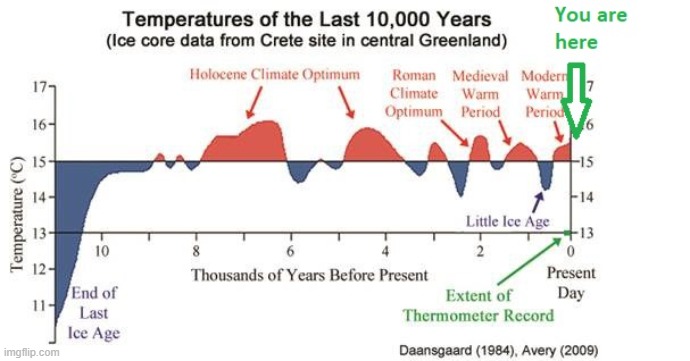
If the Modern Warm Period lasts a total of 4 to 6 centuries like the past few warming periods (graph below), then we have 2 to 4 more centuries of warming. It might be time to think of a future Alaska and Canada separated from Russia not by a bunch of ice, but by a relatively small Arctic Ocean (map below). Just like we're glad today in 2026 that we purchased Alaska from Russia in 1867, we might wish in the near future that action was taken today to create a buffer between us and Russia where the frozen north pole is now.

That is 100% correct. I and many others here on FR believe the climate changes according to Milankovitch cycles. And with the Modern Warm Period in mind, forward thinking about an ever melting Artic might ought to include more of Trump's strategy for things like Greenland.
If the Modern Warm Period lasts a total of 4 to 6 centuries like the past few warming periods (graph below), then we have 2 to 4 more centuries of warming. It might be time to think of a future Alaska and Canada separated from Russia not by a bunch of ice, but by a relatively small Arctic Ocean (map below). Just like we're glad today in 2026 that we purchased Alaska from Russia in 1867, we might wish in the near future that action was taken today to create a buffer between us and Russia where the frozen north pole is now.
Disclaimer: Opinions posted on Free Republic are those of the individual posters and do not necessarily represent the opinion of Free Republic or its management. All materials posted herein are protected by copyright law and the exemption for fair use of copyrighted works.