Posted on 10/09/2026 11:05:00 AM PDT by E. Pluribus Unum
About 40 million people rely on the Colorado River. But an extended drought and a century-old legal framework have pushed the system to a breaking point. Now, a federal plan threatening deep cuts has ignited a political and legal war across the Southwest.
Watch Arizona State University water law professor Rhett Larson break down where the government’s framework falls short, why easy fixes won’t solve the issue, and what structural overhauls are needed to protect a crucial regional economy.
(Excerpt) Read more at wsj.com ...
Dear FRiends,
We need your continuing support to keep FR funded. Your donations are our sole source of funding. No sugar daddies, no advertisers, no paid memberships, no commercial sales, no gimmicks, no tax subsidies. No spam, no pop-ups, no ad trackers.
If you enjoy using FR and agree it's a worthwhile endeavor, please consider making a contribution today:
Click here: to donate by Credit Card
Or here: to donate by PayPal
Or by mail to: Free Republic, LLC - PO Box 9771 - Fresno, CA 93794
Thank you very much and God bless you,
Jim
The Wall Street Journal examines how a century-old error in estimating the Colorado River’s water supply helped create today’s water crisis, threatening the water security of roughly 40 million people across the American West and Mexico.
In 1922, seven U.S. states negotiated the Colorado River Compact, dividing the river’s water between two regions:
Upper Basin: Colorado, New Mexico, Utah and Wyoming — allocated 7.5 million acre-feet annually.
Lower Basin: Arizona, California and Nevada — allocated another 7.5 million acre-feet annually.
A 1944 treaty also allocated 1.5 million acre-feet annually to Mexico.
The fundamental problem was that negotiators based their allocations on unusually wet years, when the river carried historically high volumes of water. They committed more water than the river could reliably supply.
According to water law professor Rhett Larson of Arizona State University, the river’s long-term average flow is closer to 13.5 million acre-feet annually , rather than the 15 million allocated to the two U.S. basins alone. Climate change and increasing aridification could reduce available supplies further, potentially toward 10 million acre-feet annually.
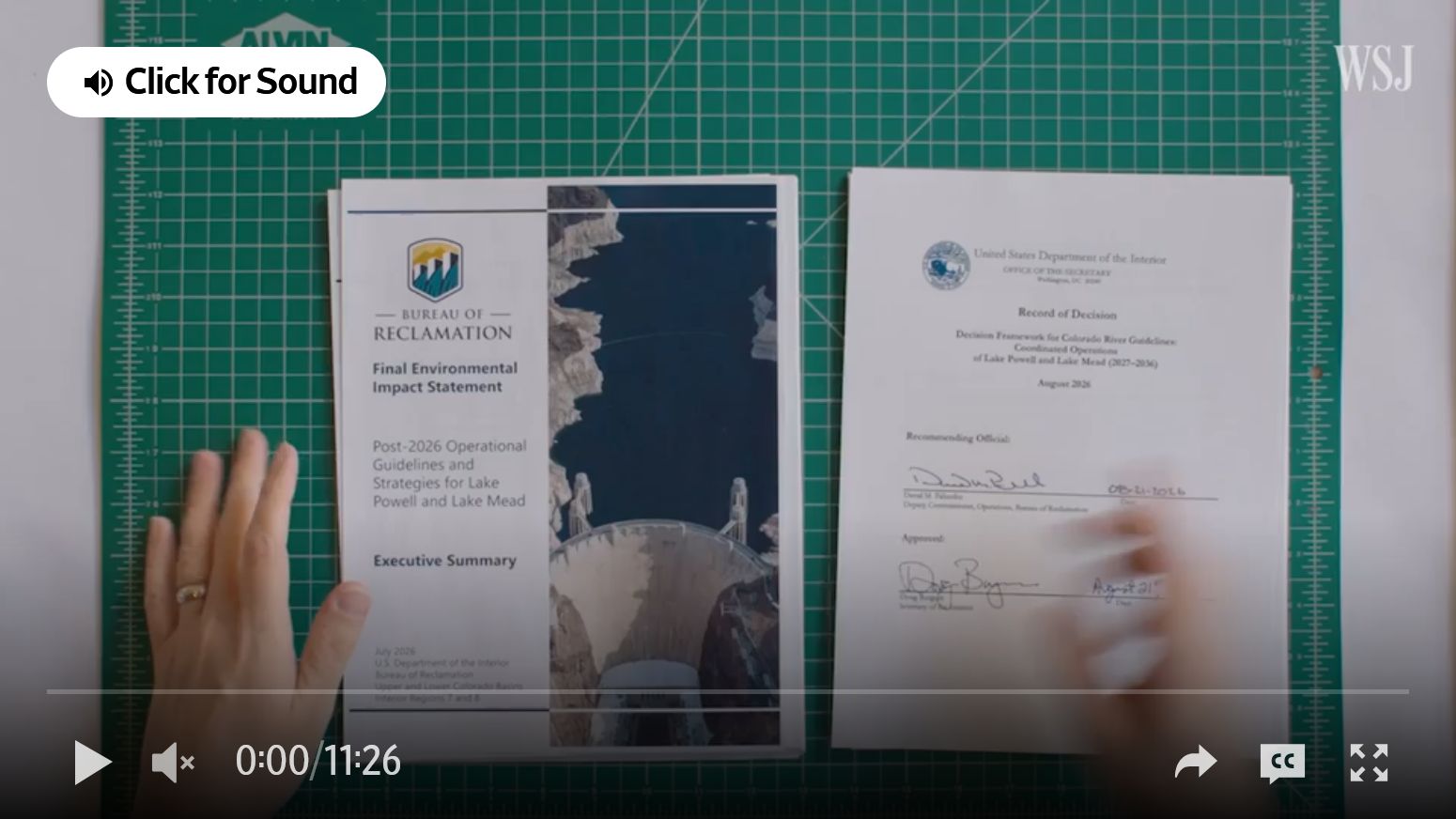
After years of failed negotiations among the states, the federal government proposed a new framework for managing the river over the next decade.
The proposal could impose anything from no cuts to the Lower Basin to reductions of as much as 3 million acre-feet annually.
The central controversy is that the proposal does not require corresponding reductions from the Upper Basin. This creates an imbalance: the Lower Basin faces potentially devastating cuts, while the Upper Basin has less incentive to agree to a compromise.
Nevada has already filed a lawsuit challenging the proposed approach, and further litigation is expected. The resulting legal battles could delay a lasting agreement while water supplies continue to deteriorate.
If another below-average winter occurs, reservoir levels could fall toward critical thresholds. At power pool , dams can no longer generate electricity normally; at dead pool , water can no longer flow downstream through a dam.
The documentary examines several ways to supplement the river's shrinking supply.
Desalination: Can turn seawater into usable water, but remains expensive.
Cloud seeding: May increase precipitation under suitable conditions, but questions remain about its effectiveness, environmental impacts and who owns the resulting water.
Water recycling: Advanced purification can make wastewater potable, but treatment costs and public resistance remain obstacles.
Groundwater pumping: Can help communities manage shortages, but many aquifers are already being depleted faster than they replenish.
Larson's central economic observation is that the United States is not necessarily running out of water in an absolute sense. It is running out of cheap, accessible water . Obtaining, transporting and treating water from alternative sources will become increasingly expensive, putting upward pressure on water bills.
The documentary identifies irrigated agriculture as the dominant consumer of Colorado River water, accounting for approximately 75% of the water used when evaporation and other natural losses are excluded from the accounting.
Municipal and industrial users account for much of the remainder.
Consequently, reducing agricultural consumption could free up substantially more water than focusing primarily on highly publicized industrial users such as data centers.
One proposed approach is to retire especially water-intensive crops, including alfalfa and hay. However, this would impose serious costs on agricultural communities, potentially reducing farm income, employment and local tax revenue. Consumers could also face higher grocery prices.
The documentary argues that federal assistance would be essential to make such transitions economically viable, including conservation grants, rebates, loans and investment in additional water supplies.
The documentary highlights Australia's experience managing the Murray-Darling Basin during its early-2000s drought.
Australia shifted toward a system in which water users held shares of the available supply, with those shares tradable in a market. Such a system can adjust allocations to the amount of water actually available rather than relying solely on fixed quantities established under older agreements.
A comparable system could help the Colorado River states adapt to changing water supplies.
However, the approach carries risks. Investors could buy up water rights and hoard them or speculate on scarcity. Any water market would therefore require safeguards to prevent manipulation and protect essential users.
The Central Arizona Project (CAP) operates a 336-mile canal supplying water to more than 6 million people. It has been essential to Arizona's growth and economy.
Because CAP water has a relatively junior priority under the existing allocation system, it is especially vulnerable to substantial cuts. Arizona has already made both mandatory and voluntary reductions and closely monitors snowpack, reservoirs and incoming water supplies.
Further reductions could threaten communities and industries that depend on the canal. Although Arizona has diversified its water sources, officials warn that this cannot indefinitely compensate for major, sustained losses of Colorado River water.
The Colorado River crisis stems from a fundamental mismatch between the water promised under a century-old allocation system and the amount the river can reliably provide today. Climate change and prolonged drought are making that mismatch worse.
The documentary's proposed path forward involves several difficult choices: renegotiating allocations, reducing agricultural water consumption, investing in alternative supplies, providing federal financial assistance and potentially creating a regulated market for water rights.
There is no cost-free solution. Preserving the river system will require deciding who receives less water, who pays for conservation and infrastructure, and how the economic consequences are shared. Without a negotiated agreement, the combination of dwindling supplies, legal disputes and declining reservoir levels could turn an existing shortage into a much broader regional crisis.
bfl
Climate change and prolonged drought are making that mismatch worse.“
Well the so called Climate change is a bunch of BS so there is that
How many millions of illegal immigrants are using up water in the dry area of the Colorado River basin? That’s clearly part of the math.
They even said earlier in the documentary that the mistake was using the water volume from an unusually high year.
No mention of the fact that human populations using the water, exploded in number over the last century. Not to mention increased use of agricultural and industrial use by increased numbers of humans. The Climate change argument takes a back seat to the other lies.
So, like many times in the last 175 years, faulty thinking by supposed expert GOVERNMENT PLANNERS I so flawed as to create disasters they were meant of totally avoid.
Millions of tons of wastewater is treated and dumped into oceans and rivers. Sewage wastewater from millions of humans should be recaptured via purification. Billions of dollars are spent on redirecting water over thousands of miles, so money really is not the issue. It is how it is managed.
Good video. Thanks for posting.
One thing the professor said is that the Upper Colorado River Basin does not use all of its allocated water. Then, logically, that water flows south. Does law require it flow to Mexico and the Gulf of California untouched? He did not explain what happens to their allocated share that they do not use today.
“Well the so called Climate change is a bunch of BS so there is that”
Uh the climate in the South West does change on a multi decade and century scale cycles with droughts and mega droughts lasting for upwards of a century. The tree rings and paleoflow and sedimentary deposits all confirm this. The El Nino cycles drastically affect it as does the solar magnetic cycle , sun spot cycle and the earth’s orbital precession and axis tilt plus elliptical orbit distances too.
This current cycle is dry much drier than the 1920d when the compact was made and if the history pattern is right we have half a century more of 11-10 million AF per year vs 14-15. Humans in suvs didn’t cause it but from a real water numbers and use that’s irrelevant what is relevant is there is and will be less water coming down on avg for a generation longer maybe 2 again if we repeated the last pattern.
So the talk needs to be how do you get by on less water that’s just fact.
Climate change is real the cause of it is not man
Lawns... Las Vegas
All urban use by residential, industrial and commercial is only 25% of total basin water use. Residential is half of that so 12.5% figure 4:1 legals to illegals so 3 ish percent almost a rounding error even being generous with the 25% of every person in the Colorado basin that’s 10 million illegals alone.
Agriculture is the issue, specifically growing crops like alfalfa that demand FIVE FEET of water per square-foot of land area per year. Clearly that is not sustainable.
We have plenty of rain east of 100W to grow grass for cows with.
Sigh
All of Nevada gets 300,000AF of water and they use less than their total amount every year and recycle 98% of every drop that hits a drain in the Vegas basin.
California takes 4.4 million acre feet and 80% of that goes to grow grass for cows in the desert or almonds for soyboy milk.
AZ takes 3.9 million
Tell the class again how 300k is the problem when they don’t even take it all.
The problem is not a math miscalculation, but false assumptions about the nature of reality.
The original estimators assumed the flow of the river would not change. In the 1920’s, there was far less use of the river, so it likely seemed not to make a difference.
In our rapidly changing world, it is an easy mistake to make.
It lasted over 100 years. All the people involved are dead.

That's the crux of the problem. The negotiated totals were unfeasible from the beginning.
They're all guilty. I just pointed out that water for lawns in a desert is an extreme use of water.


The Australian solution seems a reasonable way to allocate the water. It does not assume an absolute supply number, and allows trading so water can go to the highest/best use through market forces.
The United States government, the states involved, and Mexico all have to be involved in the negotiations.
Disclaimer: Opinions posted on Free Republic are those of the individual posters and do not necessarily represent the opinion of Free Republic or its management. All materials posted herein are protected by copyright law and the exemption for fair use of copyrighted works.