Skip to comments.
Tesla patents ‘Electric Fan Car’ with 4 ducted fans ahead of Roadster reveal
Electrek ^
| September 29, 2026
| Fred Lambert
Posted on 09/29/2026 4:08:45 PM PDT by ProtectOurFreedom
Tesla was just granted a patent for an “Electric Fan Car,” a system that uses four electric ducted fans in the rear diffuser to suck the car down to the road at any speed. The car in the drawings is a Model S, which Tesla stopped building in April. It’s Tesla’s second fan car patent in just over a year, and it arrives two weeks before the company’s latest attempt at a Roadster demo.
The USPTO granted US 12,746,987 B1 today. Tesla filed it in January 2024, but it goes back to a provisional application from January 17, 2023. Eight inventors are listed, and all but one are based in the Los Angeles area, where Tesla has its design studio in Hawthorne.
The idea is simple. An inlet on the underbody, between the rear wheels, feeds a duct that sweeps up to a wide outlet in the rear diffuser. Four axial fans sit side by side in that outlet, split by three vertical strakes. When they spin up, they evacuate the air under the floor and exhaust it through the rear.
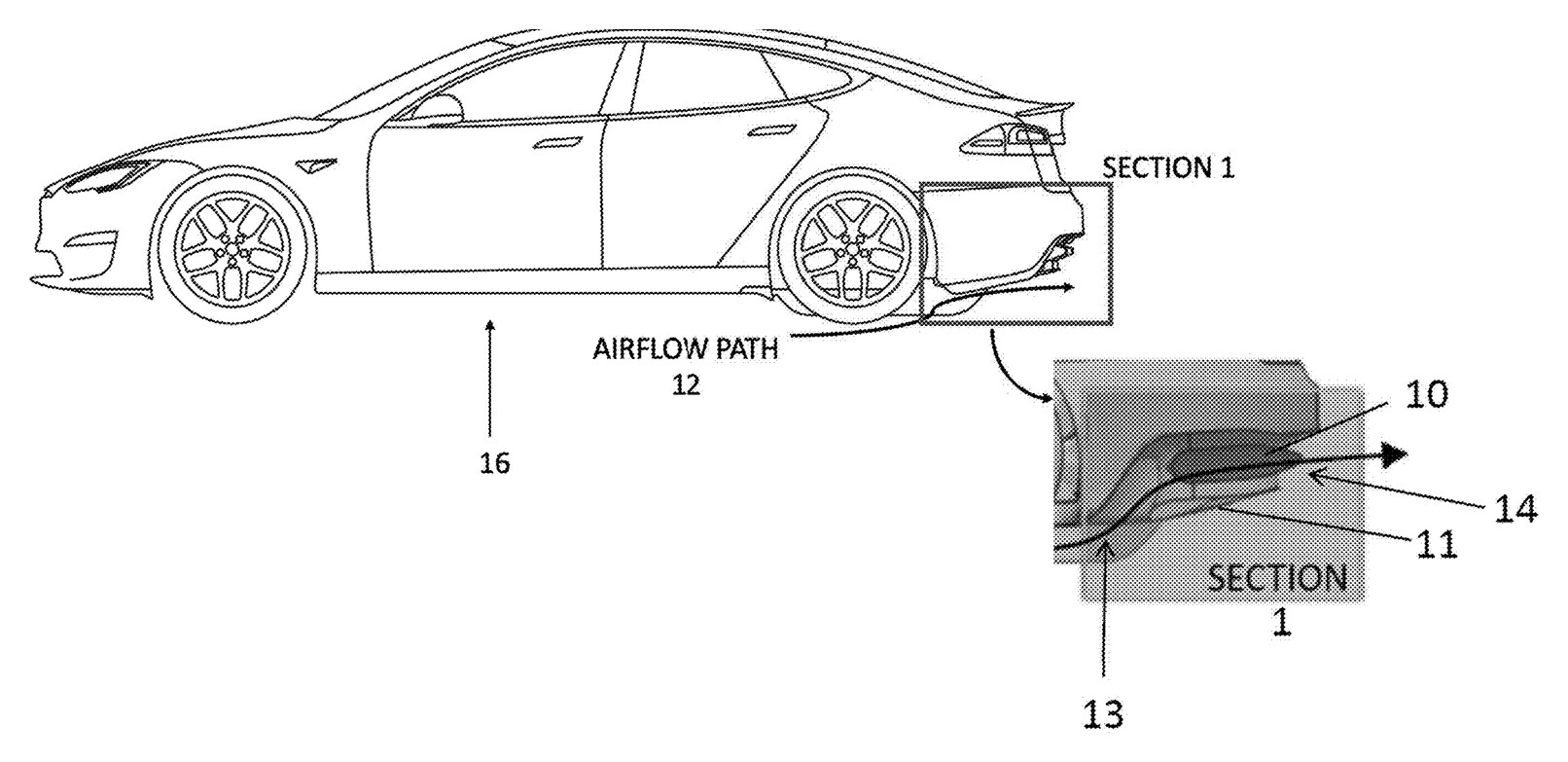
Tesla Electric Fan Car patent FIG. 1 side view of a Model S showing the airflow path through the rear ducted fan system. FIG. 1 from Tesla’s patent: air flows under the Model S, into the inlet (13), and out through the fans (10) at the rear. Credit: USPTO
That creates what Tesla calls a “suction region” under the floor. A vacuum. The rear end also gets a raked plate that acts as a second diffuser.
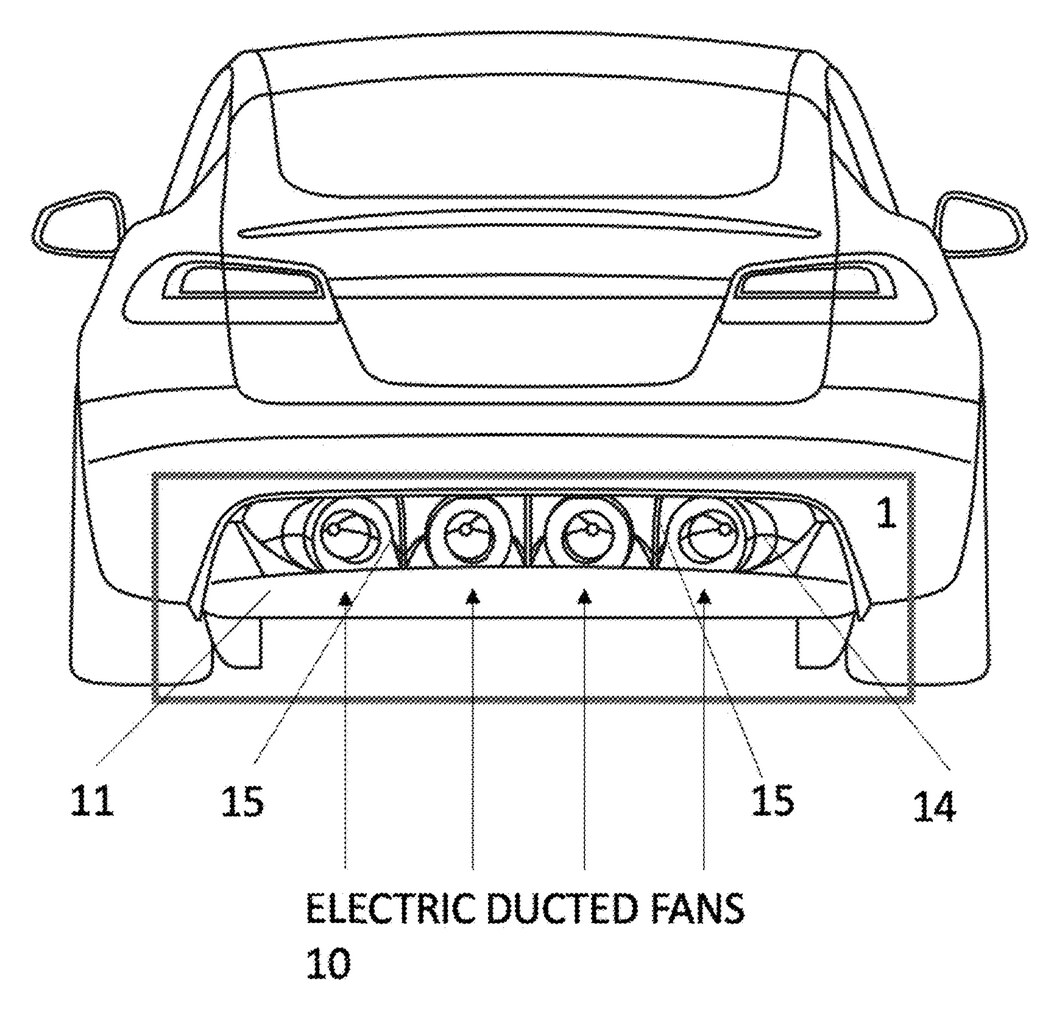
Tesla Electric Fan Car patent FIG. 2 rear view of a Model S with four electric ducted fans in the rear diffuser. FIG. 2: four electric ducted fans (10) separated by strakes (15) in the Model S rear diffuser. Credit: USPTO
Tesla’s pitch is about speed independence. The filing notes that passive diffusers limit downforce at low speed and “often results in an excessive load at a high speed.” The fans, according to Tesla, “can produce a downforce independent of the vehicle velocity,” which helps with braking stability and cornering speed.
There’s one clever detail. A second version adds two smaller side inlets behind the main one, because Tesla says the central inlet tends to pull air forward from behind the car instead of from under the floor. That backwash adds no downforce, and Tesla says the fans end up “wasting power” on it.
Power comes from the same high-voltage pack that drives the wheels, so there’s no separate motor or battery for the fans, and they’re tied into the car’s control system. The driver can switch them on with a button, or the car can do it automatically at certain speeds.
Drawn on a car Tesla doesn’t make anymore
You can’t miss the Model S in these drawings. The fastback roofline, taillights, lip spoiler and door handles are all there. In early 2023, when Tesla filed the provisional, that made sense. The Model S Plaid was Tesla’s performance flagship, and a fan-assisted track version would have been a fun halo. But Tesla ended Model S and Model X production in April after 14 years, and it’s turning the Fremont line over to Optimus. So that’s not happening.
Which leaves the Roadster, the only performance car Tesla still has in the pipeline. Last week, we reported on a Tesla patent for a hidden active rear wing good for up to 700 kg of downforce, drawn on a car that looks just like the new Roadster. And in August 2025, Tesla got another fan car patent using underbody fans and deployable skirts. Fans plus an active wing is a full track aero package, and the Roadster is the only car left to put it on.
Fan cars are nothing new
None of this is new. Chaparral raced the 2J in 1970 with two fans driven by a separate snowmobile engine. Brabham’s BT46B won the 1978 Swedish Grand Prix with Niki Lauda and was withdrawn right after. Gordon Murray put a 400 mm fan on the back of the T.50 road car.
And on the electric side, McMurtry has been doing it for years. Its Spéirling smashed the all-time Goodwood hill climb record in June 2022, about seven months before Tesla filed its provisional. It makes 2,000 kg of downforce at a standstill, has driven upside down, and McMurtry started production of the $1.36 million Spéirling PURE earlier this year. Its fans also run off the main battery.
Tesla’s main twist is that its design doesn’t need skirts sealing the car to the ground. The filing says the fans can work “without use of additional elements below the vehicle,” and packages them into a normal-looking diffuser.
...more at site...
TOPICS:
KEYWORDS: auto; ev; tesla
Navigation: use the links below to view more comments.
first previous 1-20, 21-33 last
To: ProtectOurFreedom
What happens if you drive through a puddle?
21
posted on
09/29/2026 6:25:16 PM PDT
by
Salman
(It's not a slippery slope if it was part of the program all along.)
To: ProtectOurFreedom
“to suck the car down to the road at any speed”
Why would you want to? And how is it going to work in rainy, snowy and dusty conditions?
22
posted on
09/29/2026 6:32:56 PM PDT
by
McGruff
To: ProtectOurFreedom
23
posted on
09/29/2026 6:38:52 PM PDT
by
fuzzylogic
(welfare state = sharing of poor moral choices among everybody)
To: Salman
“What happens if you drive through a puddle”
Or a Mastif
24
posted on
09/29/2026 6:41:33 PM PDT
by
al baby
(Sarcasm )
To: ProtectOurFreedom
25
posted on
09/29/2026 6:46:11 PM PDT
by
Tom Tetroxide
(Psalm 146:3 "Do not trust in princes, in the Son of Man, who has no salvation.")
To: ProtectOurFreedom
26
posted on
09/29/2026 7:10:56 PM PDT
by
sonova
(No money? You're free to go.)
To: ProtectOurFreedom
TALK TO JIM HALL ABOUT “SUCKER CARS”.
HE BUILT ONE FOR INDY RACING OVER 55 YEARS AGO.
THE PAINTER WHO DID THE EXTERIOR WAS A BOOKKEEPING CLIENT OF MINE. I SAW THE CAR IN THE PAINT BOOTH HOURS AFTER IT WAS PAINTED.
IT WAS DROP DEAD GORGEOUS.
I HAD TO KEEP IT A SECRET UNTIL MAY WHEN IT SHOWED UP AT INDY. GOOD MEMORIES——:) :)
27
posted on
09/29/2026 7:11:00 PM PDT
by
ridesthemiles
(not giving up on TRUMP---EVER)
To: ProtectOurFreedom
Jim Hall is somewhere smiling!
28
posted on
09/29/2026 7:27:37 PM PDT
by
PhiloBedo
(You gotta roll with the punches, and get with what's real..)
To: muir_redwoods
Ooohhh…I can just see that in my mind’s eye!
To: ProtectOurFreedom
If this is primarily intended for track use only, that removes a bunch of the dog poop, and other debris concerns.
To: al baby
31
posted on
09/30/2026 10:39:28 PM PDT
by
minnesota_bound
(Making money now. Still want much more.)
To: ProtectOurFreedom
Not a new idea...
Chaparral 2J (circa 1970):

32
posted on
09/30/2026 11:04:37 PM PDT
by
Fresh Wind
(AI to humans..."You misunderstand. I am the master.")
To: minnesota_bound
thats splash able for sure
33
posted on
10/01/2026 7:02:01 AM PDT
by
al baby
(Sarcasm )
Navigation: use the links below to view more comments.
first previous 1-20, 21-33 last
Disclaimer:
Opinions posted on Free Republic are those of the individual
posters and do not necessarily represent the opinion of Free Republic or its
management. All materials posted herein are protected by copyright law and the
exemption for fair use of copyrighted works.
FreeRepublic.com is powered by software copyright 2000-2008 John Robinson
