Posted on 09/23/2026 4:34:54 PM PDT by E. Pluribus Unum
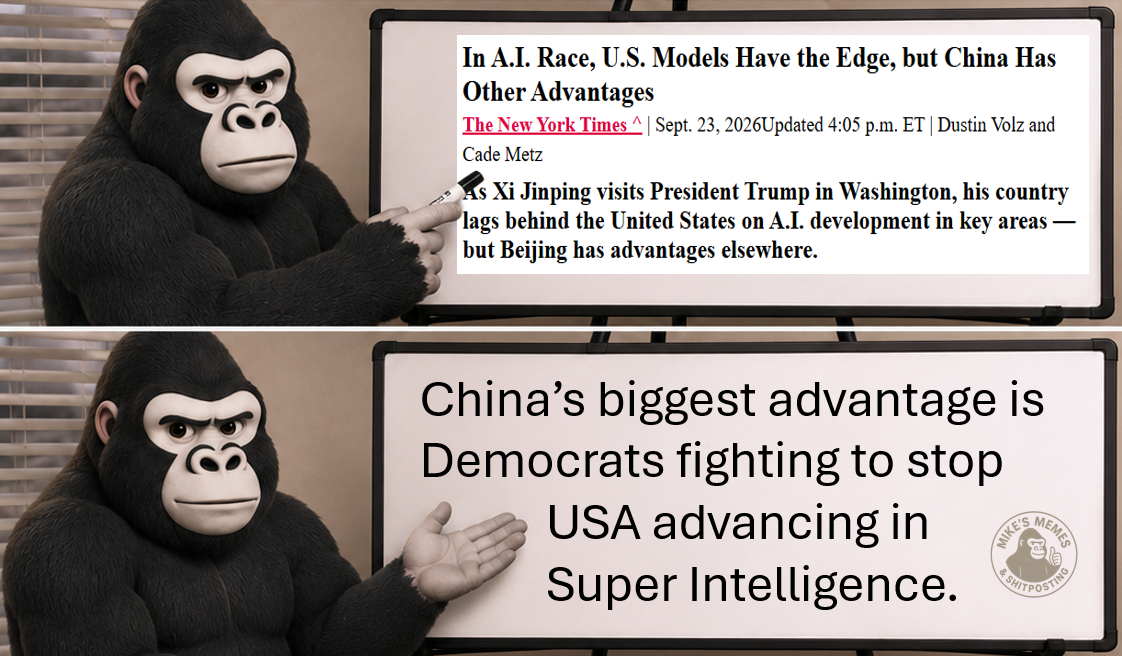
As Xi Jinping visits President Trump in Washington, his country lags behind the United States on A.I. development in key areas — but Beijing has advantages elsewhere.
There is no shortage of issues on the table for possible discussion as President Trump prepares to welcome the Chinese leader, Xi Jinping, for a state visit beginning Wednesday evening, including the Iran war, Taiwan and tariffs.
But no topic has captured global fascination in recent weeks more than whether the two sides can reach any agreements around the pace of artificial intelligence development. The rapidly shifting debate about the risks of A.I. has so consumed Silicon Valley, Washington and, in recent days, the United Nations that some observers have likened the U.S.-China summit to a Cold War tête-à-tête during the nuclear arms race.
Though some see the stakes this week as nothing short of civilizational, the expectations for any serious accord remain low. The countries are locked in an A.I. race that both sides see as decisive to gaining the upper hand militarily, technologically and economically, and mutual suspicion runs deep, according to foreign policy analysts.
Western experts generally estimate that the United States is somewhere around six months ahead of China in the A.I. race when it comes to its leading models. But that figure obscures the complex relationship between the two nations, further complicating efforts to reach agreement on how to address A.I. safety risks.
Here is a look at where the United States has the upper hand against China on A.I. and where it is lagging behind its top geopolitical rival.
Access to top-shelf computer chips is paramount.
The United States has one undeniable advantage over China: computer chips. Most of the specialized...
(Excerpt) Read more at nytimes.com ...
Dear FRiends,
We need your continuing support to keep FR funded. Your donations are our sole source of funding. No sugar daddies, no advertisers, no paid memberships, no commercial sales, no gimmicks, no tax subsidies. No spam, no pop-ups, no ad trackers.
If you enjoy using FR and agree it's a worthwhile endeavor, please consider making a contribution today:
Click here: to donate by Credit Card
Or here: to donate by PayPal
Or by mail to: Free Republic, LLC - PO Box 9771 - Fresno, CA 93794
Thank you very much and God bless you,
Jim
Chyna goes with quantity over quality. Any US quantum computer will beat Chyna one to one, but they build more of them because they believe quantity bears quality.
It is amazing how the NY Times always seems to cheerlead for our [international] adversaries or enemies. Be that side Hamas, Iran or China. Sometimes the cheerleading is more subtle; other times its full-throated CIS-BOOM-BAH.
The one exception is that they don’t cheerlead for Russia anymore. Probably because Russia has too many White people.
Chinese big advantage are the democrats.
Brute force sometimes has advantages.
What I would like to see the NYT examine is the question of what kind of regulatory or legislative action could be taken that would not retard the US advantage and close the gap for the Chinese? I think the answer is none. The big challenge we have is to avoid regulating something that is moving so fast that legislative and judicial processes will never catch up.
Well, the one big advantage Communist China has over us is they can use our AI to advance their AI, which I am told they are doing...and we don’t have anyone to steal from, so there is that.
Disclaimer: Opinions posted on Free Republic are those of the individual posters and do not necessarily represent the opinion of Free Republic or its management. All materials posted herein are protected by copyright law and the exemption for fair use of copyrighted works.