The all consuming interest on the national debt.
Every year our budget deficit requires more and more borrowing.
Every year recently fewer and fewer countries are willing to buy US securities.
Recently the cost of borrowing has risen for the US.
Default is looking more likely all the time.
Hyper inflation is certainly a possibility.
Every country that has ever used fiat currency eventually fails."
I understand that and agree, up to a point, but consider:
- For starters, let's remember, every government in history eventually failed.
- No great nation/republic/empire ever lasted forever.
- On average, large empires last around 300 years, though a few last much longer while others are relative flashes in the pan.
- Governments come & go -- when they fail & bankrupt their countries they get overthrown by revolution or invasion.
- That's why many truly ancient civilizations have very recent governments -- China comes to mind: thousands of years old, but governed by the CCP only since 1948.
The list of current governments older than the US is quite short:
- San Marino (in Italy) since 301 AD
- Iceland's Althing parliament since 930 AD
- England/Britain's parliamentary-monarchical system since 1689
- USA since 1776.
World of Empires, circa 1900:
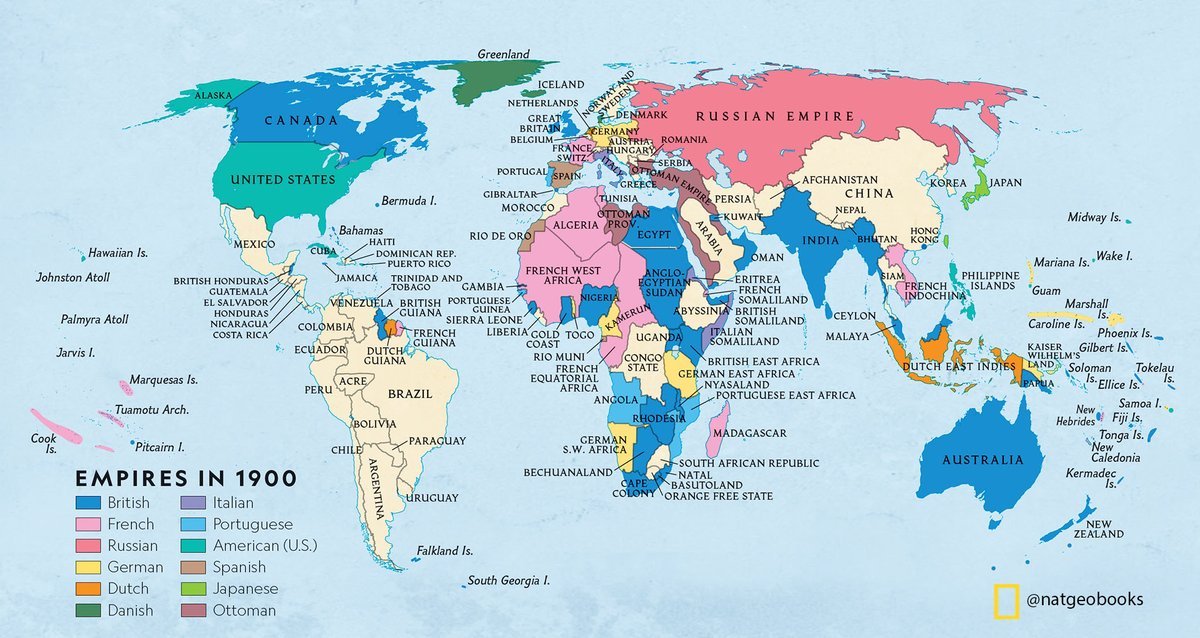
- The largest empire in history brought down by, arguably, financial collapse after two catastrophic world wars.
- Those wars, and the resulting decolonization, eliminated a dozen other large empires including:
- French,
- German,
- Russian,
- Ottoman,
- Austro-Hungarian,
- Japanese,
- Italian,
- Dutch,
- Belgian,
- Others post war
- Britain is the only empire whose government survived uninterrupted.
- Today both the US and UK have run up their national debts from under 50% of GDP before 2000 to now over 100%.
- Those numbers were equally high for the US after the Revolutionary War, for the UK after the Napoleonic Wars and for both after WWII.
Such levels are temporarily tolerable, if major efforts are made to control and reduce them, but that does not seem to be the case today. - Even Sec. Scott Bessent's 3-3-3 plan (3% GDP growth, 3% deficit/GDP and 3 million new barrels of oil/day produced) will only marginally improve things.
100%+ national debt/GDP ratios -- like the US, UK and several other major economies now carry -- are 100% manageable and reducible, if and only if:
- Economic and productivity growth reaches the levels Pres. Trump has set as goals to achieve, i.e., Bessent's 3-3-3 goals,
- Trump's $18 trillion in promised foreign investments arrive as promised,
- 2% inflation, low unemployment and high labor participation rates become normal.
In short: US national debt is manageable & reducible, so long as the economy does well.