Posted on 07/01/2026 5:36:13 AM PDT by ShadowAce
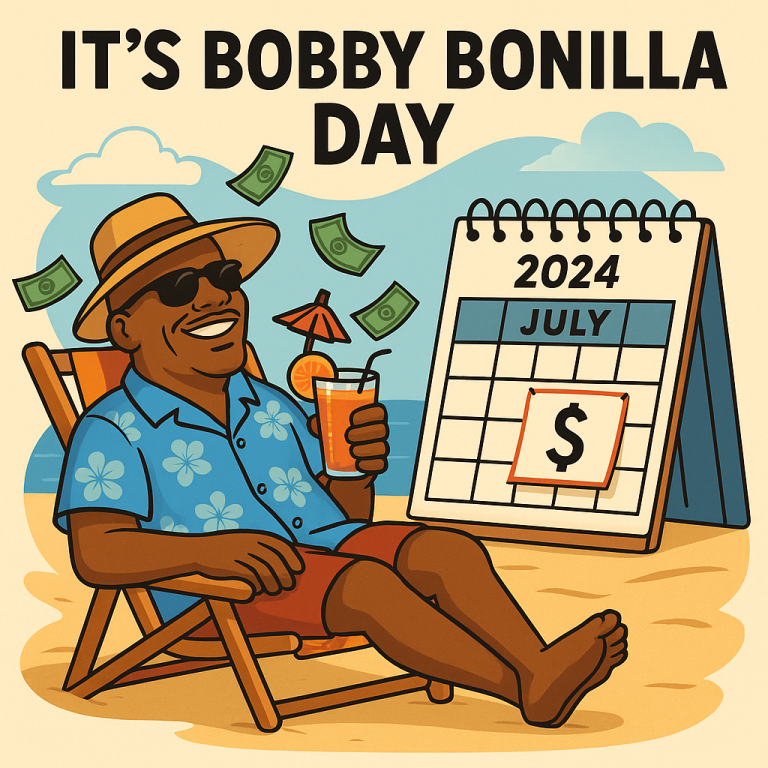
It's July 1, and that means it's time for Mets fans everywhere to wish each other a Happy Bobby Bonilla Day! Why? On Wednesday, 63-year-old Bobby Bonilla will receive a check for $1,193,248.20 from the New York Mets, as he has and will every July 1 from 2011 through 2035.
Because of baseball's unique salary structure, Bonilla's annual payday is often more than some of the game's current young stars will make in a given year.
The Mets are certainly not alone in handing out deferred payments to star players long after they last suited up for the team, with past MVPs and Cy Young winners among the notable names still collecting annual paychecks from their previous employers.
In recent MLB offseasons, deferred money became an even bigger talking point with the Los Angeles Dodgers frequently opting for the structure, highlighted by a deal with Shohei Ohtani that will delay payments for $680 million of his $700 million megadeal. He'll start receiving $68 million per year in 2034.
Here is what you need to know about Bonilla's payday, deferred money in baseball and the current players making less for the 2026 season than Bobby Bo will receive from the Mets.
In 2000, the Mets agreed to buy out the remaining $5.9 million on Bonilla's contract.
However, instead of paying Bonilla the $5.9 million at the time, the Mets agreed to make annual payments of nearly $1.2 million for 25 years starting July 1, 2011, including a negotiated 8% interest.
At the time, Mets ownership was invested in a Bernie Madoff account that promised double-digit returns, and the Mets were poised to make a significant profit if the Madoff account delivered -- but that did not work out.
Under new owner Steve Cohen, who mentioned the possibility of celebrating Bonilla at Citi Field annually soon after taking over the team, the Mets have embraced Bonilla's day.
Bonilla last played for the Mets in 1999 and last played in the majors for the Cardinals in 2001, but he will be paid through 2035 (when he'll be 72).
Here are some other notable deferred-money contracts, courtesy of ESPN Research:
• Bobby Bonilla (again): A second deferred-contract plan with the Mets and Orioles pays him $500,000 a year for 25 years. Those payments began in 2004.
• Bret Saberhagen: Will receive $250,000 a year from the Mets for 25 years (payments also began in 2004; this was the inspiration for Bonilla's deal).
As trade season starts up, here are the big names who could move -- and the teams that could deal for them. Jeff Passan »
• Max Scherzer: Will receive $105 million total from the Nationals that will be paid out through 2028.
• Manny Ramírez: Will collect the final payment of $24.2 million total from the Red Sox through 2026.
• Chris Davis: Davis' arrangement with the Orioles might make him the new Bonilla, as he collects $59 million in deferred payments during a 15-year stretch that started last year and continues through 2037. Davis received $9.16 million in both 2024 and 2025 and now will collect $3.5 million from 2026 to 2032 and $1.4 million from 2033 to 2037.
The biggest difference in the two deferral-heavy deals is that Bonilla's came as the result of a buyout by the Mets for an underperforming veteran, whereas Ohtani's salary arrangement was proposed by a superstar at the height of his free agency.
In his unprecedented contract, Ohtani is being paid just $2 million annually during the 10-year length of his deal with the Dodgers. From 2034 to 2043, Ohtani will receive $68 million per year. The parameters of the arrangement allow the Dodgers more short-term flexibility while also lowering the team's competitive balance tax burden with only the present-day value ($46 million per year) of the contract counting toward L.A.'s CBT payroll.
Because baseball's salary structure has young players start their careers by earning just over half of Bonilla's annual $1.19 million, the following players will be making less than Bonilla this season (listed in order of 2026 Fangraphs WAR entering Tuesday's games):
Pete Crow-Armstrong: $894,000 (4.9 WAR)
Jacob Misiorowski: $788,300 (4.3 WAR)
Dillon Dingler: $834,900 (3.7 WAR)
Cam Schlittler: $801,425 (3.7 WAR)
Otto Lopez: $810,500 (3.6 WAR)
Kevin McGonigle: $780,000 (3.4 WAR)
JJ Wetherholt: $780,000 (3.4 WAR)
Nick Kurtz: $780,000 (3.3 WAR)
Miguel Vargas: $805,700 (3.2 WAR)
Figures from ESPN Research were used throughout this story.
And it allows Ohtani to get out of california when he gets his big payday.
Nice work if you can get it.
Talk about a pension plan.
The latest MLB Collective Bargaining Agreement (CBA) proposal for 2027 includes the elimination of deferred compensation.
https://www.mlb.com/news/mlb-cba-proposal-addresses-minimum-salary-free-agency
The latest MLB Collective Bargaining Agreement (CBA) proposal for 2027 includes the elimination of deferred compensation.
If they insist on that, there’s going to be a strike.
I am not sure how this works. Does his MLB pension start after his lass Mets payout or is he collecting his MLB pension in addition to his Mets payment?
So, it was “invest your salary with us and Bernie Madoff” except the Mets organization has to pay up.
This is the part where I laughed out loud:
“At the time of the Bonilla deal, Mets ownership was invested in a “Bernie
Madoff account promising double-digit returns”...... but that did not work out.
Bonds & Bonilla = Killer Bees, quite a combo back in the day for Pittsburg.
As a Cubs fan who grew up hating the Mets almost as much as the Cardinals — but having several Mets fan friends, I send them all a e-card every July 1 ;-)
That said, as someone who enjoys talking finance? I think it’s a fascinating thing. First, the 1.9m is couch cushion change to Cohen or the Mets specifically. It does NOT count towards the “competitive balance” tax/salary threshold.
From the Bonilla side? Well, properly investing the salary when earned - he’d make a lot more. But of course, most pro athletes are TERRIBLE with money. If Bonilla recognized that? Something like this actually wasn’t a terrible idea. He still gets a nifty annual payday - and it’s large enough (and long enough) he could still build substantial wealth with it. And of course - living on 1.9m (figure closer to 1m after the tax man gets his greedy paws on it) still leads to a fabulous lifestyle.
Honestly, the best course is learn some discipline and at minimum, find a trusted advisor to handle your money. However, if he/his agent recognized that wasn’t going to happen? It’s not a terrible idea. Sub-optimal in the grand scheme, but probably upper quartile amongst his peers.
Still, time to send the e-cards wishing my Mets fan friends well today ;-). Even though it’s kind of mean this year, given the Mets’ struggles.
He still gets his pension — not sure when he claimed but he easily eclipsed the 10 year max ceiling. If he claimed as soon as he could (I think age 45 is the minimum), he’d get another $100k from his pension. If he waited until 62 - max date, he’s getting $290k.
Nice work, if you can get it.
Former MLB pitcher Jacob Turner has an interesting Youtube channel. He was the 9th overall draft pick in 2009 out of high school and pitched for 7 seasons in the majors. He played in Korea for one season in 2019 and then retired.
He then co-founded a wealth management company called “Moment Private Wealth” that focuses on fiduciary financial advisory services for athletes, entertainers, and high-net-worth individuals. He is a Certified Financial Planner (CFP) and holds his Series 65 license.
On his Youtube channel, he talks about pro athlete contracts, retirement plans, disabilty plans, benefits, and common financial pitfalls.
https://www.youtube.com/@TheJacobTurner
Ok.
It is just like at my work. I have x percentage of my paycheck going into a fund. The percentage can be changed anytime. I will get this money in addition to my regular retirement pension from my employer. My retirement pension from my employer is funded by my employer and me. I contribute to two retirement plans. For some reason I wasn’t thinking about this and I am not sure how other places handle retirement. Very early where I am and I had little sleep.
“And it allows Ohtani to get out of california”
Who cares? He won’t even learn to speak English.
What a disgrace
Idiots
LMAO. Yes that makes him a disgrace. He can hire a translator to be with him 24x7 if he wants.
6.7% is a pretty decent return if guaranteed but agreed, there would be a potential for a lot more. I might go ahead with the 6.7% and just coast.
He can take a class I’m not arguing this. This article is about how much these guys are making
They can take a class
The Dominican Republic guys can speak English
I speak German- I lived in Germany
My friend’s kid just got back from a year in China. She speaks Chinese.
This creep can be an example and speak English for all his millions he makes in the US
Creep
Disclaimer: Opinions posted on Free Republic are those of the individual posters and do not necessarily represent the opinion of Free Republic or its management. All materials posted herein are protected by copyright law and the exemption for fair use of copyrighted works.