Posted on 05/16/2026 8:54:37 AM PDT by MtnClimber
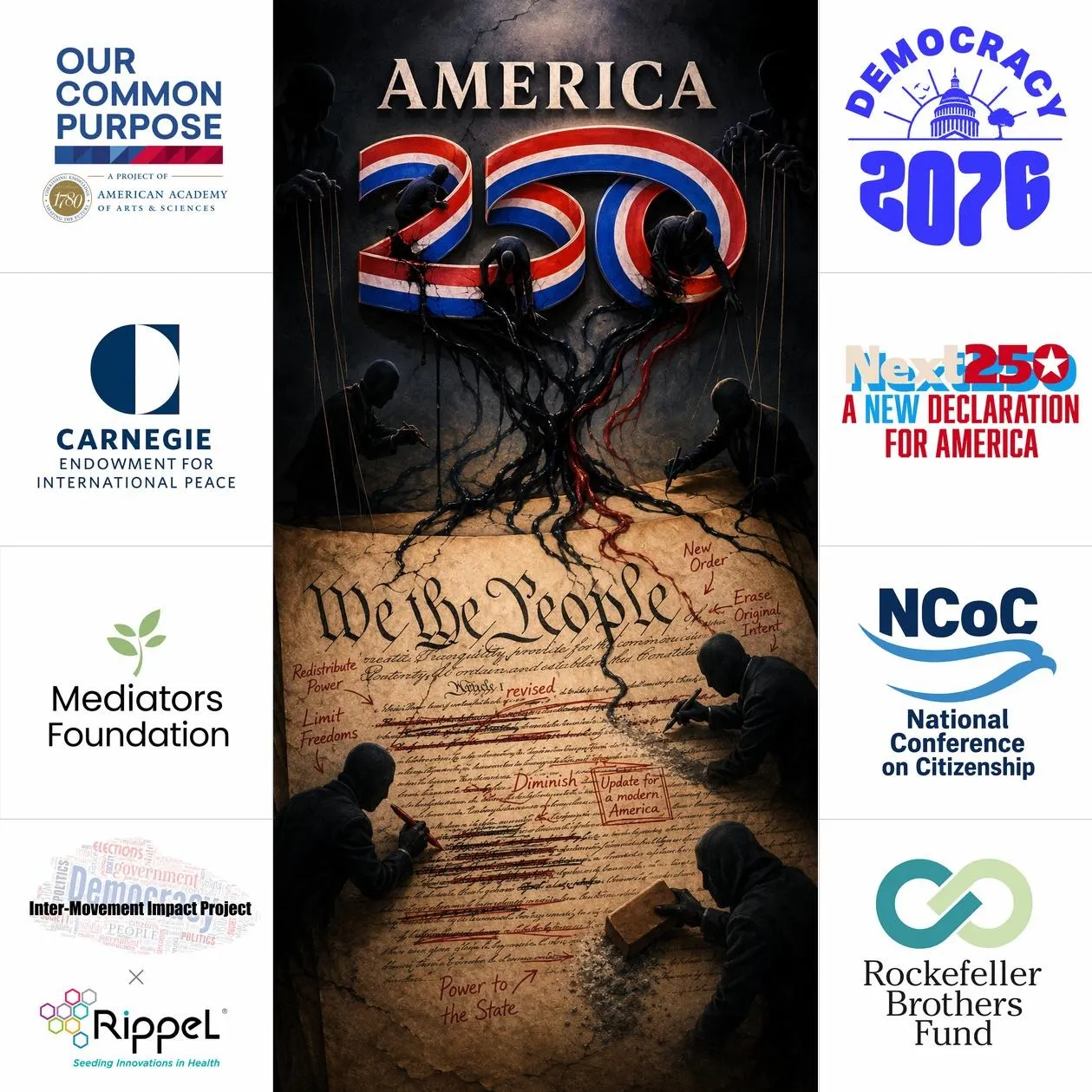
Inside the Foundation-Funded Blueprint to Restructure American Governance by the Nation's 250th Birthday.
The Oldest Learned Society
The American Academy of Arts and Sciences was founded in 1780 by John Adams and James Bowdoin. It holds a Massachusetts state charter granted by the Massachusetts General Court on May 4, 1780 — nine years before the Constitution was ratified. Its fellows have included Washington, Franklin, Einstein, Darwin, and almost every consequential American scientist and statesman for a quarter of a millennium.
It now houses a project to restructure American governance.
In the spring of 2018, a 93-year-old Republican billionaire named Stephen D. Bechtel Jr. asked the Academy a question. Bechtel — chairman of the Bechtel Corporation for thirty years, lifetime GOP donor, Hoover Institution chairman former — wanted to know what it means to be a good citizen in the twenty-first century. Jonathan Fanton, the Academy’s outgoing president, translated that question into a formal commission. Fanton — former president of the MacArthur Foundation (1999–2009), former chair of Human Rights Watch — used his final act as Academy president to launch it.
The commission’s own report foreword states the origin plainly:
“The Commission on the Practice of Democratic Citizenship was established in the spring of 2018 at the initiative of then Academy President Jonathan Fanton and Stephen D. Bechtel, Jr., Chair of the S. D. Bechtel, Jr. Foundation. Mr. Bechtel challenged the Academy to consider what it means to be a good citizen in the twenty-first century.”
They called it Our Common Purpose.
What came out was not a civics pamphlet. The commission produced 31 recommendations including proposed constitutional amendments, expansion of the U.S. House by at least fifty seats, eighteen-year term limits for Supreme Court justices, ranked-choice voting nationwide, and a universal expectation of national service. The question about good citizenship had become a structural blueprint for a different republic.
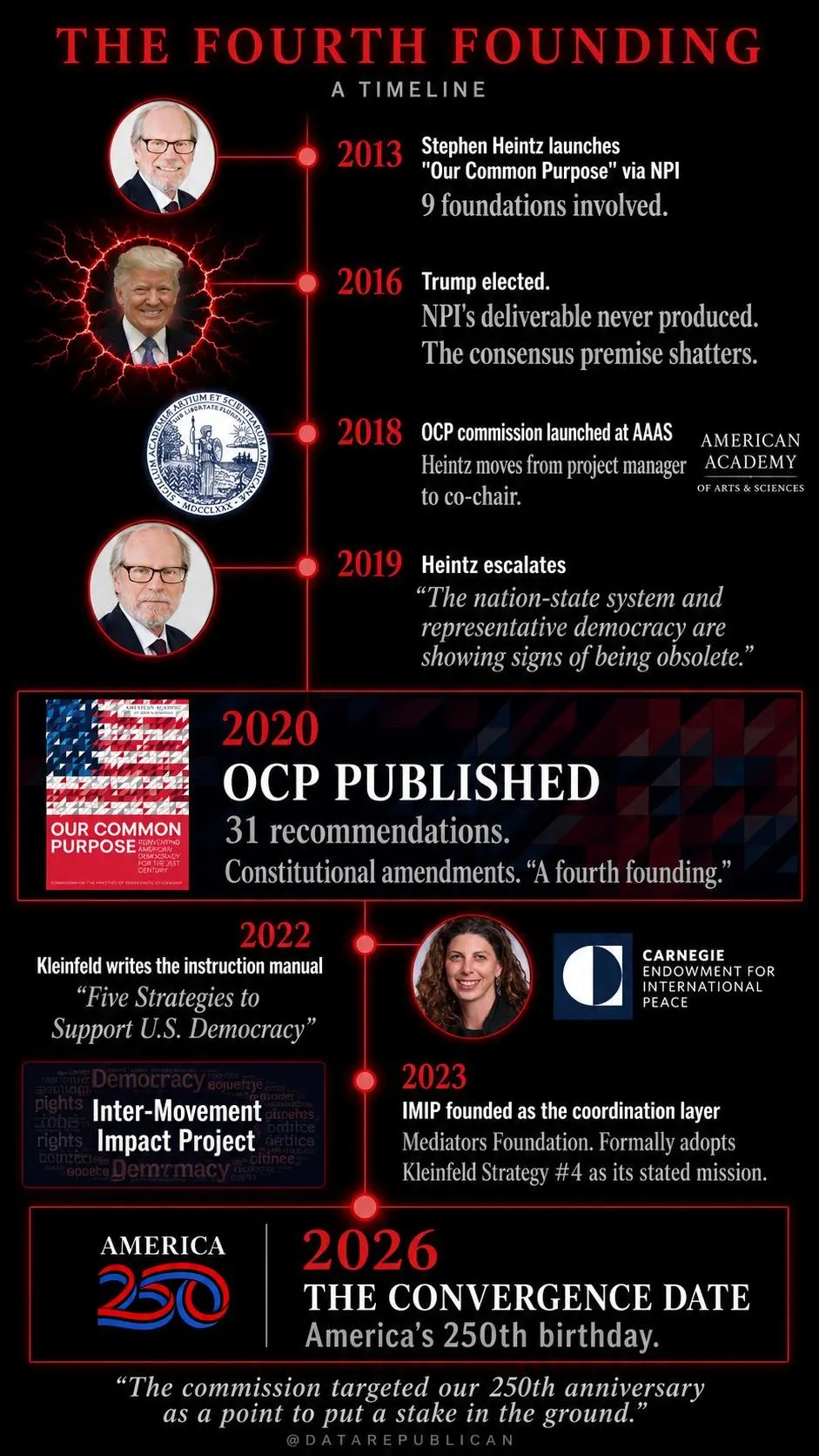
The timeline was not accidental. Commissioner Carolyn Lukensmeyer said it explicitly in 2021: “The commission targeted our 250th anniversary as a point to put a stake in the ground.” America’s semiquincentennial was embedded in the mandate from day one.
Bechtel died in March 2021 at ninety-five. His foundation closed in December 2020. Within months, the Rockefeller Brothers Fund seamlessly took over — $500,000 to AAAS in FY2022, labeled on its 990 for “IMPLEMENTATION OF THE OUR COMMON PURPOSE REPORT.”
The oldest learned society in America had a new purpose. And someone else was paying for it.
From Aspiration to Blueprint
Our Common Purpose did not originate at the American Academy of Arts and Sciences. By the time AAAS published it in 2020 under the institutional authority of a Massachusetts state charter older than the Constitution itself, the project was already on its third incarnation — and its second institutional host.
The trail begins in 2013 at the Rockefeller Brothers Fund.
Stage 1: Aspiration (2013–2015)
On September 30, 2013, RBF president Stephen Heintz delivered a speech at the Independent Sector Annual Conference. The speech was titled “Our Common Purpose.”
His co-presenter was Diana Aviv, then president of Independent Sector — and wife of Sterling Speirn, the W.K. Kellogg Foundation CEO who would later serve as a named commissioner on the AAAS version of the project. The speech was a joint production between two institutions run by the same household.
Aviv told the room that the nonprofit sector had “the kind of credibility needed to take on issues as complex and nuanced as re-launching our democracy.” Her prepared remarks included a bullet point about nonprofits welcoming “social pioneers: Who, in the quest for the common good, rewrite the laws of the land.”
Heintz offered his personal inspiration. He had spent years in Eastern Europe after the Berlin Wall fell and described the experience as a source of hope: “entire societies becoming animated by a shared sense of purpose — to redefine themselves, write a new story about themselves, seize a moment of agency.” The movement he was describing as a model was the post-Soviet civil society transformation.
Heintz announced what he called the “National Purpose Initiative,” a coalition of nine partner foundations: the Rockefeller Brothers Fund, Rockefeller Foundation, Kellogg, Open Society Foundations, Carnegie Corporation, Hewlett Foundation, Packard Foundation, Andrew W. Mellon Foundation, and MacArthur Foundation. The goal: citizens’ dialogues that would produce “a broadly shared agenda of national priorities” by 2016.
The language was aspirational. No structural reforms were proposed — no House expansion, no term limits, no constitutional amendments. The initiative sought to renew America’s promise through conversation.
By early 2015, Heintz conceded: “I am not as optimistic as I was.”.....SNIP
How about NO WAY.
The House should have at least 1000 Members, 2000 would be better.
The question, at is most basic, is a leading, corrupted and biased statement.
It implies burdens, responsibilities, and strictures on the citizen.
That is 180 degrees contrary to the intent of America's founders and our Constitution. Burdens, responsibilities and strictures were placed on GOVERNMENT and its power.
Open Society Foundations?
Enormous Red Flags starting with just that one!
Has a stench of globalism
And what is next if that doesn't work? Bet the authors wouldn't use this statement:
And for the support of this Declaration, with a firm Reliance on the Protection of divine Providence, we mutually pledge to each other our Lives, our Fortunes, and our sacred Honor.
Makes me think of people gathered around a casket and putting their stakes into Dracula.
We were never supposed to get President Trump.
We were supposed to get President Jezebel.
And our late term abortion conceived in liberty in 1776 would have just been a matter of time, maybe by the 250th..
To have a new constitution will require a revolution.
That is what they are working toward - whether they know it or not.
The question, at is most basic, is a leading, corrupted and biased statement. It implies burdens, responsibilities, and strictures on the citizen.
Exactly.
Only when one determines the best form of government for the 21st century, one that will serve for the foreseeable future, can one begin to define "good citizen" and the role of such citizen.
The founders did a good job determining the most desirable form of government given the environment in which they lived.
It may be too much to expect them to have anticipated how quickly the globe would shrink or how eager some would be to exploit the advantages of that government, or even to destroy it out of jealously.
BkMk
How about we start taxing these “foundations”?
They can’t even get our form of government correct.
Poppycock. What do you think "well regulated militia being necessary to the security of a free State" meant?
It was an obligation upon the people to be fit, trained, equipped, and ready to volunteer for combat.
Can we just fix bayonets and chrge them, yet? Asking for a friend.
Interesting read but nope.
Heavily armed, for starters. I'm guessing that's not part of this agenda, though.
Disclaimer: Opinions posted on Free Republic are those of the individual posters and do not necessarily represent the opinion of Free Republic or its management. All materials posted herein are protected by copyright law and the exemption for fair use of copyrighted works.