Posted on 05/15/2026 3:11:32 PM PDT by Cronos
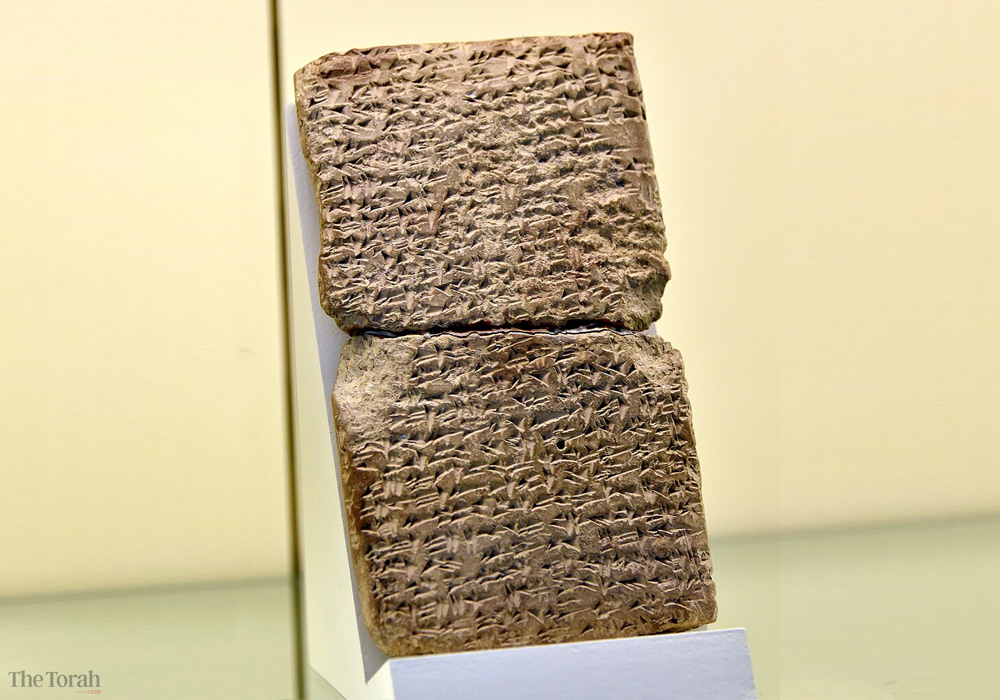
Letter from King Abdi-Heba of Jerusalem to the Egyptian Pharaoh Amenhotep III, Vorderasiatisches Museum, Berlin
The seven Jerusalem-Amarna Letters (EA 285–291) tell us about the local ruler ‘Abdi-Ḫeba, “Servant of Ḫebat,” a Hurrian goddess, and his struggles to keep control of this city.[1] Similarities in the language, orthography, formulae, paleography, and the scribal marks in these letters suggest that they were the work of a single scribe, who was not trained in Canaan. Petrographic analysis, conducted after Moran’s work on this scribe, showed that the clay of letters 286–290 was made from local materials around Jerusalem. Yet two letters were made from different clay sources, which suggests that the scribe was mobile. The clay in EA 285 is from the Egyptian garrison of Beit Shean, and the clay in EA 291 is like the clays around Gezer, a neighboring site.[3] This shows that the Jerusalem scribe traveled locally both in envoys to meet with Egyptian and Canaanite officials. Certain features of the Jerusalem letters also suggest a unique understanding of the terrain, politics, and inner workings of the Egyptian administration.
Handling an Accusation of Disloyalty As a master scribe and innovator, this scribe used knowledge of Canaanite politics to craft sophisticated letters. For example, in EA 286, after the introduction, the scribe explains that ‘Abdi-Heba has been accused of not being loyal to the pharaoh.
The letter defends ‘Abdi-Heba, acquitting him of wrongdoing, and the scribe’s goal is to dismantle the accusations against him and paint them as ridiculous. Abdi-Ḫeba owes everything to Egypt—his rule in Jerusalem depends on the pharaoh’s support. Instead, the letter continues by casting blame on two other people: Yanhamu an Egyptian official, and Milkilu, the ruler of Gezer,[4] and concludes with a clear message: if the pharaoh wants to maintain power in the region, he needs to send a garrison of troops to Jerusalem.
Because the scribe’s work is so complex, a multimodal perspective is helpful in untangling the different facets of the Jerusalem Letters.[5] Communication theory highlights how writers use different resources—texts are both linguistic and material things. The Jerusalem scribe communicated in the known letters through variation in language, orthography, and through the use of parallelism, and through the use of repetition. For example, in the passage below (from EA 286), the scribe makes use of both standard Akkadian, i.e., a mix of logograms (Sumerian signs that represent Akkadian words, marked in all caps) and syllabic writing, but also Canaanite elements (marked in bold): [6]
What have I done to the king, my lord? They are slandering me (lit. they are eating my pieces): I am being slandered before the king, my lord: “As for ‘Abdi-Ḫeba, he has deserted the king, his lord.” Look, as for me, neither my father nor my mother put me in this place. Rather, it was the strong arm of the king that caused me to enter to my father's house.”
Only a cuneiform scribe familiar with Akkadian and Canaanite would have been able to read and fully understand this passage. The scribe varies the language and orthographic conventions in this rhetorically important passage. The variation has parallels to how “code-switching” works in spoken language.[8] Speakers use different languages (the classic model for bilingual code-switching), and even dialects of the same language (there is no one “English” but a range of Englishes used globally); and we even use different registers of language, in our own speech practices in the same dialects that we use for communication (for example, I don’t speak in my formal academic lectures the way that I do at home to my hamster). When we write, we also vary our language use.
But, writing has an additional complication: writing is material and visual. We can influence and direct the meaning of a text by playing with the form that language takes. Code-alternation is my own term to describe the fluidity in the variation in the Canaanite Letters, where scribes do more than just vary the language of the text. They use different cuneiform signs, orthographies, scribal marks, harnesses all possible linguistic and extralinguistic aspects of their cuneiform arsenal. We would furthermore assume a degree of intentionally in the process of writing diplomatic letters, that suggest that we should pay attention to where the scribe alternate their writing practices. Context is everything.
In the example of the Jerusalem Amarna Letters, the variation extends beyond language to spelling, scribal marks, grammar, and literary structures. In this case, the nuances of such multimodal layered communication would have been perceptible only to another scribe, but not to someone, such as the pharaoh, just hearing the words of this passage (especially if it was translated in Egyptian, if the letter’s message ever reached pharaoh).
Here, the scribe interwove both more “standard” Akkadian and Canaanite elements into a powerful statement about ‘Abdi-Ḫeba’s loyalty to the pharaoh. Here are some “Canaanite” features of the letters, which are rarer than in the other Canaanite Letters (and therefore when they are used, they seem to stand out). The forms here date to the mid-14th century, are not Hebrew. They are Akkadian words, that use aspects of the local grammar. The scribe was not originally trained in this region. And, these form are used all over the Canaanite Letters (spanning a large region, by speakers, no doubt of many Canaanite dialects).
5 ma-an-na ep-ša-ti a-na LUGAL EN-ia 6 i-ka-lu ka-ar-ṣi!(MURUB4)-ya : ú-ša-a-ru 7 ⸢i⸣-⸢na⸣ pa-ni LUGAL EN-ri IÌR-ḫé-ba 8 pa-ṭa-ar-mi a-na LUGAL-ri EN-šu 9 a-mur a-na-ku la-a LÚa-bi-ia 10 ù la-a MUNUSú-mi-ia : ša-ak-na-ni 11 i-na aš-ri an-ni-e 12 ⸢zu⸣-ru-uḫ LUGAL-ri KAL.GA 13 ⸢ú⸣-še-ri-ba-an-ni a-na É LÚa-bi-ia [7]
EA 286:5-13 What have I done to the king, my lord? They are slandering me (lit. they are eating my pieces): I am being slandered before the king, my lord: “As for ‘Abdi-Ḫeba, he has deserted the king, his lord.” Look, as for me, neither my father nor my mother put me in this place. Rather, it was the strong arm of the king that caused me to enter to my father's house.”
Only a cuneiform scribe familiar with Akkadian and Canaanite would have been able to read and fully understand this passage. The scribe varies the language and orthographic conventions in this rhetorically important passage. The variation has parallels to how “code-switching” works in spoken language.[8] Speakers use different languages (the classic model for bilingual code-switching), and even dialects of the same language (there is no one “English” but a range of Englishes used globally); and we even use different registers of language, in our own speech practices in the same dialects that we use for communication (for example, I don’t speak in my formal academic lectures the way that I do at home to my hamster). When we write, we also vary our language use.
But, writing has an additional complication: writing is material and visual. We can influence and direct the meaning of a text by playing with the form that language takes. Code-alternation is my own term to describe the fluidity in the variation in the Canaanite Letters, where Context helps us to untangle the scribe’s writing practice. It is telling that the Canaanite forms are in reference to ‘Abdi-Ḫeba and his parents, whereas the scribe uses a more classic Akkadian verb in reference to the pharaoh. The signaling here reflects the identities of these people mentioned, and perhaps a comment of the difference in their relative power and status (local Canaanite elites [=less powerful] vs. the pharaoh [=an international force]).
Then, to beef up the point, the scribe employs parallelism. The two clauses are written in a way that highlights the contrast between the two sets of elites. When read as a multimodal text (the way a scribes would have read it), ‘Abdi-Ḫeba’s message is rich and textured. It openly acknowledges that he did not get his power from his parents (using a Canaanite verbal form), or from the local dynasty. Instead, he acknowledges that his power comes from the pharaoh, who placed him in power (using a more standard Akkadian verbal form).[11]
The parallelism coupled with the scribe’s scribes’ alternation between Canaanite and Akkadian may not have been noticeable to a person hearing an Egyptian translation of this letter. Yet a scribe who was used to reading letters from Canaanite scribes would have noticed the linguistic variation in this passage and its clever organization. In other words, the Jerusalem scribe used these strategies to add texture and depth to the letter, perhaps, with the goal of getting a scribe working for Egypt to communicate the message to the pharaoh [or his officials entrusted with Levantine matters] in a certain way.
The multimodal perspective enables us to evaluate the different communicative elements in the letter, and how they work together as a global rhetorical strategy. We can “read” the subtext of this passage from a scribal perspective: “My parents (local scribal code) did not place me…. But rather, you, of pharaoh, (higher-register of Akkadian), placed me in power….” The scribe contrasts ‘Abdi-Ḫeba’s mother and father with the real source of his power: the mighty arm of his Egyptian overlord.
As noted, the scribe employed a local word to describe the pharaoh’s mighty arm. In another letter (EA 147), another scribe employs the Egyptian term, ḫpš, also in a scribal gloss, to describe the pharaoh’s mighty arm. The use of a Canaanite term in the Jerusalem Letters demonstrates how complex and interesting the letters are, once we read them as scribal artifacts.
Instructions for Other Scribes
Four of the letters from the southern Levant have a secondary message addressed to a scribe. EA 316, and four Jerusalem Amarna Letters. We will look at the examples from our Jerusalem scribe. In four of the letters (EA 286, 287, 288, and 289), the Jerusalem scribe provided instructions on the reverse side as to how the scribes in Egypt should access the main messages on the tablet.[12] While these mini-messages are attached to complicated letters addressed to the Egyptian pharaoh, they are not written for the pharaoh’s eyes but for his scribes, people trained in the cuneiform script who worked for the Egyptian court.
The postscripts in these four letters are all similar. They have a letter heading, and then a all ask the scribe who received the letters in Egypt to present the words of the letter in a favorable way (“present good words to the king, my lord!”). Next, there is a very short message, just a few lines, but all different.
Rather than viewing these messages as separate letters from the main letter, I have argued that they are summaries that the scribe wrote to help the scribes working for Egypt get to the main meat the longer letter on the tablet. The short messages either cite an important word in the main letter on the tablet (EA 286:63-64; 287:66-70; 288:64-66), or summarize the main argument being made (EA 289: 49-51). I’ve called them “CliffsNotes” —short notes from one scribe (our Jerusalem scribe) to the scribes working for the pharaoh.
In other words, they serve as guides to the scribes in Egypt about how to read the letter, and about what information to prioritize; they are scribal cue-cards of a sort. They reach out and communicate: “Dear Scribe who gets this message: please do a good job of communicating it to the pharaoh—and please prioritize this important take-away point.”
Noting a Catch Phrase
The Jerusalem scribe also uses a catch-phrase in bold below from the main letter to tell the scribe where to look for the most important part of the message. For example, in the letter discussed above, the Jerusalem scribe writes a postscript flagging a key phrase repeated many times in the main letter, warning about the loss of the land.
EA 286: 61-64 To the scribe of the king, my lord, thus ʿAbdi-Ḫeba, your servant: Present the eloquent words to the king, my lord! ‘All of the lands of the king, my lord, are lost!’”[13]
This same warning is repeated several times in the main letter, always in important sections of the message, to argue that pharaoh needs to step in and get more involved in governance in Canaan. How can the pharaoh stop the devastation in Canaan? Simple: by sending troops to help ‘Abdi-Ḫeba[14].
In short, scribes wrote letters addressed to the Egyptian pharaoh but at the same time, they were aware that the real audiences of the letters were other scribes—their professional counterparts who received them in Egypt. No one else could read the letters and access their full range of meaning. And the scribes were the gatekeepers for any correspondence in cuneiform addressed to the pharaoh or his officials.
A Glimpse into Pre-Israelite Jerusalem
These examples show us the sophistication of a scribe working in Jerusalem in the Amarna Period. The lucky survival of these documents gives us an unprecedented glimpse into the political world of Jerusalem in a time when it was governed by a Canaanite elite (about whom we do not know much), yet who was very clearly under the thumb of the Egyptian pharaoh. We don’t know whether or not the scribe was actually attached to Abdi-Ḫeba, or, more likely, was appointed there by Egypt and was familiar with Egyptian administration in the Levant.
The Earliest Texts from Jerusalem
The Jerusalem Amarna Letters are the earliest texts from Jerusalem. Yet they were written by an outside scribe, someone who was slowly becoming integrated into the local scribal and political culture. They mention a local elite, someone with a personal name, that connected them to a Hurrian deity. We do not know very much about this person, but their presence in Jerusalem suggests that the site was deemed important to Egypt’s aims of controlling the region.
Other references in the Jerusalem letters suggests that an Egyptian garrison was stationed at Jerusalem for a short period. Above all, the letters show us how interconnected Jerusalem was with Egypt and neighboring sites in the southern Levant, in the 14th century. Earlier Egyptian texts, known as the “Execration texts” offer the first reference to Jerusalem, from an Egyptian perspective. In these texts, Jerusalem is an enemy of Egypt, by the Amarna Period, Jerusalem was integrated into Egypt’s master plan in Canaan.
Even so, we should study the Jerusalem Amarna Letters for their own sake, rather than merely use the letters to study later periods of Jerusalem’s history. When we block out this outside noise, the beauty and mastery of the work of this single scribe crystalizes, and we see the ingenuity and creativity of the first known Jerusalem scribe.
Abdi-Ḫeba (Abdi-Kheba, Abdi-Ḫepat, or Abdi-Ḫebat) was a local chieftain of Jerusalem during the Amarna period (mid-1330s BC). Egyptian documents have him deny he was a mayor (ḫazānu) and assert he is a soldier (we'w), the implication being he was the son of a local chief sent to Egypt to receive military training there
Abdi-Ḫeba's name can be translated as "servant of Ḫebat", a Hurrian goddess. Whether Abdi-Ḫeba was himself of Hurrian descent is unknown. There is a mix of Canaanite and Hurrian influences (cf. Mitanni Empire) in this region.
During Abdi-Ḫeba's reign the region was under attack from marauding bands of Habiru.
[snip] After complaining that the land was falling to the invading bands (habiru), the king of Jerusalem wrote: ". . . and now, in addition, the capital of the country of Jerusalem -- its name is Bit Šulmáni -- , the king's city, has broken away . . ."(4) Beth Šulmán in Hebrew, as Professor Lewy correctly translated, is Temple of Šulmán. But, of course, writing in 1940, Lewy could not surmise that the edifice was the Temple of Solomon and therefore made the supposition that it was a place of worship (in Canaanite times) of a god found in Akkadian sources as Shelmi, Shulmanu, or Salamu.
The correction of the reading of Knudtzon (who was uncertain of his reading) fits well with the chronological reconstruction of the period. In Ages in Chaos (chapters vi-viii) I deal with the el-Amama letters; there it is shown that the king of Jerusalem whose name is variously read Ebed-Tov, Abdi-Hiba, etc. was King Jehoshaphat (ninth century). It was only to be expected that there would be in some of his letters a reference to the Temple of Solomon.
Also, in el-Amama letter No. 74, the king of Damascus, inciting his subordinate sheiks to attack the king of Jerusalem, commanded them to "assemble in the Temple of Šulmán."(5) [/snip]The Šulmán Temple in Jerusalem | Immanuel Velikovsky | Collected Essays
114. Among the correspondents of Amenhotep III and Akhnaton are biblical personages: Jehoshaphat (Abdi-Hiba), King of Jerusalem; Ahab (Rib Addi), King of Samaria; Ben-Hadad (Abdi-Ashirta), King of Damascus; Hazael (Azaru), King of Damascus; Aman (Aman-appa), Governor of Samaria; Adaja (Adaja), Adna (Adadanu), Amasia, son of Zihri (son of Zuhru), Jehozabad (Jahzibada), military governors of Jehoshaphat; Obadia, the chief of Jezreel; Obadia (Widia), a city governor in Judea; the Great Lady of Shunem (Baalath Nesse); Naaman (Janhama), the captain of Damascus; and others. Arza (Arzaja), the courtier in Samaria, is referred to in a letter.
115. Mesha, King of Moab, is often mentioned in the Letters by his name (Mesh). The omission of the name of the rebel king by the translators of the Letters is not warranted.Theses for the Reconstruction of Ancient History | Immanuel Velikovsky | 1945
The Rossato brothers are muscleing in on our territory..
Abdi-Ḫeba (Abdi-Kheba, Abdi-Ḫepat, or Abdi-Ḫebat) was a local chieftain of Jerusalem during the Amarna period (mid-1330s BC). Egyptian documents have him deny he was a mayor (ḫazānu) and assert he is a soldier (we’w), the implication being he was the son of a local chief sent to Egypt to receive military training there
During Abdi-Ḫeba’s reign the region was under attack from marauding bands of Habiru.
/////////
Presumably the Habiru are the Hebrews. But I thought that the hebrews entered the Promised Land roughly 1400 BC. Did it take them 70 years to take it over? Plus there is no mention of Egyptian control of any of the cities in the promised land during Joshua’s conquest.
Disclaimer: Opinions posted on Free Republic are those of the individual posters and do not necessarily represent the opinion of Free Republic or its management. All materials posted herein are protected by copyright law and the exemption for fair use of copyrighted works.

