Posted on 05/09/2026 6:52:14 PM PDT by Red Badger
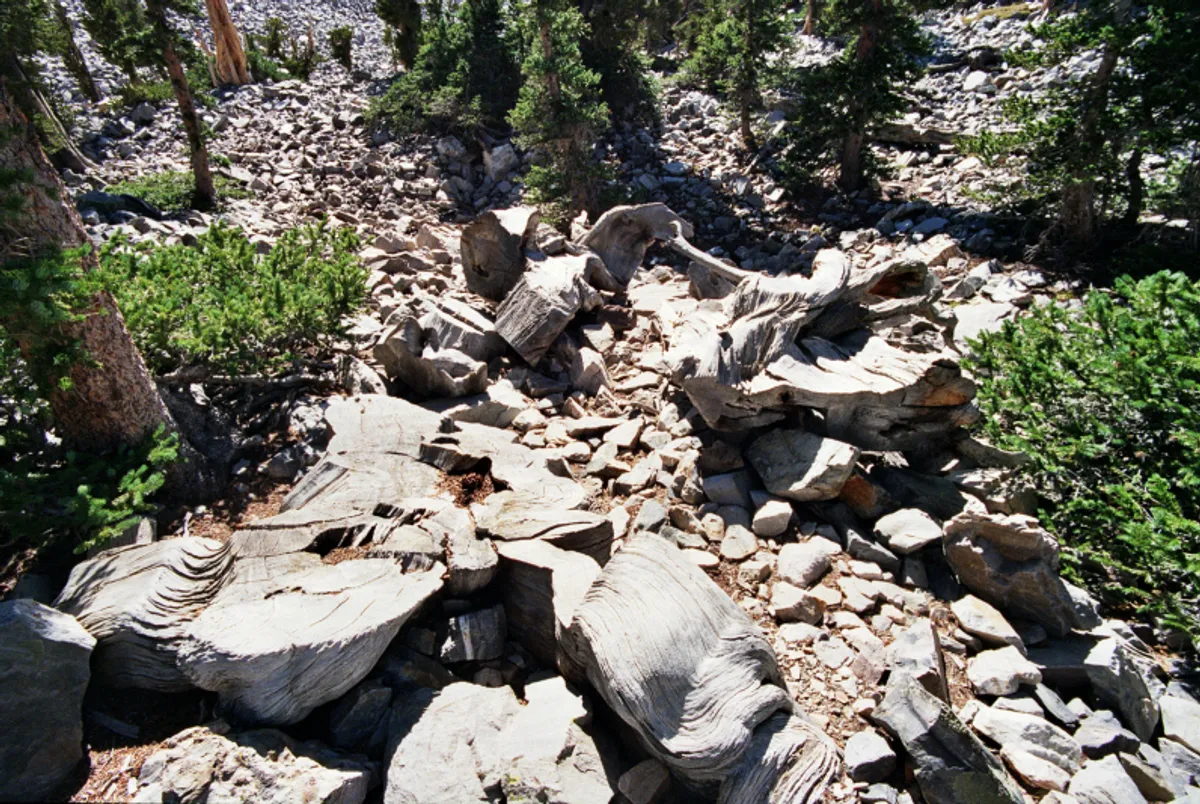
The tree, known as Prometheus, was cut down to study, with permission from the US Forest Service.
The stump of Prometheus in the Wheeler Bristlecone Pine Grove at Great Basin National Park, Nevada.
Image credit: James R Bouldin via Wikimedia Commons (public domain)
Science isn't always perfect; mistakes are made, occasionally to the detriment of one's subject. But what about inadvertently chopping down what would later turn out to be the world's oldest non-clonal tree?
That’s exactly what happened to an unfortunate graduate student named Donald R. Currey back in the summer of 1964, who ended up responsible for the demise of Prometheus, a bristlecone pine that stood in what is now Great Basin National Park, Nevada.
Bristlecone pines are some of the hardiest trees out there; they’re slow growing, with dense wood keeping them resistant to the effects of weather, insects, and fungi, and have a characteristically twisted appearance. One species in particular, the Great Basin bristlecone pine (Pinus longaeva) is capable of living for thousands of years.
After never having heard of bristlecone pines before graduate school, Currey took an interest in them after his mother sent him a National Geographic article written by Edmund Schulman, the researcher who famously sampled bristlecone pine Methuselah – which may now be the oldest known non-clonal tree in the world.
A geographer, Currey theorized that these trees could possibly be of use to his research in dating glacial features found below Great Basin’s Wheeler Peak, where he was carrying out fieldwork. The growth rings of trees can act as a record of the climate at the time they formed, which in turn can provide information about what glaciers were up to at the time, too. And when it comes to ancient trees like bristlecone pines, the information they contain can span a seriously long period of time.
To get this growth ring data requires using a borer to extract a roughly pencil-sized cylinder of wood from a tree, known as a core sample. Currey got permission from the US Forest Service to do exactly that on a group of bristlecone pines growing beneath Wheeler Peak, including one known to local mountaineers as Prometheus.
But when it came to this particular tree, Currey ran into a problem. In a 2001 NOVA documentary, the researcher said that it was particularly tricky to sample with the usual method. “The normal approach to coring the tree wasn't working because the largest available increment bores were too small to core even from several angles,” Currey explained.
And so, with further permission from the Forest Service, Prometheus was cut down, with a 30-centimeter (1-foot) thick cross-section taken from the felled tree.
Currey had already suspected that Prometheus was over 4,000 years old, but it was only when he sat down to count the rings later on that he realized what exactly he’d just chopped down.
“We could begin to see that we were getting over 4,000 years, over 4,500, over 4,600, which was the oldest record that had been reported in the literature up until that time,” said Currey. “And we ended around 4,900 years. And you've got to think, "I've got to have done something wrong. I better recount. I better recount again. I better look really carefully with higher magnification.”
But there was no mistake. Prometheus was an estimated 4,900 years old, and at that point, the oldest tree ever dated – and it was now dead. No one knew exactly how significant it was before it was cut down, of course, but we can imagine the slow realization of what happened was probably downright gut-wrenching regardless.
Now, all that remains of Prometheus in its original location is its stump, which looks rather inconspicuous amongst the surrounding, similarly colored rocks. Pop to the Great Basin Visitor Center, however, and you’ll be able to see a slab of the tree – and you can count the rings yourself.
Since then, we have new contenders for the world's oldest tree. As mentioned, Methuselah, another bristlecone pine, is thought to be around 4,789 years old. Great Grandfather, a giant cypress tree in Chile, is thought to be around 5,400 years old. However, Utah holds the record for one of the oldest living organisms in the world, with the sprawling lump of quaking aspen (Populus tremuloides) known as Pando – made up of a tangle of clones – that dates up to 80,000 years old.
An earlier version of this article was published in 2025.
After your post I’m starting to feel the onset of cosmic consciousness.
Hold on just a second here Hoss.
You’re claimimg I don’t know anything about the “Truth” here, because I wasn’t a Logger.
You were a Logger, then I take it? And can personally vouch for 10k calories daily? See where I’m goin’ with that?
I call bullshit on that anyway. At least the Army studies were a methodical, scientific approach trying to determine what it takes to feed an Army. I can tell you from personal observation that the Infantry as a class and the special ops guys in particular have absolutely insane work loads in the field. And 4 to 5k calories probably isn’t enough, the numbers are approximate and just barely sustain them. From what I saw they don’t even have the time to eat enough food.
I was not an Infantry guy, so I have not idea about that. I do know logging an commercial fishing, and yes, lots of high calorie food is necessary to work in those extreme conditions. 10K would be about right, although we never counted calories.
Being in the infantry is not the same as working in extreme conditions 6 days a week year round and some times 24/7.
End of discussion.
“ 10k would be about right”
LOL! No, it really isn’t. You’re just guessing.
Thanks
Disclaimer: Opinions posted on Free Republic are those of the individual posters and do not necessarily represent the opinion of Free Republic or its management. All materials posted herein are protected by copyright law and the exemption for fair use of copyrighted works.