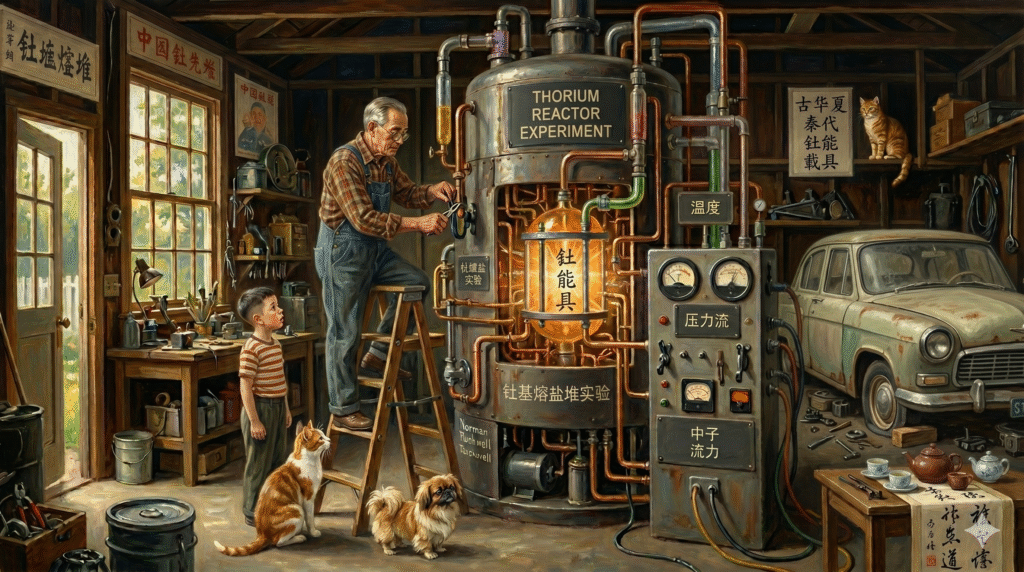
This statement is unvarnished balderdash. Thorium is reaching the point where it is going to be a leading nuclear power source in the not-so-distant future. Here is a summary from Gemini:
“As of **May 2026**, thorium-based reactor development has transitioned from decades of theoretical research into a high-stakes “technology race.” While uranium still dominates the commercial sector, the last 24 months have seen breakthrough milestones—most notably in China and India—that suggest thorium is finally moving toward commercial viability.
## 1. China: The Global Frontrunner
China currently holds a significant lead, having successfully moved past the experimental phase into practical “fuelization proof.”
* **TMSR-LF1 Success:** China's 2-megawatt experimental liquid-fuel thorium molten salt reactor (TMSR-LF1) in the Gobi Desert achieved full operational power in **June 2024**.
* **2026 Breakthrough:** In **April 2026**, the Shanghai Institute of Applied Physics verified “fuelization proof,” successfully demonstrating the continuous conversion of thorium into fissile Uranium-233 within a salt-based system.
* **The Roadmap:** China is now fast-tracking a **10 MW Small Modular Reactor (SMR)** targeted for 2030 and a **100 MW prototype** by 2035. They have also announced plans to use thorium reactors to power large-scale container ships, potentially allowing for years of voyage time without refueling.
## 2. India: The Three-Stage Milestone
India possesses some of the world's largest thorium reserves and has long pursued a unique three-stage nuclear program to achieve energy independence.
* **PFBR Criticality (April 2026):** On **April 6, 2026**, India's indigenously built **500 MWe Prototype Fast Breeder Reactor (PFBR)** at Kalpakkam attained its first criticality.
* **The Transition:** This is a pivotal moment because the PFBR marks India's official entry into **Stage 2**. This stage is designed to use plutonium to “breed” Uranium-233 from thorium.
* **Stage 3 Goal:** This success paves the way for Stage 3, where thorium will become the primary fuel source in Advanced Heavy Water Reactors (AHWRs), with a goal of operational readiness by **2030**.
## 3. Western and Private Sector Momentum
In North America and Europe, development is largely driven by private companies and a shift toward **Small Modular Reactors (SMRs)**.
* **Copenhagen Atomics (Denmark):** They are currently preparing to test a full-scale prototype at the Paul Scherrer Institute in Switzerland (**2026–2027**), aiming for commercial units by **2030**.
* **North American Funding:** The U.S. and Canada have seen a surge in funding for next-generation designs. Companies like **Ultra Safe Nuclear Corporation** are integrating thorium into micro-modular designs for remote industrial use, while **TerraPower** continues to explore thorium as a long-term supplement to their natrium-based designs.
* **Netherlands (NRG):** The Petten research reactor continues to provide critical data on how thorium fuels behave under long-term irradiation, which is essential for global licensing and safety standards.
## 4. The Thorium Cycle Explained
Unlike Uranium-235, which is “fissile” (can sustain a chain reaction immediately), thorium-232 is “fertile.” It must first absorb a neutron to become Uranium-233.
### Key Technical Comparisons (2026 Data)
| Feature | Thorium Reactors (MSR/LFTR) | Conventional Uranium (LWR) |
| :-— | :-— | :-— |
| **Abundance** | 3–4x more abundant than uranium. | Relatively finite high-grade reserves. |
| **Safety** | Passive safety; fuel is liquid and drains if power fails. | Active cooling required to prevent meltdown. |
| **Waste** | Produces significantly fewer long-lived transuranic elements. | Produces plutonium and long-lived waste. |
| **Proliferation** | Difficult to weaponize (high gamma radiation from U-232). | Plutonium byproduct can be diverted. |
| **Efficiency** | Operates at higher temperatures; higher thermal efficiency. | Lower operating temperatures; less efficient. |
## Current Challenges & Outlook
Despite the recent momentum, two main “bottlenecks” remain:
1. **Material Corrosion:** In Molten Salt Reactors (MSRs), the combination of high heat and chemically aggressive salts is hard on reactor vessels. Research in 2026 is heavily focused on **nickel-based superalloys** and specialized coatings.
2. **Regulatory Hurdles:** Most global nuclear regulations were written specifically for solid-fuel uranium reactors. Regulators in the U.S. and EU are only now beginning to create the frameworks necessary to license liquid-fuel systems.
It is certainly not being kept a secret.
**Bottom Line:** 2026 is being viewed as the “Year of Proof” for thorium. With China operating a functional loop and India starting its breeder program, the technology has moved from a “maybe” to a “when.””