Posted on 04/20/2026 5:38:20 PM PDT by CharlesOConnell
"17 rare books, worth $ millions … stolen from venture capitalist John Hay Whitney's Long Island home decades ago have been recovered." (Shift to Wikipeida on Whitney 1904-1982.)
… inherited a large fortune from his father, making him one of the wealthiest people in the United States. In 1929, he participated in a hostile takeover of Lee, Higginson & Co.*** with Langbourne Willliams, rising to the position of chairman of the board at just 29 years old. In 1946, after serving in the OSS during WW2, he founded J. H. Whitney & Company, the oldest venture capital firm in the United States and the origin of the term venture capital. By the 1970s, he was one of the wealthiest men in the world.
(*** Lee, Higginson & Co. was a Boston-based investment bank established in 1848 that was the home of many members of the Boston Brahmin establishment. The bank collapsed in the Swedish match scandal in 1932 while under the leadership of Jerome Davis Greene. The bank helped finance the growth of General Motors during the nascent phase of the American automobile industry. (Switch to Co-Pilot for title question.)
Investment banks are called “banks” because historically they were part of the broader banking system, handling deposits and lending, but over time they became distinct from commercial banks.
Why “Banks”?
In the early 20th century, “bank” was a broad term covering any institution that accepted deposits, made loans, and managed money. Investment banks began as part of this system, often taking deposits and using them to underwrite securities, lend to corporations, and trade in stocks and bonds. Over time, as the financial system evolved, investment banks specialized in securities markets, while commercial banks focused on retail and business deposits and loans. The term “investment bank” stuck because of their role in financing and trading investments, even though they no longer took deposits in the same way as traditional banks
What Glass–Steagall Did
The Glass–Steagall Act of 1933 (Banking Act of 1933) was a major reform passed during the Great Depression to restore public confidence in the banking system. It separated commercial banking from investment banking to prevent the kind of risky, speculative use of depositor funds that contributed to the 1929 crash.
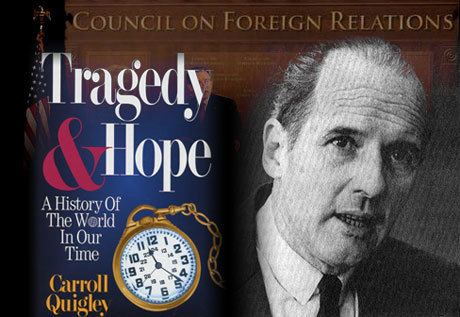
Quigley’s View of Glass–Steagall and the Rockefeller–Morgan Banking Shift Carroll Quigley’s Tragedy and Hope does not explicitly name “Rockefeller banking interests” or “J.P. Morgan banking dominance” in the way some later interpretations frame it, but his broader narrative of the late 19th–early 20th century financial transformation aligns with that reading. Quigley portrays the period 1895–1950 as a transition from a Europe-dominated world to a multi-polar global order, with the United States emerging as a central financial power Open Library. In this context, he traces the rise of Anglo-American financial elites and the consolidation of banking and investment functions.
Glass–Steagall, enacted in 1933, was a legislative response to the Great Depression that separated commercial banking from investment banking. Historically, J.P. Morgan & Co. and its allies had long dominated investment banking, channeling capital into industrial ventures and international finance. By the early 20th century, figures like John D. Rockefeller’s Standard Oil and other industrialists had significant influence over financial institutions, and the “Rockefeller banking interests” Quigley’s critics invoke may refer to the integration of industrial and financial power that began in the late 19th century.
Quigley’s account emphasizes the financial and commercial patterns of the West before 1914 as a key driver of modern global structures Open Library. He sees the post–World War I era as a time when Anglo-American financial elites—often linked to industrialists—began to reshape the global economic order. The separation of commercial and investment banking under Glass–Steagall can be read as a structural change that altered the balance of influence between traditional investment banks (like Morgan) and the newer, more diversified financial institutions that industrialists and their allies were building.
Was it an oversimplification?
From a modern historical perspective, Quigley’s framing is a simplified but plausible interpretation. The shift was not solely about “Rockefeller overthrowing Morgan” but part of a broader trend:
* The rise of industrial-financial conglomerates in the U.S. and Europe.
* The increasing role of private equity, venture capital, and corporate finance.
* Legislative and regulatory changes (like Glass–Steagall) that reflected and reinforced these shifts.
* The global expansion of Anglo-American financial networks.
In short, Quigley’s narrative captures the essence of the financial realignment but omits the full complexity of competing industrialists, regulatory debates, and the role of other institutions. His “oversimplification” is in reducing a multifaceted economic transformation to a single institutional and corporate battle, but it remains consistent with the broader historical currents he describes.
Carroll Quigley, engineer turned historiographer, was Bill Clinton’s favorite Georgetown University professor.
“The relationship between Henry Ford, the Ford Motor Company, and Manufacturers National Bank of Detroit (founded 1933) was a complex, somewhat paradoxical alliance, evolving from Henry Ford’s deep-seated distrust of traditional banking to a controlled partnership essential for Detroit’s economic survival during the Great Depression.
While Henry Ford notoriously preferred self-funding, avoiding Wall Street debt, and hoarding cash, the need to stabilize Detroit after the 1933 banking crisis forced a symbiotic relationship where Ford provided the capital/credibility, and the bank provided secure financial infrastructure for Ford’s massive workforce.
Here is the outline of that symbiotic relationship:
1. The Context: Ford’s Financial Philosophy
Independence from Debt: Henry Ford believed bankers were “money changers” who sought control over industrial operations. He built his empire by rejecting loans, allowing him to cut prices and set wages without investor pressure.
Self-Funding/Vertical Integration: Ford funded expansion internally, producing his own steel, glass, and electricity, making the company its own economic ecosystem.
The “Cash-in-Vault” Approach: Ford often kept millions in cash, avoiding traditional bank deposits, and used dealer payments to fund operations.
Facebook
Facebook
+4
2. The Genesis: The 1933 Detroit Banking Crisis
The Catalyst: The Great Depression brought Detroit banks to the brink of collapse. The Guardian Trust Company and First National Bank of Detroit, where the Fords held millions in deposits, failed.
The Ford-Led Solution: After other banking plans failed, Henry and Edsel Ford stepped in to establish Manufacturers National Bank of Detroit in 1933 to fill the void.
Symbolic Support: By backing a new institution, the Fords restored confidence in Detroit’s financial system, crucial for paying their own employees and vendors.
Time Magazine
Time Magazine
+4
3. The Symbiosis: How They Worked Together
Geographic and Functional Integration: Manufacturers Bank placed branches directly adjacent to Ford facilities, such as the Highland Park plant.
The Underground Tunnel: A secure underground tunnel connected the Highland Park Ford plant directly to the Manufacturers Bank branch to facilitate the fast and secure movement of massive cash payrolls.
Stabilizing Deposits: Manufacturers Bank received the assets and liabilities of several distressed banks, including Dearborn State Bank, providing a safe harbor for funds.
Edsel Ford’s Active Role: While Henry Ford was skeptical of banking, his son Edsel was actively involved in these financial institutions, balancing the need for stability with his father’s desire for independence.
EHERG
EHERG
+3
4. Summary of Benefits
Ford to Manufacturers Bank: Provided prestige, initial capital, and an immense, consistent deposit base (payroll).
Manufacturers Bank to Ford: Provided security for cash, facilitated worker payroll, and maintained stability in Detroit to ensure Ford’s supply chain remained intact.
This partnership, born of necessity in 1933, marked a turning point where Ford had to transition from absolute independence to a managed relationship with a “trusted” bank, which lasted until Manufacturers Bank merged with Comerica in 1993.”
-Google AI
The repeal of Glass–Steagall is what led to the 2007 collapse. And has a lot to do with the way things are messed up today.
Investment banks are usually able to earn higher returns on their investments than commercial banks earn on loans, but they do so with a higher risk of loss. Glass-Steagall barred commercial banks from investment bank activity, thus creating a system in which commercial banks were safe, with lower potential earnings but little risk of loss to their depositors.
Disclaimer: Opinions posted on Free Republic are those of the individual posters and do not necessarily represent the opinion of Free Republic or its management. All materials posted herein are protected by copyright law and the exemption for fair use of copyrighted works.