
The kids told me about this. They loved Bob hope bing crosby and Hedy road to films, looked up her bio and this…
She also invented more or less plastic surgery. Every woman thinking about letting their sister or their MD talk them into plastic surgery must take a look at Hedy later years and beeeware
But Hedy was very smart. She came from Austria and her parents were appreciative immigrants with a real sense of education starting, of course, with language and music in language formative years- 2-5

She is not uncute.
NOT Beyond the mental capability...
They named it the Hedy. Because "it sounds like a young man's lust going off."
> Antheil and Lamarr never received a penny for their work <
That seemed very unfair. So I just looked it up. Antheil and Lamarr donated their patent to the U.S. Navy.
Respect to them. Not every hero wears a uniform.
https://en.wikipedia.org/wiki/Frequency-hopping_spread_spectrum#
I don’t agree with you on many things on this forum, but admiration for Hedy Lamarr is one of them.
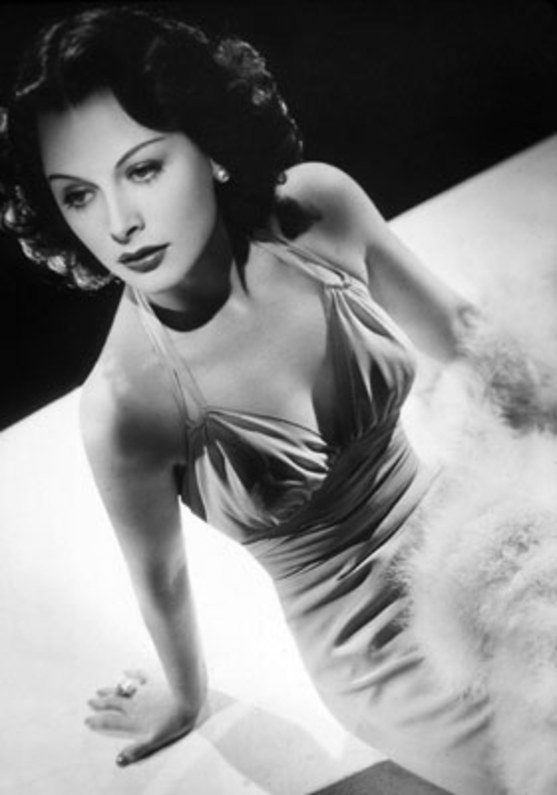
A remarkable combination of brains and beauty.
Last week TCM showed a famous 16 minute short silent film called “Ballet Mecanique”. Antheil wrote the soundtrack. Avantgarde it certainly the word to describe the film and the music.
https://youtu.be/oMnZgykH1Bk?si=zVwtNxR8vB0s5H8S
As reported here several years ago, she spent many months in DC trying to get the attention of the USN bureaucracy...
Meanwhile, our torpedoes were laughably pathetic, ultimately costing many Amercan sailor’s lives, either missing or not exploding 80% of the time they were used on jap ships...
It took the Naval bureaucracy 2 years before they finally did something about it (instead of continuing to blame the sub commanders as incompetent), using, in part, her brilliant designs...
I had an uncle who was part of that WWII Naval bureaucracy and, when I returned from Korea in 1953, he regaled me with the torpedo story...
Frequency hopping through history... From Wikipedia :
“In 1899, Guglielmo Marconi experimented with frequency-selective reception in an attempt to minimise interference.[3]
The earliest mentions of frequency hopping in open literature are in US patent 725,605, awarded to Nikola Tesla on March 17, 1903,[4] and in radio pioneer Jonathan Zenneck’s book Wireless Telegraphy (German, 1908, English translation McGraw Hill, 1915),[5][a] although Zenneck writes that Telefunken had already tried it. Nikola Tesla doesn’t mention the phrase “frequency hopping” directly, but certainly alludes to it. Entitled Method of Signaling, the patent describes a system that would enable radio communication without any danger of the signals or messages being disturbed, intercepted, interfered with in any way.[6]
The German military made limited use of frequency hopping for communication between fixed command points in World War I to prevent eavesdropping by British forces, who did not have the technology to follow the sequence.[7] Jonathan Zenneck’s book Wireless Telegraphy was originally published in German in 1908, but was translated into English in 1915 as the enemy started using frequency hopping on the front line.
In 1920, Otto B. Blackwell, De Loss K. Martin, and Gilbert S. Vernam filed a patent application for a “Secrecy Communication System”, granted as U.S. Patent 1,598,673 in 1926. This patent described a method of transmitting signals on multiple frequencies in a random manner for secrecy, anticipating key features of later frequency hopping systems.[4]
A Polish engineer and inventor, Leonard Danilewicz, claimed to have suggested the concept of frequency hopping in 1929 to the Polish General Staff, but it was rejected.[8]
In 1932, U.S. patent 1,869,659 was awarded to Willem Broertjes, named “Method of maintaining secrecy in the transmission of wireless telegraphic messages”, which describes a system where “messages are transmitted by means of a group of frequencies... known to the sender and receiver alone, and alternated at will during transmission of the messages”.
During World War II, the US Army Signal Corps was inventing a communication system called SIGSALY, which incorporated spread spectrum in a single frequency context. However, SIGSALY was a top-secret communications system, so its existence was not known until the 1980s.
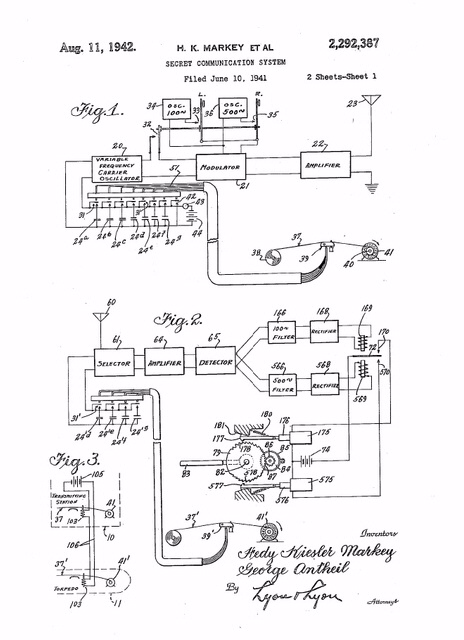
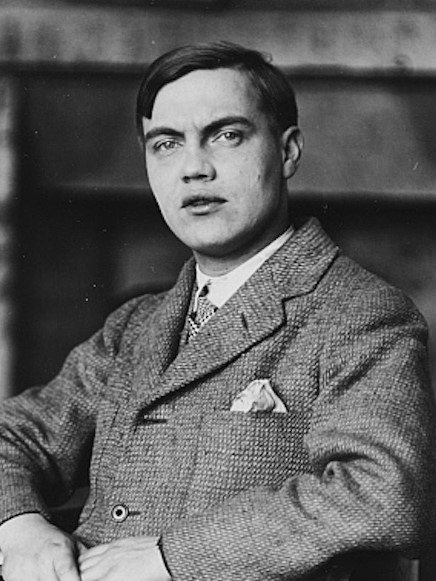
In 1942, actress Hedy Lamarr and composer George Antheil received U.S. patent 2,292,387 for their “Secret Communications System”,[9][10] an early version of frequency hopping using a piano-roll to switch among 88 frequencies to make radio-guided torpedoes harder for enemies to detect or jam. They then donated the patent to the U.S. Navy.[11]
Frequency-hopping ideas may have been rediscovered in the 1950s during patent searches when private companies were independently developing direct-sequence Code Division Multiple Access, a non-frequency-hopping form of spread-spectrum.[citation needed] In 1957, engineers at Sylvania Electronic Systems Division adopted a similar idea, using the recently invented transistor instead of Lamarr’s and Antheil’s clockwork technology.[9][dubious – discuss] In 1962, the US Navy utilized Sylvania Electronic Systems Division’s work during the Cuban Missile Crisis.[12]
A practical application of frequency hopping was developed by Ray Zinn, co-founder of Micrel Corporation. Zinn developed a method allowing radio devices to operate without the need to synchronize a receiver with a transmitter. Using frequency hopping and sweep modes, Zinn’s method is primarily applied in low data rate wireless applications such as utility metering, machine and equipment monitoring and metering, and remote control. In 2006 Zinn received U.S. patent 6,996,399 for his “Wireless device and method using frequency hopping and sweep modes.”
beautiful Jewish girl my fav of that era
Towards the end of my career, the AF started using HAVE QUICK radios. These were jam resistant UHF radios that used precise timing to jump from one frequency to another. Grandchild of Hedy’s invention?