

Posted on 04/11/2026 4:51:40 PM PDT by CondoleezzaProtege
Fight Club (1999), The Matrix (1999), The Truman Show (1998), Office Space (1999)– four movies, spanning genres from Thriller to Sci-Fi to Comedy, all have one very important thing in common: they share the same premise:
“A disillusioned man abandons a comfortable lifestyle, rebelling against the status quo in search of truth, purpose, and fulfillment.”
Sound familiar? It should.
This formula defined an era of filmmaking brimming with existentialist questioning and thinly veiled angst. The movies of this period reflect the most prevalent problems, anxieties, ideologies, and sensibilities of the 90s, ultimately forming a niche subgroup of their own– what can aptly be called “End of History” cinema.
To understand how this trend occurred, we have to acknowledge the cultural landscape that produced it.
During the years immediately following the collapse of the Soviet Union in 1991, the Western world experienced a period of unprecedented peace and stability. With the defeat of the 20th century’s two greatest terrors– fascism and communism– it was as if the world had crossed a threshold into a new era....
However, as the decade wore on, alternative responses to the new, pacified state of the world began to emerge...
Ironically, this peace created an epidemic– a generation of lost souls yearning for their own great challenge. A trial that would give their lives meaning.
Fight Club (1999) is probably the most famous example of a film in this vein. It captures in visceral detail the dark paths one might follow in searching for purpose.
(Excerpt) Read more at trillmag.com ...

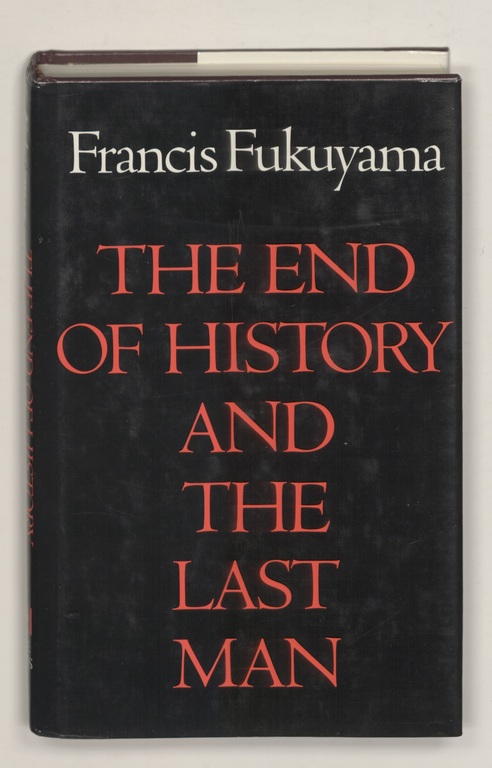
“Experience suggests that if men cannot struggle on behalf of a just cause … They will struggle for the sake of struggle. They will struggle, in other words, out of a certain boredom: for they cannot imagine living in a world without struggle.”
— Francis Fukuyama
“What we may be witnessing is … the end of history as such … the endpoint of mankind’s ideological evolution and the universalization of Western liberal democracy as the final form of human government.”
— Francis Fukuyama
I remember The Matrix—from when I watched and when I recognized for the first time the hatred of beauty.
The sub-genre, as defined was around long before the 1990s. “Brazil” comes to mind. And in television, about 15% of Twilight Zone episodes.
Ah, The Matrix. Carrie-Anne Moss and black leather together made the most spectacular keister ever seen in movies.
Meh. That sounds more like a 60s or 70s movie.
Brazil is a fantastic movie. I first saw it at the U of Arizona student union theater in 1987. It came out when I was in high school in 85 but I lived in the sticks in remote SE Montana then.

That is not a sociological argument and definitely not about utopia. So the writer has a problem when he says, “This notion of the world entering a fixed state of utopia is referred to by political scholars as the “End of History.” It looks like the movie critic is using a FF’s thesis in twisted form.
Why should we continue reading his 90s film file? Maybe for old time's sake.
Why even read Fukuyama, who thinks that consent of the governed is what characterizes the final liberal state. So Locke found the end in the 18th century, without Hegel!
BTW, it's hard to imagine anybody who hates the liberal endpoint as much as the EU.
I digress. This was about the crest wave of optimism in the 80s. I was once said you have to be serious to play rock and roll. And someone looked at me, “—serious? It's fun, you mean fun." Like a fixed state of utopia. Wait, you meant the 90s? Sorry, just sprinkle some Fukuyama on the 90s.
Nah. The author is wrong. It's not new. It's not 90s. Same old spoiled "notice me" Rebel Without A Cause narcissistic blather.
My parents, The Greatest Generation, had nothing. Grew on farms. Dad served in Patton's 3rd in Europe. After the war mom and dad both worked outside the home and gave their kids everything they never had. Toys. Clothes. Recreation. Movies. Later, cars, college.
Baby boomers were spoiled, lazy, and self centered. We are like James Dean in RWAC. He's getting ready to play chicken and asks Buzz, "why do we do this?" Buzz says, "You've gotta do something, man."
Office Space was a dud at the box office, as most of Jennifer Aniston’s movies were.
It was a simplistic store of disaffected white collar workers, nothing really new or special at the time
But it is now like a time capsule.
,,,,,,,,,,,,,,,,,,,,”Carrie-Anne Moss and black leather together made the most
spectacular keister ever seen in movies.”
Interesting. Could explain why I lost all interest in movies at about that time.
Office Space could is one of my favorite movies.
What an interesting thought. Antifa/BLM/No Kings/DEI and all of the rest of the crap is just a struggle to have a struggle, because struggle is the natural, normal human condition. If a man pretending to be a woman does not create enough struggle, then he invades your kids locker room to create more conflict and struggle. If only this energy could be directed to something positive.
For some, that positive is the latest war, but I wonder if the people enlisted share the same enthusiasm as those sending them...
Disclaimer: Opinions posted on Free Republic are those of the individual posters and do not necessarily represent the opinion of Free Republic or its management. All materials posted herein are protected by copyright law and the exemption for fair use of copyrighted works.