Posted on 03/28/2026 7:46:08 AM PDT by BEJ
I'm looking for good ideas on playing the guitar for beginners. Any suggestions?
Starting to Play the Guitar: Chords and Notes
1. Start by learning the chords at the foot of the neck or open position. There are a limited number of chords – roughly about 12 -- but you can eventually play many songs just using these chords.
2. Get to know the names of the strings.
3. Start to play notes up the strings. The C scale is good. Start of the low E string and play the natural notes from E up to G on the high E string. See if you can memorize these notes. (show how it is done). Keep fingers hovering close to the fretboard. Beginners often pull their hand away too far, which makes the next note harder to hit. Eventually you want to play melodies like Ode to Joy.
4. When showing them the C scale mention it has no sharps or flats (no black keys on a piano), which makes it the best scale for understanding how music is built 5. Get a chord chart with the fingerings for chords at the foot of the neck.
6. The first chord to play should be the easiest and that is E minor. Strum Em minor with down strokes. Hear how beautiful it sounds.
7. The second chord is the G chord. Watch how you only have to move one finger from the Em chord to play this new G chord. Keep the one finger as an anchor. Try not to move your hand off the strings. And keep you fingers near the strings.
8. Eventually get to finger all the chords. Pick each string one by one after forming a chord. This helps to identify which finger is accidentally muting a string.
9. Go from one chord to another and keep the fingers that don’t need moving in place as you change chords.
10. Good progression is G, Em, C, D or G, C, D. Do 4 down strums for each chord and then change. Eventually you will include up strums as well.
11. Fingers will take time to move but go slow and see it you can get to another chord on the beat. The chords can be played with different fingering: for example, the A chord can have 3 fingers pushing down the strings or 1 finger across the strings. Beginners should start with 3 fingers.
12. If you are good at getting to the other chords on time, then try up and down stroke for every beat.
13. Once you can get to the next chord easily and on time try going through all the chords. New progressions are C, F, G, F or D, G, A, G or E, A, B7, A.
14. It takes a while before you can move from one chord to another easily. Your hands will adjust, and it will be easier because of muscle memory. Keep things relaxed and even if there is a pause to get the grip of a new chord that will eventually disappear, and your hands will mover fluently. Try to switch chords without stopping your right-hand strumming, even if the chord isn't perfectly clear yet. Keeping the rhythm is more important than a perfect grip.
Most of the great guitarists, listened to mostly classical music, and not rock, case in point, Eddie Van Halen.
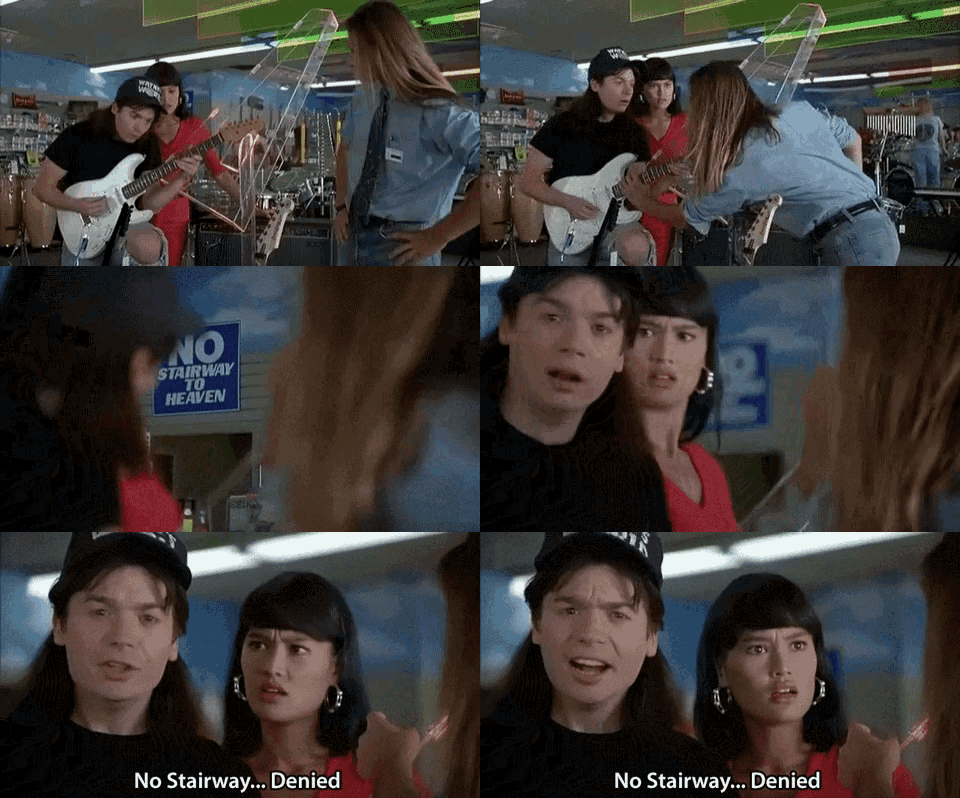
Great gif. Thanks for posting.
Start with electric. Way less frustrating to learn the ropes and much more gentle period of developing callouses on the fingers.
Once you have a better grasp of what you’re doing and some callouses have developed you can insert acoustic instruments into your practices.
Depending on time spent I’d say 6 months minimum electric only, up to a year.
I’d suggest a flatter neck radius, like 12”, for the electric. Standard for most Gibsons and Epiphones plus plenty other brands.
Zig
Learn tablature & power chords.
It’s a strength thing. Build up finger strength just by playing as much as you can. You can feel when they’re stronger. They have to be just to play so don’t gauge your ability and stamina until your finger strength is up and good. And callouses are your friend.
Lastly, I actually try to always play standing up. It’s about having the guitar suspended in space and not leaning on your lap. To me that affects the intonation and tone. Plus that’s what you do on stage 90% of the time as a guitarist. You’re more alert standing and the arm and hand motions are more natural.
Go online and get chord diagrams for the basic chords that are used most often: A, Am, A7, B, Bm, B7, C, Cm, D, Dm, D7, E, Em, E7, F, Fm (you can just press bottom 2 strings instead of full barre), G, Gm, G7.
Practice forming the chords (don’t let your thumb hang over the neck of the guitar, keep it behind the neck when playing chords. Arch the fingers so only the tips press the strings down). Strum strings downward while forming chords until you can produce relatively clear sounds on all strings.
Don’t practice for too long each day or your fingertips will get sore - after a while you will get callouses.
Once you can form chords and strum strings clearly, go online and find a song that uses those simple chords (and not a lot of them - some songs, like Neil Young’s ‘Helpless’ are only 3 chords, D, A and G). Play by simple strumming up and down, or any other strum pattern that you like - this is called playing ‘rhythm guitar’, as opposed to ‘fingerpicking’.
Some other time you can look up simple fingerpicking patterns for the right hand.
Important note - get a capo, so you can play chords at higher positions on the neck (if you want to sing/play a song at a higher pitch - just play the same chords, but with the capo on the neck in the middle of whatever fret you want, pressing down the strings. Can look up ‘how to use a capo for beginners’ on youtube if you want.
Also note - I’d suggest getting a pick (medium stiffness) and using that as well sometimes for a different strumming sound.
Also note - I’d suggest getting a strap for your guitar (I’m assuming acoustic/steel-string guitar here) and learning to play while standing - it will put you in better position than sitting down hunched over the guitar. If you learn to play standing, you can always sit down, but the opposite is harder (learning to play sitting down and trying to play standing.
Btw, it’s okay to have the words (with the chords above the words) in front of you while you play. Later on you can try to memorize where the chord changes - I still have trouble remembering chord changes, it comes easier for some and harder for others - but I don’t forget lyrics.
Keep it simple - the above is enough to get you started.
Good luck to you!
I was left handed but played right handed.
Guitar is a rhythm instrument.
My playing was not rhythmically good.
I couldn’t start over.
I gave it up.
Actually, Em7 is the easiest, since it just requires one finger.
The first chord to play should be the easiest and that is E minor. …
Disclaimer: Opinions posted on Free Republic are those of the individual posters and do not necessarily represent the opinion of Free Republic or its management. All materials posted herein are protected by copyright law and the exemption for fair use of copyrighted works.