Posted on 03/22/2026 8:48:00 AM PDT by MtnClimber
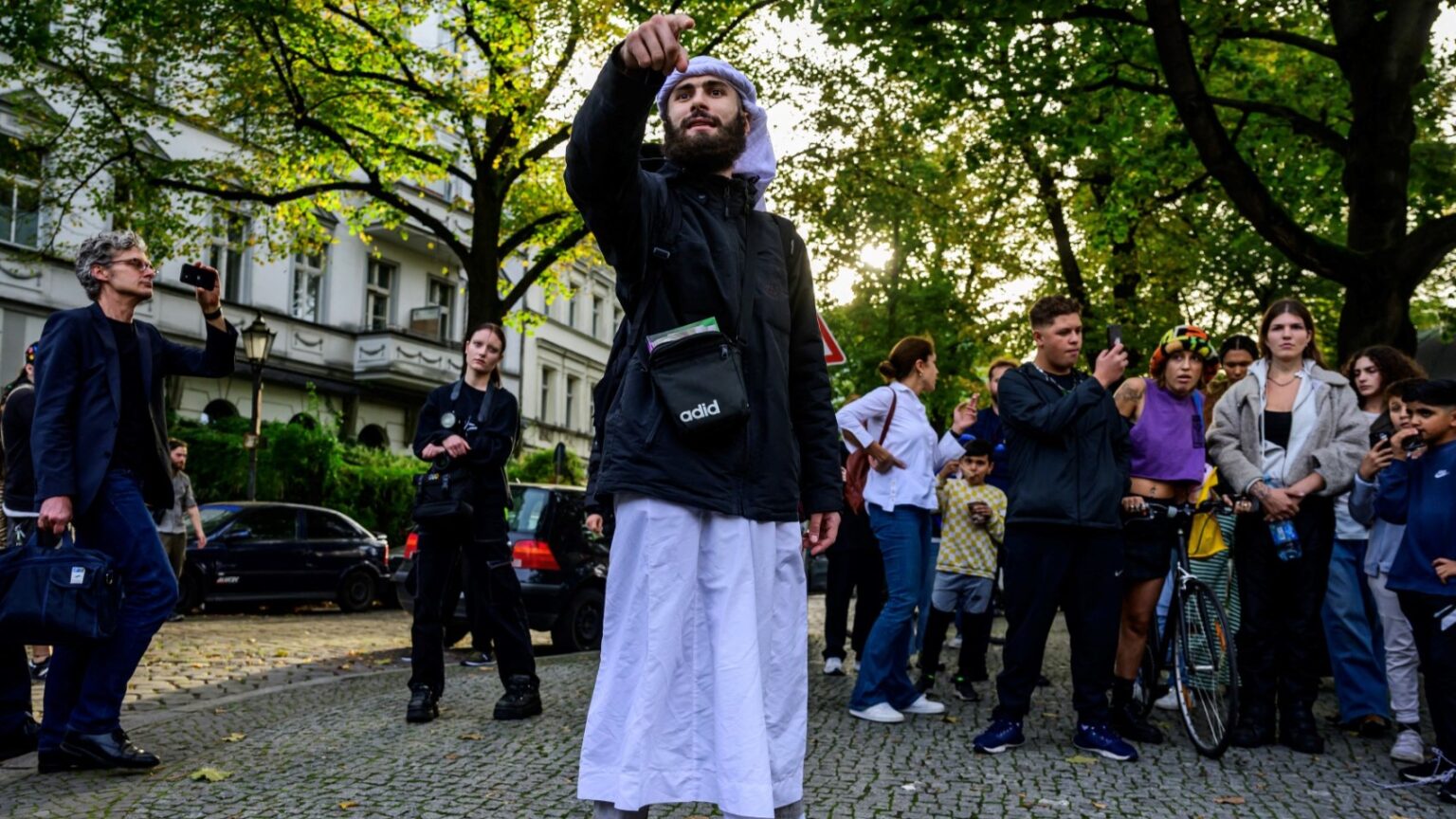
A Muslim preacher calls on Muslims to show themselves during a banned demonstration in support of Palestinians at Richardplatz, Neukölln, Berlin on October 11, 2023, four days after the October 7 Hamas pogrom in Israel. JOHN MACDOUGALL / AFP.
The last thing Berlin needs is a day against Islamophobia—what it does need is better politicians.
Last Sunday, March 15th, was Berlin’s first “Day of Action and Commemoration against Islamophobia”—an event the city’s senate claimed was intended to strengthen “diversity and social cohesion.” It might better be described as a ‘day of intimidation’ directed at the many Berliners who disagree with the multicultural ethos promoted by sections of the city’s elite—designed to discredit critics of mass migration from Muslim countries as racists.
The day’s chief promoter was Cansel Kiziltepe (SPD), Berlin’s Senator for Integration and Diversity. Mayor Kai Wegener (CDU) kept a markedly low profile, most probably aware of how unpopular the event would be with parts of his more conservative electorate. Kiziltepe, however, seized every opportunity to go on the offensive. In interviews she claimed that “60% of Berliners harbour anti-Muslim prejudices,” that “anti-Muslim racism is a bitter reality for many people,” and that it was “high time for the senate to demonstrate its appreciation of the 400,000 Muslims in the city.”
These sweeping claims about ordinary Berliners—portraying the city as a hotbed of anti-Muslim ‘racism’—rested on a single source: the Berlin Monitor, a research project examining political attitudes, social cohesion and experiences of discrimination, funded by the Berlin Senate itself. The Monitor found that 58% of Berliners agreed with the statement that “Islam is misogynistic in all its forms”; 61% rejected the claim that “Muslims advocate for an open society”; 42% believed the number of Muslims in Germany was too high; and 36% affirmed that “Muslims plan to Islamise the West step by step.”
Such survey questions—offering respondents a simple yes-or-no choice—appear designed less to understand the city’s citizens than to justify activities like the day of action.
It goes without saying that it is a gross generalisation to claim, for example, that all Muslims plan to Islamise the West. But it is equally wrong to dismiss concerns about the spread of Islamism as entirely unfounded. Nor is it surprising that so many should be concerned about Muslim migration. Berlin, like many cities in Western Europe, has had more than its fair share of problems linked to radical Islam, including attacks against women, a growth of virulent anti-Semitism, and terrorism.
Even as the day was being celebrated, Berlin’s security forces warned they were stretched to their limits, with the threat of terror attacks—in part a response to the war in Iran—reaching an unprecedented high.
Berlin is also the city shamed by street celebrations following the October 7th Hamas pogrom in 2023, centred on largely Muslim neighbourhoods in Neukölln. Since then, Berlin’s Jewish community has lived in near-constant fear of attack. In 2024, the city’s chief of police made headlines when she said that anyone openly gay, lesbian or visibly Jewish risked their safety in parts of Berlin. She was careful not to defame anyone, she noted, but pointed to “certain neighbourhoods, predominantly inhabited by people of Arab origin, who also harbour sympathies for terrorist groups.”
There have been terror attacks in the German capital to justify fears—some deadly, others thankfully thwarted. In 2024, police foiled a plot against the Israeli embassy. In 2020, a 30-year-old Iraqi man rammed his car into motorcyclists, severely injuring three, on Berlin’s A100 motorway, shouting “Allahu Akbar.” In 2016, 13 people were killed and 50 injured in an attack on Berlin’s Christmas market by 24-year-old Anis Amri, an unsuccessful asylum seeker from Tunisia, claiming allegiance to ISIS.
Then there are the honour killings—Muslim women murdered, often in broad daylight on public streets, by brothers, husbands or other male relatives for their “liberal lifestyles.” The most notorious cases are those of Hatun Sürücü, a young mother shot dead by her brother at a bus stop in Berlin-Tempelhof in 2005; Maryam H., a 34-year-old Afghan woman killed by her two brothers in Berlin-Hellersdorf in July 2021; and Zohra G., 31, stabbed by her husband in Berlin-Pankow in 2022.
The situation in Berlin’s schools has also raised legitimate alarm. Several teachers and headmasters have felt compelled to publish open letters urging the authorities to act. In 2025 the Carl-Bolle-Grundschule in Moabit made headlines after a gay teacher was told by students that he would “go to hell” and should leave because “Islam is the boss here.” Despite other teachers corroborating widespread intimidation by largely Muslim students, school authorities offered little to no support.
The Day against Islamophobia is the act of an authority that has long failed its citizens—one that, out of cowardice or incompetence, has turned a blind eye to the problems and dangers of a certain type of migration—with consequences that extend far beyond the classroom.
Just days before the state-ordered day against Islamophobia, news broke of the rape of a 16-year-old girl by a group of young Muslim men at a state-funded youth club, also in Neukölln. The scandal was not just the rape itself, but the reported attempts to cover it up to avoid stigmatising the Muslim perpetrators. When the story broke, Youth State Secretary Falko Liecke (CDU) stated: “It is unacceptable that the Muslim perpetrators are obviously being protected here so as not to stigmatise them, while the victim is being abandoned.” He is right—but it is the senate’s own conduct that has fostered this climate.
The day of action will have made matters worse. If anything, it will encourage the shameless display of some of the worst aspects of Islamist ideology.
It’s hardly surprising that the day was promptly exploited by pro-Mullah protesters carrying images of Khamenei, alongside veiled women holding signs with antisemitic slogans such as “Better the Mullahs than Epstein.” Few, if any, in Berlin’s senate would defend these demonstrators—but at the same time, far too few will speak out against them.
Ultimately, it is not Muslims that Berlin’s multiculturalists are trying to protect—it is their own ideologies and positions, particularly as growing numbers of people recognise how destructive multiculturalism truly is: an ideology that celebrates diversity as a virtue in itself while rejecting and even discrediting anyone who demands integration or assimilation.
Some of the sharpest critics of the day were Muslims themselves. Among the speakers at a protest organised by the feminist group Frauenheldinnen was Seyran Ateş, a lawyer, feminist and Muslim whose long-standing criticism of political Islam has made her the target of death threats and fatwas, requiring constant police protection. Like her fellow speakers, she deplored the suppression of free speech, arguing that the very concept of “anti-Muslim racism” was an insult to her intelligence—Islam, after all, is a religion, not a race.
The Berlin senate claims it was following the UN’s recommendation: the UN designated March 15th as the “International Day to Combat Islamophobia”. It is hardly surprising that the UN—long marked by anti-Zionist and anti-Western bias—should promote such a cause.
For Berlin, the day carries a toxic message. It incites hostility towards some of the West’s most foundational values: the separation of church and state, and the right to criticise—even mock—any religion. The notion that Islam deserves special protection reflects an anti-Western outlook rooted in defensive self-loathing. It also cultivates a culture of grievance within certain sections of the Muslim minority, at a time when teachers and other citizens must already weigh every word for fear of giving offence.
The last thing Berlin needs is a day against Islamophobia—what it does need is better politicians.
When will one of our democRATs propose a “Day of Action and Commemoration against Islamophobia” as a holiday in the USA?

Since Germany seems so fond of outsiders, maybe they will end up having some guy come in from Austria to set the house in order.
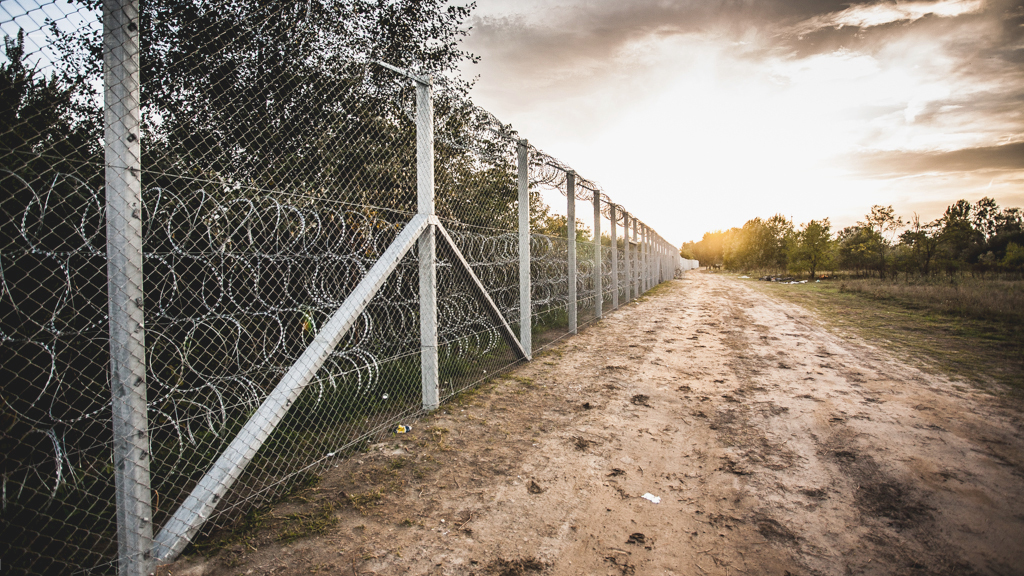
Hmm…maybe the Hungarian border fence has something to do with it.
More than 40% of Vienna’s schoolchildren are now Muslim. So the next despot coming out of Austria will probably be named Mohammed, and not Adolf.
Deport the Cult leader
I can remember when Hungary took down its border fence with Austria. We celebrated the of the ‘Eastern Bloc’ of Soviet controlled Europe. Of course that fence was to keep Hungarians in and this fence is to keep non-Hungarians out.
> this fence is to keep non-Hungarians out <
Hungary is oh so politically incorrect. The Hungarian border wall was built specifically to keep the Muslim invaders out. There is no border wall between Hungary and Slovakia to the north, for example.
Islamophobia is sort of like ebolaphobia.
The last Austrian to try that wrecked California!
“Skrrrew yah Freedum!”
Austrians don’t have a great track record when it comes to running places outside of Austria.
Or not.
They have Christianophobia Real Bad
Neukoln is a dump. I don’t think any Germans live there. Imported trash people and USA east coast hipsters live there.
I didn’t know about any Americans living there…but apart from that, it’s the equivalent of the South Bronx in the early Eighties.
Just with Middle Easterners, for the most part, instead of African Americans.
Hmm…iirc, Polish historians do generally cut the Austro-Hungarian authorities some slack when it comes to the administration of the Kingdom of Galicia and Lodomeria between 1772 and 1918.
Sorry if I am repeating myself for the umpteenth time, but it’s really no secret that our power elites in the state, the deep state and the presstitutes, would love us (indigenous Germans) gone.
https://lawliberty.org/the-oikophobic-will-to-power/
Madness, yes, but with a structure behind it. That article deals mainly with the situation in Britain, but it applies to many other Western nations, too.
Ebolaphobia?
Comment of the day, thanks for the laugh.
LOL. Where is Hitler when we need him? Or Stalin?
I went to Germany right before the Berlin Wall came down. West Germany was terrific, stayed at an excellent hotel, little restuarants in the neighbor were really good. And Germans were happy to meet an American.
Then I went to Chickpoint Charlie, climbed on a bus, and went to East Berlin, run by the commies. All the nice homes had been torn down and replaced with sterile commie apartments. Food at restaurant sucked beyond measure and there was only one towel in the ladies’ room. Etc etc. Though illegal, I ran over to the wall and picked up a rock that had fallen out. Still in my living room as a reminder.
Sounds to me that the German public could use a reminder too. My friend’s kids who live in Munich didn’t know about WW2. May give them that piece of the wall next time I see them,
Disclaimer: Opinions posted on Free Republic are those of the individual posters and do not necessarily represent the opinion of Free Republic or its management. All materials posted herein are protected by copyright law and the exemption for fair use of copyrighted works.