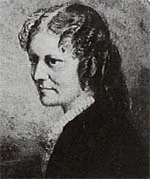
 Anna Sewell, 1878. Image by www.educared.org.ar via Wikimedia Commons (CC0)
Posted on 02/26/2026 5:00:31 AM PST by Cronos
“We have no right to distress any of God’s creatures without a very good reason; we call them dumb animals, and so they are, for they cannot tell us how they feel, but they do not suffer less because they have no words.”
These are the words of Black Beauty, the eponymous horse from Anna Sewell’s novel, Black Beauty: His Grooms and Companions, the Autobiography of a Horse.
The book, published by Norwich based Jarrold & Sons in 1877, was transformative. Sewell’s stated objective, “to induce kindness, sympathy, and an understanding treatment of horses”, is credited with the abolition of the checkrein or “bearing rein“. This strap was used to keep a horse’s head high – a fashionable, but cruel practice, and very painful and damaging to a horse’s neck.
Anna Sewell was born in 1820 at 26 Church Plain, Great Yarmouth. The UK’s largest horse welfare charity, Redwings, is the custodian of her birthplace, which is open to the public.
Anna Sewell, 1878. Image by www.educared.org.ar via Wikimedia Commons (CC0)Sewell wrote Black Beauty towards the end of her life while living in Old Catton. It took her seven years. She sold the copyright to Jarrolds for £40. Since then, the book has never been out of print and has been translated into over 125 languages. By telling the story of a horse’s life in the form of an autobiography, and describing the world through the horse’s eyes, Sewell broke new literary ground.
Her compassion for horses and their welfare arose from her constant use of horse-drawn carriages. Due to a fall at the age of 14, breaking both her ankles, Sewell was unable to stand or walk for very long for the rest of her life. Developing a love of equine creatures, it distressed her to see the abuse, neglect and cruelty they suffered.
“Although Black Beauty is often thought of as a children’s book, it obviously had a much deeper purpose in striving to stop cruel practices with horses, while being a very good read,” Caroline Jarrold, Non Executive Director at Jarrold & Sons, told East Anglia Bylines. “At first, sales were poor, and then, through careful marketing and advocacy, it captured the imagination of those campaigning for better treatment of horses, and general readers from across the world. As a company, we are proud of this heritage and the small part in which our forefathers’ decisions helped to make a difference to animal welfare.”
Since Sewell’s day, much has changed with regard to horse welfare. The Fédération Équestre Internationale has published an Equine Welfare Strategy Action Plan that sets out ethical training methods that consider the physical and mental state of the horse, as well as the safety of both horse and human.
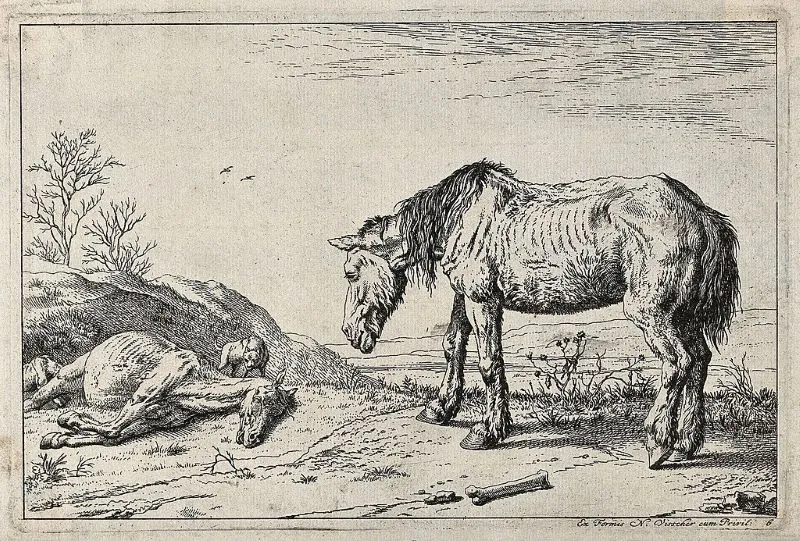 Ill and emaciated horse looking down on a dead horse. Image by Wellcome Library via Wikimedia Commons (CC BY 4.0)
“Horses really are tricky creatures – they have very individual needs, so actually caring for them can be challenging,” says Jane, a Norfolk horsewomen. “There is so much to go wrong. It isn’t just a case of sticking them in a field and riding them when you can be bothered. Stable management is a recognised field of study that recognises the complexities of the horses.”
Sadly, the need for horse sanctuaries persists. Across East Anglia, there are many sanctuaries and rescue centres. Isleham Horse and Pony Rescue Centre in Cambridgeshire has saved hundreds of animals from neglect and abuse. Their rescue of Prince, found starving and in very poor condition, is not unusual. Cecil’s Horse Sanctuary provides a home for more than 80 horses, ponies, mules and donkeys who have been abandoned, neglected, or have grown too old for their owners to care for them.
Redwings cares for more than 1,500 horses, ponies, donkeys and mules every day at their sanctuary sites in England and Scotland. Hillside Animal Sanctuary in West Runton has given sanctuary to 2,500 horses, ponies and donkeys. Essex Horse and Pony Protection Society has rescued over a thousand horses, ponies, and donkeys since their foundation in 1983. Like Redwings, the charity aims to rehome their animals in long-term, experienced foster homes.
A recent report by RSPCA argues for further strengthening of livery yard licensing and regulations. Their findings include overbreeding, abandonment and neglect. Inadequate equine-keeping facilities fail to provide enough opportunities for turnout, grazing and socialisation. Owners failing to respect the Three Fs – Forage, Friends, and Freedom – result in fewer opportunities for leisure and competition horses to experience positive welfare and a good quality of life.
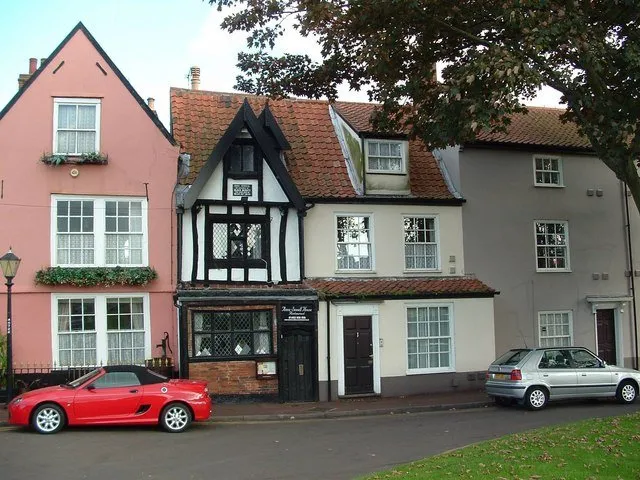 Timber framed house where Anna Sewell was born. Image by Paul Shreeve via Wikimedia Commons (CC BY-SA 2.0)
Sewell was buried on 30 April 1878 in the Quaker burial-ground at Lammas near Buxton, Norfolk. Black Beauty was not only a plea for more humane treatment of horses, but a great story. Every horse, pony, donkey and mule has the right to a happy and healthy life, free of fear and neglect. To quote Black Beauty:
“Now, I say that with cruelty and oppression, it is everybody’s business to interfere when they see it.”
We have come a long way in improving equine welfare. And yet, 150 years after the publication of Sewell’s novel, we still need equine rescue centres and sanctuaries. It is for all of us to continue this incredible lady’s legacy for horse welfare.
The Anna Sewell House is open to the public. As part of Norfolk Heritage Open Days, the house is open for free and Jarrolds is offering a History Tour.
Jarrolds was not involved in publishing Black Beauty from about 1921 onwards.
Just visited the Anna Sewell house yesterday
I watch a podcast from Normandy, France that is about a family, the Moons, that have a sanctuary for “legacy horses”. These horses were former racehorses or show horses. Some of them were minutes from slaughterhouses. They don’t limit themselves to horses. They have donkeys and lately dogs whose owners have passed away. One recent arrival was a horse covered in magots. It was heartbreaking, but they nursed this horse with immense care and kindness to bring it back to the life it deserved. The Moons’ for retired sport horses and animals on YouTube.
Maybe I'm thinking of the Black Stallion?
Black Beauty was a standalone novel, the only book that Anna Sewell wrote. Walter Farley wrote a series of books about the Black Stallion.
thanks
Wow, 20 books of the Black Stallion. I think I only had access to the first two or three.
We had a copy of Black Beauty around the house when I was a kid, and I read it a couple of times, but I never did read any of the Black Stallion series. I had no idea there were that many of them. Might give one or two to a kid we know who actually likes to read books.
Lots of great movies about horses.
National Velvet, Hidalgo, Secretariat… I know I’m forgetting some…
We had horses when I was younger, my dad, my brother, and I Mom was too scared to get on one..
Then my brother and I became more interested in two-legged fillys and that was the end of the horses…..
I was never much for riding horses, though all of my sisters liked to ride. My dad raised Belgians in retirement, but they weren’t really for riding. If nothing else, you’d need a stepladder to get up on one.
A movie was made pretty recently called “War Horse.”
A beautiful story about how a Hunting horse was bought
to aid the war effort.
Read more here from our friends @ Wikipedia:
(Spoiler Alert!)
https://en.wikipedia.org/wiki/War_Horse_(film)
I do not wish to get into arguments about the Directer (Spielberg) and so on.
I will say that NO horses were killed or abused while making this movie.
It’s a nice way to spend an afternoon in the
cold winter, watching with your spouse and kiddos
and a good topic for discussion with young
ones about World War 1.
Enjoy!
P.S.
I would not recommend it to kids under 14 years of age
due to some graphic scenes.
It might however, show them that unlike video games-
some of the brave military, unlike their games-never got back up.
Disclaimer: Opinions posted on Free Republic are those of the individual posters and do not necessarily represent the opinion of Free Republic or its management. All materials posted herein are protected by copyright law and the exemption for fair use of copyrighted works.


