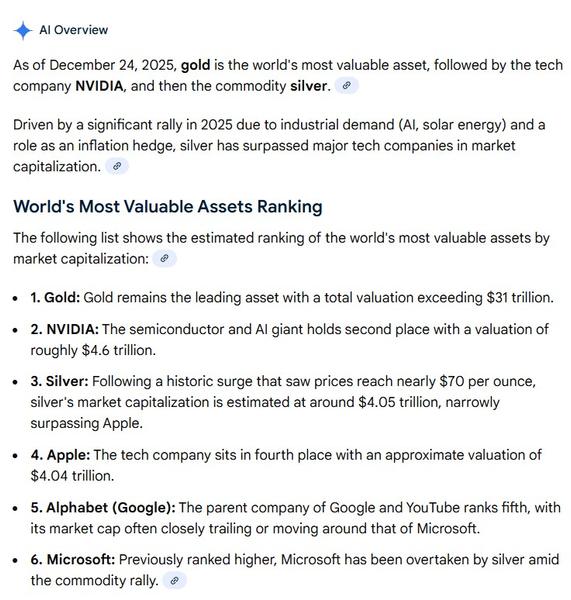
Silver’s market cap is $4.05 trillion - but @ $72/ounce are there 56,250,000,000 deliverable ounces of silver on the planet?
,,, maybe they're mindful of a possible second Roosevelt racket... compulsory surrender of public holdings.
As of December 24, 2025, gold is the world's most valuable asset, followed by the tech company NVIDIA, and then the commodity silver. Driven by a significant rally in 2025 due to industrial demand (AI, solar energy) and a role as an inflation hedge, silver has surpassed major tech companies in market capitalization.Karl Spooner is committing a so-called "category mistake."World's most Valuable Assets Ranking
The following list shows the estimated ranking of the world's most valuable assets, by market capitalization:
1. Gold (with a total valuation exceeding $31 trillion);
2. NVIDIA (with a valuation of roughly $4.6 trillion);
3. Silver (following a historic surge that saw prices reach nearly $70 per ounce, silver's market capitalization is estimated at around $4.05 trillion, narrowly surpassing Apple).
Karl Spooner's central claim—that silver has become the world's third most valuable asset after gold and NVIDIA—is built on a series of questionable assumptions, selective metrics, and category errors. While silver has indeed experienced a dramatic price rally in 2025, Karl Spooner's framing exaggerates its economic significance and misrepresents how asset valuations should be compared.
Below is a structured rebuttal that challenges Karl Spooner's logic, methodology, and conclusions.
The ranking presented—gold, NVIDIA, silver—compares:
This is an apples to oranges comparison. Market capitalization for a company reflects investor expectations, earnings, and future cash flows. Market capitalization for a commodity reflects spot price × estimated above ground supply.
These are not equivalent economic measures. Calling silver the "third most valuable asset" because its theoretical above ground value exceeds Apple's equity valuation is a category mistake.
Karl Spooner claims silver's "market value" is about $4.04 trillion. But this number is derived from:
Price per ounce × Estimated total above ground silver
This is not how market capitalization works.
By contrast, Apple's or NVIDIA's market cap reflects the actual value of tradable shares.
As other commenters on the page point out, the amount of silver implied by the valuation is not physically deliverable. This matters because:
A valuation that cannot be realized in any real world scenario is not a meaningful valuation.
Karl Spooner attributes silver's surge to:
While these factors do influence silver prices, Karl Spooner ignores:
As others have noted: Silver production has been in deficit for years and that paper markets distort pricing. This suggests the rally is not purely fundamental.
Calling silver the "third most valuable asset" implies a durable, structural shift. But silver's price history is notoriously volatile:
A temporary rally does not justify rewriting global asset rankings.
If the goal is to rank "the world's most valuable assets," then the article omits:
By excluding these, Karl Spooner creates a misleading narrative that elevates silver beyond its actual economic footprint.
Silver's 2025 rally is real and noteworthy. But the claim that silver is now the "world's third most valuable asset" is not supported by:
At best, Karl Spooner presents an interesting trivia point:
"If you multiply silver's spot price by an estimate of all above ground silver, you get a number larger than Apple's market cap."
That is not the same as saying silver is the world's third most valuable asset. Regards,