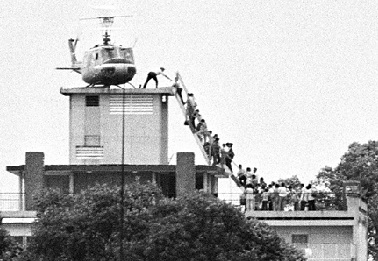
Second, I think we agree on a lot here, but there's more to the story, and especially the role of majority Democrats in defeating the US war effort in Vietnam:
jeffersondem: "U.S. fighting men did win all, or most, of the major battles so in that sense the U.S. Army did “win”; but at a cost that was not sustainable.
I contend, in hindsight, the U.S. Army lost the war when U.S. Army generals agreed to fight a land war in Asia for 14 years using tactics that played to the long-term advantage of insurgent forces and the North Vietnamese.
The tit-for-tat fighting resulted in 50,000 U.S. dead and 300,000 wounded."
Let's start here: the Vietnam War lasted 20 years from 1955 to 1975, but 98% of US costs and casualties came in the 8 years from 1965 through 1972.
US Vietnam force levels peaked in 1968 at around 536,000.
From 1968 through 1975 North Vietnamese PAVN launched three major invasions of South Vietnam:
- 1968 Tet Offensive, over 540,000 PAVN/VC troops, versus 1,300,000 US, South Vietnamese ARVN and other allies -- result: US victory
- 1972 Easter offensive, smaller at 300,000 PAVN troops vs. 850,000 of which 90% were South Vietnam ARVN & 10% US forces -- result: South Vietnam and US victory.
- 1975 Spring Offensive & Fall of Saigon, 270,000 PAVN troops vs 1,300,000 South Vietnamese ARVN troops, not supported by US navy and Airforce assets on Guam and at Subic Bay -- result: North Vietnam victory.
However, success in peace required US continued support for South Vietnam -- at roughly the same levels we were then supporting South Korea, and have been supporting Ukraine since February 2022 = ~$30 billion per year in today's equivalent dollars.
But in 1973, Democrats in Congress voted to halve the aid requested and, in 1974, to eliminate future aid.
The result was, in 1975 South Vietnam's Army was unable to withstand the weaker PAVN 1975 Spring Offensive.
jeffersondem: "It should have been predicted by the Army that these casualty rates would not be supported by the public for 20 years.
And it wasn't."
US KIA's rose from 2,000 in 1965, reached a peak of ~17,000 in 1968, and fell to 1,000 in 1972.
In the NVA's 1972 Spring Offensive, which the South Vietnamese won, US casualties were 300 KIA, ~1,500 wounded.
So, even in 1972, casualty rates were not a major issue.
And US casualties were fully addressed by Pres. Nixon in his 1973 Paris Peace Accord, by withdrawal of US combat troops from South Vietnam.
So, the Paris accord assumed no US combat troops, but continued US support of South Vietnam -- again: at roughly the dollar level of US aid to South Korea then, and to Ukraine today.
In round numbers of today's equivalents, the Vietnam war cost the US around $5 trillion over 20 years, but 98% of that during the last 10 years, from 1965 to 1975 = about $500 billion per year (which was also roughly the cost of the US 20 year-long War on Terror = $500 billion per year in today's equivalents).
The cost to maintain the South Vietnamese government was about $30 billion per year (in today's equivalents), however, in 1973 Democrats in Congress cut US aid in half and in 1974 they eliminated all aid to South Vietnam.
The result was: the South Vietnamese army, which had stood up against previous larger invasions, failed in the face of the smaller 1975 North Vietnamese Spring Offensive.
The US abandoned about $5 billion of equipment in Vietnam, in today's values that's around $100 billion worth.
jeffersondem: "The other rule, less mentioned, is that U.S. military leaders have an absolute responsibility to advocate effective war fighting strategy to civilian leaders and if civilian leaders pursue disastrous national policies top military brass have an obligation to resign and explain their concerns to the public."
That much is certainly true, but what's not true is that the US military lost its battles, or the war, in Vietnam.
Defeat in Vietnam, as in many other places, was accomplished by Democrats in Congress.
jeffersondem: "I don't remember a lot of generals resigning because they opposed the policies of Kennedy, Johnson, or Nixon. Maybe there were some."
Defeat in Vietnam was guaranteed by LBJ's 1964 campaign against Mr. Conservative Republican Sen. Barry Goldwater, when LBJ accused Goldwater of wanting to start a nuclear war, thus promising that he, Johnson, would not.
Therefore, Vietnam had to be fought with a constant eye towards not "provoking" the Soviets into nuking us!
This was the Cause, and the Result:
1964 LBJ's Daisy Girl Ad -- 1968 anti-war protests -- 1975 Fall of Saigon: