It plainly states that the Southern states would win economically and the Northern States would lose.
*If* one is pushing the "all about slavery" argument then it is indeed a statement against interest.
Here is a northern newspaper making the economic argument quite clearly."
This is the same argument DiogenesLamp has made for years, and it's just as false here as it is when he makes it, because:
- First, "all about slavery" begins with declarations of secession and their official "Reasons for Secession" documents, which did emphasize slavery in every case.
- Second, "all about slavery" doesn't mean secessionists didn't have other complaints to throw in at the same time, which we've reviewed at length now:
"Reasons for Secession" Documents before Fort Sumter -- % of words devoted to each reason *
Reasons for Secession S. Carolina Mississippi Georgia Texas Rbt. Rhett A. Stephens AVERAGE OF 6 Historical context 41% 20% 23% 21% 20% 20% 24% Slavery 20% 73% 56% 54% 35% 50% 48% States' Rights 37% 3% 4% 15% 15% 10% 14% Lincoln's election 2% 4% 4% 4% 5% 0% 3% Economic issues** 0 0 15% 0% 25% 20% 10% Military protection 0 0 0 6% 0% 0% 1% * Alabama listed only slavery in its "whereas" reasons for secession.
** Economic issues include tariffs, "fishing smacks" and other alleged favoritism to Northerners in Federal spending. - Third, nobody has ever argued that "all about slavery" referred to the Union responses to secession -- that is a complete strawman.
Instead, the first Union response was, in effect: secession "at pleasure" is not constitutional and if it results in war, then we will fight to restore the Union.
Many in the Union also looked for "compromises" they might offer to prevent further secessions, and these "compromises" were always "all about slavery". - Fourth, the Battle of Fort Sumter, which launched the Civil War, had nothing directly to do with slavery, but was "all about" Jefferson Davis asserting Confederate "sovereignty" and winning over Upper South states to secession.
- Finally, "all about slavery" did play out throughout the war, beginning with freedom for "Contraband of War" and the Emancipation Proclamation for the North, along with many Confederate comments on the subject:
Here are some, listed in date sequence:
- 1849: "Henry L. Benning, Georgia politician and future Confederate general, writing in the summer of 1849 to his fellow Georgian, Howell Cobb (GA Governor, Buchanan’s Sec of Treasury):
- 'First then, it is apparent, horribly apparent, that the slavery question rides insolently over every other everywhere -- in fact that is the only question which in the least affects the results of the elections.'
[Allan Nevins, The Fruits of Manifest Destiny pages 240-241.]Later in the same letter Benning says,
- 'I think then, 1st, that the only safety of the South from abolition universal is to be found in an early dissolution of the Union.' “
- 1856: "Richmond Enquirer, 1856:
- 'Democratic liberty exists solely because we have slaves . . . freedom is not possible without slavery.' "
- 1858: "Albert Gallatin Brown, U.S. Senator from Mississippi, speaking with regard to the several filibuster expeditions to Central America:
- 'I want a foothold in Central America... because I want to plant slavery there....
I want Cuba,... Tamaulipas, Potosi, and one or two other Mexican States;
and I want them all for the same reason - for the planting or spreading of slavery'
[McPherson: Battle Cry of Freedom, p. 106.]" - 1858: Speech of Jefferson Davis before the Mississippi Legislature (16 November 1858)
- ’Whether by the House or by the People, if an Abolitionist be chosen President of the United States, you will have presented to you the question of whether you will permit the government to pass into the hands of your avowed and implacable enemies... such a result would be a species of revolution by which the purposes of the Government would be destroyed and the observance of its mere forms entitled to no respect.
In that event, in such manner as should be most expedient, I should deem it your duty to provide for your safety outside the Union ‘ - 1859 -- "Richard Thompson Archer (Mississippi planter):
- 'The South is invaded.
It is time for all patriots to be united, to be under military organization, to be advancing to the conflict determined to live or die in defence of the God given right to own the African'
---letter to the Vicksburg Sun, Dec. 8, 1859." - 1859: "Senator Robert M. T. Hunter of Virginia:
- 'There is not a respectable system of civilization known to history whose foundations were not laid in the institution of domestic slavery.'
[McPherson: Battle Cry of Freedom, p. 56.]" - 1860: "Atlanta Confederacy, 1860:
- 'We regard every man in our midst an enemy to the institutions of the South, who does not boldly declare that he believes African slavery to be a social, moral, and political blessing.' "
- 1860: "Lawrence Keitt, Congressman from South Carolina, in a speech to the House on January 25, 1860:
- 'African slavery is the corner-stone of the industrial, social, and political fabric of the South; and whatever wars against it, wars against her very existence.
Strike down the institution of African slavery and you reduce the South to depopulation and barbarism.'Later in the same speech he said,
- 'The anti-slavery party contend that slavery is wrong in itself, and the Government is a consolidated national democracy.
We of the South contend that slavery is right, and that this is a confederate Republic of sovereign States.'
Taken from a photocopy of the Congressional Globe supplied by Steve Miller." - 1860: "Keitt again, this time as delegate to the South Carolina secession convention, during the debates on the state's declaration of causes:
- 'Our people have come to this on the question of slavery.
I am willing, in that address to rest it upon that question.
I think it is the great central point from which we are now proceeding, and I am not willing to divert the public attention from it.'Taken from the Charleston, South Carolina, Courier, dated Dec. 22, 1860.
See the Furman documents site for more transcription from these debates.
Keitt became a colonel in the Confederate army and was killed at Cold Harbor on June 1, 1864." - 1860: “William Grimball to Elizabeth Grimball, Nov. 20, 1860:
- ’A stand must be made for African slavery or it is forever lost."
[James McPherson, For Cause and Comrades, p. 20] - 1860: "Senator Louis Trezevant Wigfall; December 11, 1860, on the floor of the Senate;
- 'I said that one of the causes, and the one that has created more excitement and dissatisfaction than any other, is, that the Government will not hereafter, and when it is necessary, interpose to protect slaves as property in the Territories;
and I asked the Senator if he would abandon his squatter-sovereignty notions and agree to protect slaves as all other property?'
[Quote taken from The Congressional Globe, 36th Cong., 2nd Sess., p. 58.]" - 1860: "Alfred P. Aldrich, South Carolina legislator from Barnwell:
- 'If the Republican party with its platform of principles, the main feature of which is the abolition of slavery and, therefore, the destruction of the South, carries the country at the next Presidential election, shall we remain in the Union, or form a separate Confederacy?
This is the great, grave issue.
It is not who shall be President, it is not which party shall rule --- it is a question of political and social existence.'
[Steven Channing, Crisis of Fear, pp. 141-142.]" - 1861: Jefferson Davis made a farewell address to the Senate, in January 1861.
- ’It has been a conviction of pressing necessity, it has been a belief that we are to be deprived in the Union of the rights which our fathers bequeathed to us, which has brought Mississippi to her present decision.
She has heard proclaimed the theory that all men are created free and equal, and this made the basis of an attack upon her social institutions; and the sacred Declaration of Independence has been invoked to maintain the position of the equality of the races.’ - 1861: "John Tyler Morgan, Dallas County, Alabama; also speaking to the Alabama Secession Convention on January 25, 1861:
- ’The Ordinance of Secession rests, in a great measure, upon our assertion of a right to enslave the African race, or, what amounts to the same thing, to hold them in slavery.' "
- 1861: "Henry M. Rector, Governor of Arkansas, March 2, 1861, Arkansas Secession Convention, p. 44
- 'The area of slavery must be extended correlative with its antagonism, or it will be put speedily in the 'course of ultimate extinction.'....
The extension of slavery is the vital point of the whole controversy between the North and the South...
Amendments to the federal constitution are urged by some as a panacea for all the ills that beset us.
That instrument is amply sufficient as it now stands, for the protection of Southern rights, if it was only enforced.
The South wants practical evidence of good faith from the North, not mere paper agreements and compromises.
They believe slavery a sin, we do not, and there lies the trouble.' " - 1861: from Lincoln's first inaugural address, on March 4, 1861:
- “One section of our country believes slavery is right and ought to be extended, while the other believes it is wrong and ought not to be extended.
This is the only substantial dispute." - 1861: from CSA VP Alexander Stephens's "Cornerstone Speech," seventeen days later:
- "The new [Confederate] Constitution has put at rest forever all the agitating questions relating to our peculiar institutions — African slavery as it exists among us—the proper status of the negro in our form of civilization.
This was the immediate cause of the late rupture and present revolution. ..." - 1861: "Thomas F. Goode, Mecklenburg County, Virginia, March 28, 1861, Virginia Secession Convention, vol. II, p. 518,
- 'Sir, the great question which is now uprooting this Government to its foundation---the great question which underlies all our deliberations here, is the question of African slavery...' "
- 1861: "Methodist Rev. John T. Wightman, preaching at Yorkville, South Carolina:
- 'The triumphs of Christianity rest this very hour upon slavery; and slavery depends on the triumphs of the South . . .
This war is the servant of slavery.'
[The Glory of God, the Defence of the South (1861), cited in Eugene Genovese's Consuming Fire (1998).]" - 1862: "The Vidette, a camp newspaper for Confederate Brig. Gen. John Hunt Morgan's cavalry brigade.
In one of the November, 1862 issues, the following appeared:- "...any man who pretends to believe that this is not a war for the emancipation of the blacks, and that the whole course of the Yankee government has not only been directed to the abolition of slavery, but even to a stirring up of servile insurrections, is either a fool or a liar.' "
- 1863: "William Nugent to Eleanor Nugent, Sept 7, 1863:
- 'This country without slave labor would be completely worthless.
We can only live & exist by that species of labor; and hence I am willing to fight for the last.'
[James McPherson, For Cause and Comrades, p. 107]" - 1864: "Catherine Ann Devereux Edmonston, December 30, 1864:
- 'We have hitherto contended that Slavery was Cuffee's normal condition, the very best position he could occupy, the one of all others in which he was happiest... No!
Freedom for whites, slavery for negroes.
God has so ordained it.'
From: The Journal of a Secesh Lady: The Diary of Catherine Ann Devereux Edmonston, 1860-1866." - 1864: "CS Brigadier General Clement Stevens:
- 'If slavery is to be abolished then I take no more interest in our fight.
The justification of slavery in the South is the inferiority of the negro.
If we make him a soldier, we concede the whole question.'
[Cited in James C. Nisbet, Four Years on the Firing Line, pp. 172—173]" - 1894: CSA Col. John S. Mosby – leader of “Mosby’s Rangers”:
- “I've always understood that we went to war on account of the thing we quarreled with the north about.
I've never heard of any other cause of quarrel than slavery.
Letter (1894), as quoted in The Confederate Battle Flag: America’s Most Embattled Emblem (2005), by John M. Coski - 1907: Letter from Samuel "Sam" Chapman (June 1907)
- ’The South went to war on account of slavery.
South Carolina went to war, as she said in her secession proclamation, because slavery would not be secure under Lincoln.
South Carolina ought to know what was the cause for her seceding.
The truth is the modern Virginians departed from the teachings of the Father's.” - 1997: James M. McPherson, For Cause and Comrades: Why Men Fought in the Civil War (1997), p. 106.[40]
- ’Unlike many slaveholders in the age of Thomas Jefferson, Confederate soldiers from slaveholding families expressed no feelings of embarrassment or inconsistency in fighting for their liberty while holding other people in slavery.
Indeed, white supremacy and the right of property in slaves were at the core of the ideology for which Confederate soldiers fought.’“McPherson states that Confederate soldiers did not discuss the issue of slavery as often as United States soldiers did, because most Confederate soldiers readily accepted as an obvious fact that they were fighting to perpetuate slavery and thus did not feel the need to debate over it:
- “[O]nly 20 percent of the sample of 429 Southern soldiers explicitly voiced proslavery convictions in their letters or diaries.
As one might expect, a much higher percentage of soldiers from slaveholding families than from non-slaveholding families expressed such a purpose: 33 percent, compared with 12 percent.
Ironically, the proportion of Union soldiers who wrote about the slavery question was greater, as the next chapter will show.
There is a ready explanation for this apparent paradox.
Emancipation was a salient issue for Union soldiers because it was controversial.
Slavery was less salient for most Confederate soldiers because it was not controversial.
They took slavery for granted as one of the Southern 'rights' and institutions for which they fought, and did not feel compelled to discuss it.”
— James M. McPherson, For Cause and Comrades: Why Men Fought in the Civil War (1997), pp. 109–110.[41]“Continuing, McPherson also stated that of the hundreds of Confederate soldiers' letters he had examined, none of them contained any anti-slavery sentiment whatsoever:
- 'Although only 20 percent of the soldiers avowed explicit proslavery purposes in their letters and diaries, none at all dissented from that view’.”
— James M. McPherson, For Cause and Comrades: Why Men Fought in the Civil War (1997), p. 110, emphasis in original.[41]
Bottom line: there's no doubt that protecting slavery was important to many Confederates as was abolition to many Unionists.
Others eventually began to say the war was really over something else:
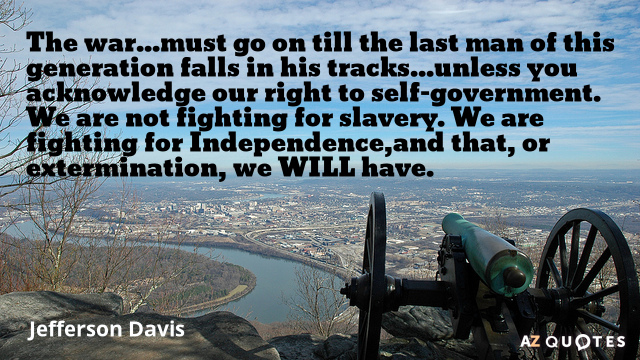
Fortunately, Jefferson Davis did not get his wish in either case.