
The data for the Nissan Leaf look a LOT worse...

Posted on 04/30/2024 8:23:30 PM PDT by Libloather
Money Mail can today reveal a timebomb looming in the second-hand market for electric vehicles (EVs).
Our investigation found that many EVs could become almost impossible to resell because of their limited battery life.
Experts said that the average EV battery guarantee lasts just eight years. After this time, the battery may lose power more quickly and so reduce mileage between charges.
Many EVs will lose up to 12 per cent of their charge capacity by six years. Some may lose even more.
Yet the cost of replacing an EV battery is astonishingly high, our research found.
In some cases, the cost of a replacement battery is as much as £40,000. For certain EVs, the cost of replacing the battery could be ten times the value of the vehicle itself on the second-hand market.
That means used EVs have a limited lifespan — which makes them a bigger and bigger risk as the years go by.
Research into EV batteries is yet to be conclusive and the second-hand EV market is new, given the first popular EVs were rolled off the production line in 2009.
Last night, one motoring expert said customers should be wary of buying a used electric car beyond its warranty (typically eight years), as after that timespan there is no easy way of measuring how much the battery will degrade before it needs replacing.
This may mean you end up needing to pay for an expensive new battery.
Motor expert Shahzad Sheikh, who runs the YouTube channel Brown Car Guy, said: ‘With a decaying battery, the range will be poor and you may find it becomes increasingly hard to resell the vehicle after eight years.
Buyers will know that they’ll only get a small amount of life out of the car so will pay...
(Excerpt) Read more at dailymail.co.uk ...
It will be interesting to see how this plays out in another 10 years.
research dollars that have been sunk into battery tech have been paying off so far and that if lightweight solid state batteries become practical it will just be the beginning of even more density.
Ask Hertz, who is going bankrupt trying to unload a huge cache of used EVs nobody wants to rent and nobody wants to buy.
I’ve quelled a couple of ICE vehicle [engine] fires. [When it gets beyond the engine compartment, it’s generally over.]
Easy Peasy with a good extinguisher [CO2 is best given minimal cleanup effort].
Li batt fires? Totally tough, even for the pros with extensive equipment.
I own 2 50 year old VW beetles. Parts are cheap. Both run well. There is no way an EV can last that long.
“It is also very difficult, time consuming, and potentially impossible to check a used battery for defects”
ROTFLMAO!
Check overall range estimates: Fully charge the battery and then check the estimated range on the dash. If that lines up with the manufacturer’s estimated range, you’re in good shape.
State of Charge (SOC): The dash or infotainment display will show you the state of charge or remaining battery percentage as you drive. If this drops an abnormal amount during casual city driving, it could be a sign of a bigger issue. Keep in mind that estimates aren’t always accurate, but this is one more quick way to gauge the situation.
Check Engine Lights (or Battery): No one wants to see a CEL while driving, and on an EV, it’s even worse if you get an alert on the dash from the battery management system (BMS). Check the owner’s manual for more details if you see a light you don’t understand.
Diagnostic Tools and Apps: Most companion apps (from Tesla to Hyundai) have tools that let users check battery health. Any honest 3rd party seller will show you the vehicle battery stats. You can even access select battery health information from Tesla’s infotainment display in the service menu.
Dealer Tools and OBD-2 scanners: Additionally, you could always request bringing the vehicle to a dealer service center to complete a battery test. I’d recommend it on any large purchase, like taking a used car to a mechanic before buying. Savvy DIY buyers could even use their own OBD-2 scanner.
https://www.howtogeek.com/how-to-check-ev-battery-health/
I have an old cell phone for sell to go with the car
“Ask Hertz, who is going bankrupt trying to unload a huge cache of used EVs nobody wants to rent and nobody wants to buy.”
Facts, please.
The data for the Nissan Leaf look a LOT worse...
“Well then Tesla is full of crap because batteries are not just about miles they are about the number of years since they were made. Even a battery that was never used will expire in a number of years. So basing battery life only on miles is deceptive at best.”
Tesla says batteries should last 1500 or more cycles. Fewet cycles per year results in more years.
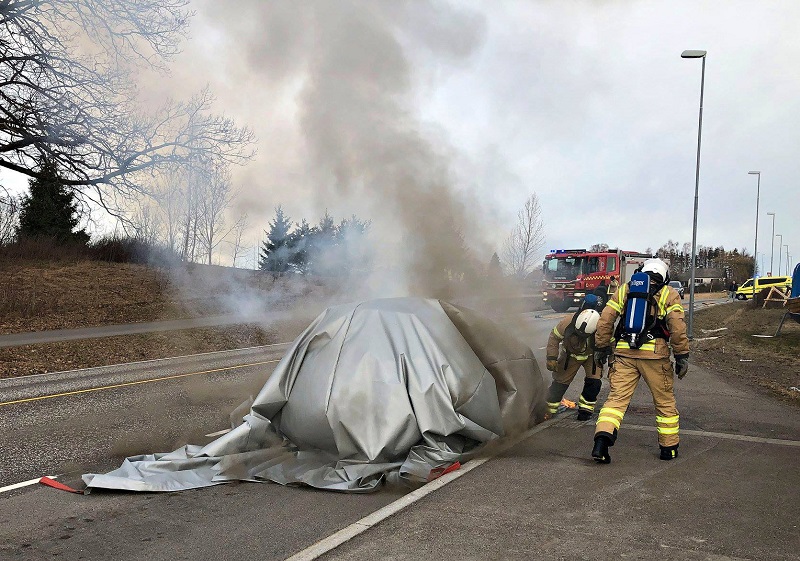
It gets even better. Add in the EV dunk tanks with eleven tons of water...

And portable containment systems to corral all the polluted water...

Those all seem expensive and a functional hassle for the average EV owner to carry onboard as one goes about their daily bidness.
Hook up a ICE engine/generator trailer to tow with an umbilical cord.
EV batteries typically degrade due to temperature, cycles and time. Storage and operating temperatures have a huge impact on EV battery longevity; in general, warmer climates negatively affect the lifespan of an EV battery. As the battery goes through charge cycles — discharged while driving and charged back up while plugged in — it slowly loses maximum potential. However, simply not using or charging your EV battery does not mean it will last forever: Calendar degradation is the battery losing life over time.
https://www.evconnect.com/blog/how-long-does-an-electric-car-battery-last
You can have your friends follow you with the portable dunk tank and claw...

“Many EVs will lose up to 12 per cent of their charge capacity by six years.”
A lot will depend on whether that capacity loss is linear or falls off a cliff. It it is linear, then why bother to change the battery? You would have 75% of original range in a 12 year old car. Just use it for shorter trips or sell it to people who have short-range needs.
But if the capacity loss is nonlinear and you hit 75% at (say) 8 years and 50% at 9 years, then you a piece of junk with zero resale value. Then call Pick and Pull and hope they are taking the junk.
Someone is going to make a fortune refurbishing EV packs. Usually only one or two cells go “bad” and are flagged by the BMS which triggers a fault and a battery replacement. In reality only those individual cells need to be replaced but not with new cells since the others will try to pull charge from them due to slightly different fully charged voltages. The key is finding similar cells with a range of SOC that matches the over all pack average. Not hard just find a module of similar miles or age and test the cells with a volt/amp ramp test. Modules might be different but the cells are of a standardized cell size and type. Tesla uses 18650 and 21700 cells those are industry standard cylindrical cells. Taking apart a module will yield hundreds of individual cells only one or two would be bad the rest have life left. Test them and match them to other cells of similar use and age reassemble the module and put it back with the other modules. This is not a $40,000 process it’s a few hours in labor and used cells would have a value in the few dollars each otherwise they end up recycled or landfilled.
I just looked my Model 3 with LFP cells has 45,xxxx miles it shows a pack loss of 5% from new. LFP packs in uber service are going 300,000+ miles before 80% pack loss. And those get supercharged on the regular. Mine is a lease so I’m not really worried about cell life it’s interesting to see how it holds up under Texas heat and my lead foot. Mine hardly ever sees a supercharger it gets L2 240V overnight. If the college kid that subleases it for uber drives supercharges it the car will keep a note of it in this charge history so far he hasn’t needed too. One of the Turo rentals did at 50% SOC why I don’t know they didn’t drive more than 50 miles more and brought it back with 70+% SOC I told them they could bring it home with 10% or more. Newbies I guess with range anxiety.
I sincerely hope your lead foot ends up causing a collision fatal to you
Disclaimer: Opinions posted on Free Republic are those of the individual posters and do not necessarily represent the opinion of Free Republic or its management. All materials posted herein are protected by copyright law and the exemption for fair use of copyrighted works.