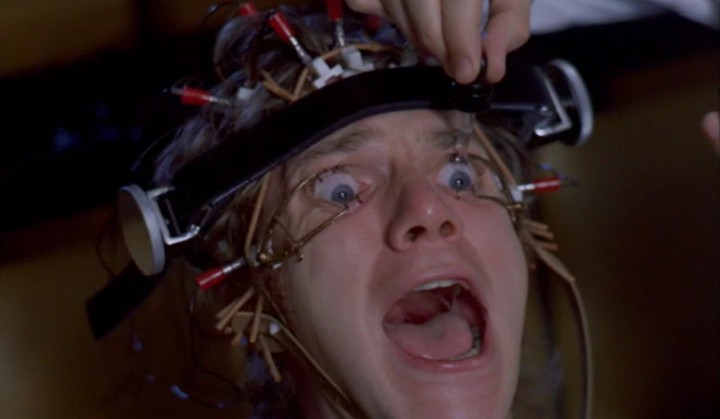
Remember, Alex, the Orangeman is BAD!
Posted on 10/07/2023 6:26:34 AM PDT by MtnClimber
Fifty-one years after Burgess’ novel, the Droogs seem starkly familiar: menacingly dressed sociopaths, speaking near-incomprehensible dialect, who burn, loot, and murder their way across the urban landscape.
Straight from A Clockwork Orange, the prescient Anthony Burgess novel (and equally visionary movie by Stanley Kubrick), a caravan of hundreds recently spent two days looting dozens of stores in Philadelphia. A social media influencer even livestreamed it to thousands.
Clockwork Orange questions whether an authoritarian government should reprogram humans to make evil impossible. This is in response to a revolt by part of society (the “Droogs”), devoted to “a bit a’ the ol’ ultraviolence” by adopting nihilism, a deliberate absence of morals and values.
Fifty-one years after Burgess’s novel, the Droogs seem starkly familiar: menacingly dressed sociopaths, speaking near-incomprehensible dialect, who burn, loot, and murder their way across the urban landscape.
But Burgess got the conundrum only half right: the question today is not whether authoritarianism can engineer morality but instead whether governmental leftists can destroy rational incentives for mutually beneficial behavior with the goal of engineering nihilism.
Why would any government do that? Because nihilism promotes civil disorder which, in turn, justifies more governmental intervention to “solve” the problem it created. As Saul Alinksy, strategist for the Left, put it: “The first step in community organization is community disorganization.” To create the socialist utopia they envision, leftists must first degrade existing society.
‘Success’ in social engineering
The answer as to whether government can create nihilism, as demonstrated by the last three years, is “yes.” Starting with Antifa and BLM riots of 2020 -- fully supported by leftist local governments -- urban centers in Democrat-led cities like San Francisco have spiraled into a “doom loop” wherein urban business flees “flash mob” looting and skyrocketing violent crime. A few examples:
(Excerpt) Read more at americanthinker.com ...
“Everywhere Soros-backed prosecutors go, crime follows… The only good Soros prosecutor is a defeated Soros prosecutor.” - Tom Cotton
When I first saw A Clockwork Orange, I described it as a dysfunctional world of my future children. But it was actually my grandchildren’s generation that ended up that way. And in reality it was due to complete incompetence by the government - elected by the people.
.
Libs are all grahzny bratchnies.
“Never underestimate the power of stupid people in large groups” applies. “elections have consequences and then everyone suffers the consequences” is where the country is at.
Oh boy has he clearly only read the American version.
So no Burgess does not QUESTION if government should reprogram people, it flat out says they SHOULDN’T. That the ills of society can only be cured by society.
Interesting take.
I used to say over a decade ago that I felt like a Jew living in mid-1930’s Germany. I felt the same until recently. It appears the right is growing a spine. The left went for a bridge too far.
Don’t get me wrong. The left seems to have entered “scorched earth mode”. i.e. if they are not getting their way as the election looms, I expect some rather serious violence, and Rittenhouse may have just been a warning shot.
Korova Milky Bar, is based on the Polish “Milk Bars”, which in Communist Poland served as places for workers to get cheap meals.
The first I watched it was during it’s release in LA.
A friend who worked for ABC had tickets for some sort of uncut version. (About 3 hrs long as I recall).
While I was stunned by the violence, I was more stunned at the laughing by the audience through parts that I’d found horrifying. I saw the movie in a slimmed down version few times after but none of the audiences were the same as that LA experience.
I read a few of Burgess’s other books, One Hand Clapping being the best.
The urgency of the medical crisis that Burgess faced made for a spare and fast paced narrative style that impressed his agent and prospective publishers. Clockwork Orange quickly went to print and rocketed to success.
Burgess's next few novels also came out at a rapid pace. At a book launch party, several writer and reviewer colleagues cornered Burgess and waggishly asked if he needed any suggestions for titles and plots to keep up with his book a month schedule.
Burgess, of course, survived to have a long and successful writing career and often explored Catholic ideas. At the heart of Clockwork Orange was a Catholic conundrum: was it possible or moral to attempt to force man to be be good through psychological conditioning that attempted to override free will?
At the time, this was a dissent from the dominant post WW II view that the power of the welfare state could be mobilized with insights from behavioral psychology to make people behave better, eliminate crime, and even to avert the kind of evil that manifested in the horrors of Nazism.
Taken in full, Clockwork Orange argued to the contrary. Notably, the final chapter of the novel saw the protagonist Alex as having chosen to become a responsible young adult, a qualifiedly optimistic outcome that argued in favor of free will and the possibility of moral redemption.
The American publisher omitted this ending, as did the movie adaptation. In college, I saw Burgess in his first American appearance after the movie came out. Burgess was puzzled why it was that Americans preferred a more pessimistic and dystopian view of human nature.
Thinking about it now, it seems to me that the New York publisher and Hollywood studio for Clockwork Orange both disliked the point about free will. In effect, they preferred to see the welfare state and behavioral psychology in control and did not want any dissent.
“That the ills of society can only be cured by society.”
Meaning what?
Isn’t government part of society? In many ways it is the the most direct expression of a society.
Remember, Alex, the Orangeman is BAD!
Meaning don’t expect panaceas. Don’t support tyranny. And don’t get addicted to expedience. Government is generally a direct expression of the WORST of a society. How it wants to wield power. Power, force, rarely fixes societal problems. It mostly just redirects them.
That was the 21st chapter of Clockwork Orange. The one that for whatever reason isn’t included in American editions. Alex grows up, figures out where he fits in society, loses interest in craziness, wants to be a father.
Now you can argue whether or not he deserved that opportunity. But the point of the story is that if someone can get there it will be with their work and societies (who at least gave him a job, and normal friends), not by being forced to by the government. All that did was make him a victim of others. Unable to fight back. And with no understanding of why what he did was wrong. Society just demanded the government fix the problem, but never bothered to care about the problem. So the government’s anti-crime program was psychological experiments. Not dealing with homelessness, or derelict buildings, or ineffective police.
“Society just demanded the government fix the problem, but never bothered to care about the problem.”
I don’t get your separation of society from the government it creates.
A society is a group of people living close enough together and interacting with each other, so that one’s action impacts others.
Given that some (usually a small minority) people’s action can be harmful to others, in order for there to be a modicum of peaceful coexistence, the majority decides to set up some behavioral standards and to create a “bigger force” ie, a “government”, to enforce those rules.
So “society” (the group of people living and interacting with each other) create the government they want. If they create a “bad government” it is society’s fault. No?
Even a dictatorship can be laid at the feet of the people (society) who put up with it.
Because they are 2 different things. Society is a group of people. Government is force.
It becomes most obvious how the 2 are different when you pay attention to how many people say “the government oughta do something about that”. Whatever “that” is. Obviously they don’t consider government and society to be that linked. They just want somebody to solve a perceived problem that they don’t actually care enough about to do anything themselves.
Bad government is very much societies fault. But again, you can see right in that sentence, that they are TWO things. And only society can figure out how to fix itself, and its government.
I read the novel in high school and have never seen the movie version. I don’t know if the edition I read omitted the last chapter, but it did have a useful glossary explaining the meanings of some of the Russian-derived slang used by the characters in the novel.
“Society is a group of people. Government is force.”
Yes, government is what is called “force majeure” (French for “biggest force”) and it’s instituted by the people, ie, society, to overpower any other force within society - to prevent crooks, hoodlums, punks murderers, bullies to run amok and disturb the “domestic tranquility. It also is establishes a judicial system to resolve disputes among the citizens so they don’t start going after each others with fists and guns. And it can also become oppressive if the people that created it don’t watch the politicians like a hawk and keep them on short leashes.
As the founders explained when they created our government (and ratified by the then colonies - the “people”, ie “society”)...
“We the People of the United States, in Order to form a more perfect Union, establish Justice, insure domestic Tranquility, provide for the common defence, promote the general Welfare, and secure the Blessings of Liberty to ourselves and our Posterity, do ordain and establish this Constitution for the United States of America.”
“It becomes most obvious how the 2 are different when you pay attention to how many people say “the government oughta do something about that”.”
That’s because those people are ignoramuses and have no clue about civics. They think government is some magic thing that came out of thin air. They never ask themselves where it came from and don’t understand that “government” is politicians that we collectively as a society gave power to. Where do you think “government” came from?
Disclaimer: Opinions posted on Free Republic are those of the individual posters and do not necessarily represent the opinion of Free Republic or its management. All materials posted herein are protected by copyright law and the exemption for fair use of copyrighted works.