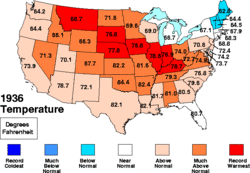
1936: An extremely hot summer
- Average summer temperature: 74.0° F (#1 warmest year; 3.6% above 100-year average)
- Maximum summer temperature: 87.9° F (#1 warmest year; 4.2% above 100-year average)
- Minimum summer temperature: 60.1° F (#13 warmest year; 2.8% above 100-year average)
- Average precipitation: 6.4" (#101 highest; 22.7% below 100-year average)
July 1936
U.S. slightly surpasses 1936 record for hottest summer ... CBS News https://www.cbsnews.com › Science Sep 10, 2021 — The contiguous U.S. just recorded its hottest summer ever, topping the previous record set in 1936 by less than a hundredth of a degree,
July started off relatively mild in many areas, with many areas in the Midwest seeing highs in the upper-80's to low-90's. However, areas in the Central Great Plains saw temperature's in the 100's with Topeka, KS, Omaha, NE and other locations seeing daily record highs. On Independence Day, July 4, this all quickly changed.
Heat Dome Forms Over Midwest
July started off relatively mild in many areas, with many areas in the Midwest seeing highs in the upper-80's to low-90's. However, areas in the Central Great Plains saw temperature's in the 100's with Topeka, KS, Omaha, NE and other locations seeing daily record highs. On Independence Day, July 4, this all quickly changed.
Heat Dome Forms Over Midwest[edit]
On July 4, multiple areas centered around the Central Midwest saw temperatures spike into the 100's. Peoria, Illinois reached 106 °F (41 °C), Sioux City, Iowa hit 111 °F (44 °C) (their highest temperature on record), Des Moines, Iowa hit 109 °F (43 °C) (falling one degree short of the record), Springfield, Illinois hit 105 °F (41 °C), and Kansas City, Missouri hit 108 °F (42 °C). All these areas saw their hottest Independence Day on record. That night, temperatures would only fall into the 70's.[18][19][20]
On July 5, the heat persisted in these areas while spreading to others. Areas in Eastern Iowa had highs in the low to mid 100's, with Burlington, Iowa hitting 108 °F (42 °C) for the second day in a row. In Bismarck, North Dakota, the temperature hit 106 °F (41 °C) and in Aberdeen, South Dakota, it hit 108 °F (42 °C).[21]
On July 6, Steele, North Dakota hit 121 °F (49 °C), the highest temperature ever recorded in North Dakota. this occurred 5 months after the record low of −60 °F (−51 °C) was set in the state. Fargo and Bismarck both hit 114 °F (46 °C). In Moorhead, Minnesota, the record high of 113 °F (45 °C) was also set. The heat continued to spread, with Rockford, Illinois hitting 102 °F (39 °C), and Minneapolis, Minnesota and Grand Forks, North Dakota hitting 104 °F (40 °C) respectively.[22]
On July 7, the heat spread to the Great Lakes area. Milwaukee, Wisconsin hit 98 °F (37 °C), Madison, Wisconsin hit 102 °F (39 °C), Green Bay, Wisconsin hit 103 °F (39 °C), Duluth, Minnesota hit 100 °F (38 °C), and Kalamazoo, Michigan hit 101 °F (38 °C).[23][24][25][26] The heat also spread south, with Evansville, Indiana hitting 106 °F (41 °C), and Lexington, Kentucky hitting 101 °F (38 °C).
On July 8, heat began to creep back into the Northeastern United States, with some areas having highs in the 80's and 90's. Elsewhere the heat dome expanded more with Indianapolis, and Fort Wayne, Indiana hitting 104 °F (40 °C) respectively. South Bend, hit 106 °F (41 °C) (their second day above 100), and Louisville, Kentucky hit 103 °F (39 °C). Flint, Michigan hit 108 °F (42 °C), breaking the record.[27]
On July 9, temperature's spiked, with many all-time record highs being set in both the Great Lakes and Northeast United States. The recap of temperatures are as follows for July 9th.
Rockford, IL: 101 °F (38 °C)[22]
Pittsburgh, PA: 101 °F (38 °C)
Syracuse, NY: 102 °F (39 °C)
Rochester, NY: 102 °F (39 °C)
Detroit, MI: 102 °F (39 °C)[28]
Philadelphia, PA: 103 °F (39 °C)
Albany, NY: 103 °F (39 °C)[29]
Baltimore, MD: 103 °F (39 °C)
Scranton, PA: 103 °F (39 °C)
Washington DC: 104 °F (40 °C)
Johnstown, PA: 104 °F (40 °C)
Columbus, OH: 105 °F (40.6 °C)
Warren, OH: 105 °F (40.6 °C)
Williamsport, PA: 106 °F (41.1 °C)
Trenton, NJ: 106 °F (41.1 °C)
Central Park, New York City: 106 °F (41.1 °C)
On July 10, the heat peaked in Mid-Atlantic and Northeast, with some areas setting all-time record highs in parts of the South and most of the Midwest. The recap is as follows.
Atlanta, GA: 100 °F (37.8 °C)
Pittsburgh PA: 101 °F (38.3 °C)
Detroit, MI: 102 °F (38.9 °C)[28]
Grand Rapids, MI: 102 °F (38.9 °C)[26]
Central Park, New York City: 102 °F (38.9 °C)[5]
Youngstown, OH: 103 °F (39.4 °C)
Philadelphia, PA: 104 °F (40.0 °C)
Richmond, VA: 105 °F (40.6 °C)
Washington DC: 105 °F (40.6 °C)
Lynchburg, VA: 106 °F (41.1 °C)
Rockford, IL: 106 °F (41.1 °C)[22]
Bowling Green, KY: 106 °F (41.1 °C)
St. Cloud, MN: 106 °F (41.1 °C)[30]
Baltimore, MD: 107 °F (41.7 °C)
Lexington, KY: 108 °F (42.2 °C)
Xenia, OH: 108 °F (42.2 °C)
Cumberland & Frederick, MD: 109 °F (42.8 °C)
Runyon, NJ: 110 °F (43.3 °C)
Phoenixville, PA: 111 °F (43.9 °C)
Martinsburg, WV: 112 °F (44.4 °C)
Aberdeen, SD: 114 °F (45.6 °C)
On July 11, the heat began subsided in the Northeast, though highs were still in the 90's. The heat temporarily stopped spreading but was still heavily impacting areas with Bismarck, ND recording a low of only 83°.
On July 13, the heat spread south through the Great Plains, with Wichita, Kansas reporting a high of 101 °F (38.3 °C), Fort Smith, Arkansas hitting 106 °F (41.1 °C), Tulsa, Oklahoma hitting 107 °F (41.7 °C), and Oklahoma City, Oklahoma hitting 101 °F (38.3 °C). Elsewhere, temperatures began to significantly rise with multiple areas hitting above 110 °F (43.3 °C). The recap is as follows:
Columbus, OH: 101 °F (38.3 °C)
Detroit, MI: 102 °F (38.9 °C)[28]
Green Bay, WI: 104 °F (40.0 °C)[24]
Minneapolis, MN: 105 °F (40.6 °C)[30]
Alpena, MI: 106 °F (41.1 °C)
Madison, WI: 106 °F (41.1 °C)[23]
Duluth, MN: 106 °F (41.1 °C)[25]
St. Cloud, MN: 107 °F (41.7 °C)[30]
Decatur, IL: 108 °F (42.2 °C)[18]
Grand Rapids, MI: 108 °F (42.2 °C)[26]
Evansville, IN: 108 °F (42.2 °C)
Kalamazoo, MI: 109 °F (42.8 °C)[26]
Rockford, IL: 110 °F (43.3 °C)[22]
Saginaw, MI: 111 °F (43.9 °C)[28]
Eau Claire, WI: 111 °F (43.9 °C)[31]
Waterloo, IA: 112 °F (44.4 °C)[21]
Mt. Vernon, IL: 112 °F (44.4 °C)[18]
Mio, MI: 112 °F (44.4 °C)
Henderson, KY: 113 °F (45.0 °C)
Wisconsin Dells, WI: 114 °F (45.6 °C)
July 14 was the peak day of the heat wave for most areas with countless record-breaking temperatures broken across many areas. The records are as follows.
Detroit, MI: 104 °F (40.0 °C) (105 °F (40.6 °C) on July 24, 1934)
Springfield, MO: 104 °F (40.0 °C) (113 °F (45.0 °C) in 1954)
Indianapolis, IN: 106 °F (41.1 °C) (tied July 22, 1901 and July 21, 1934)[32]
Columbus, OH: 106 °F (41.1 °C) (tied July 21, 1934)
Cincinnati, OH: 106 °F (41.1 °C) (tied July 24, 1934)
Madison, WI: 107 °F (41.7 °C)[23]
Louisville, KY: 107 °F (41.7 °C)
Kalamazoo, MI: 108 °F (42.2 °C)[26]
Minneapolis, MN: 108 °F (42.2 °C)[30]
Rochester, MN: 108 °F (42.2 °C)
Xenia, OH: 108 °F (42.2 °C)
St. Louis, MO: 108 °F (42.2 °C) (115 °F (46.1 °C) in 1954)
Lima, OH: 109 °F (42.8 °C)
Cedar Rapids, IA: 109 °F (42.8 °C)[18]
Dubuque, IA: 110 °F (43.3 °C)
Terre Haute, IN: 110 °F (43.3 °C)
Springfield, IL: 110 °F (43.3 °C) (112 °F (44.4 °C) in 1954)[18]
Decatur, IL: 110 °F (43.3 °C) (113 °F (45.0 °C) in 1954)[18]
Moline, IL: 111 °F (43.9 °C)[18]
Burlington, IA: 111 °F (43.9 °C)[18]
Rockford, IL: 112 °F (44.4 °C)[22]
Waterloo, IA: 112 °F (44.4 °C)[18]
Palestine, IL: 112 °F (44.4 °C) (114 °F (45.6 °C) in 1954)[18]
Mt. Vernon, IL: 114 °F (45.6 °C)[18]
Collegeville, IN: 116 °F (46.7 °C)
On July 15, temperatures finally began to decline over most areas while other isolated areas still saw heat still increase. Missouri hit an all-time high of 115 °F (46.1 °C) in Clinton, Missouri. Peoria, IL hit 113 °F (45.0 °C) and Quincy hit 114 °F (45.6 °C), setting all-time records for those cities.[18] In Iowa, many cities tied the records set the previous day. However, in the Great Plains temperatures continued to rise as a new heat wave began to develop.
Heat Persists over the Great Plains[edit]
Although heat in the Midwest had begun to subside, heat had been building in the Great Plains over that period. It began on July 13 when there was a noticeable increase in temperatures but began to peak on July 14.
On July 14, the temperature climbed to 107F in Lincoln, NE after having 5 days of temperature's in the low 100's, though that night it would be the first time the temperature fell below 80F in a week. Norfolk, NE hit 105F and Omaha, NE hit 109F. Further south, Topeka, KS hit 108F, and Kansas City, MO hit 109F. In Tulsa, OK, temperatures had been climbing the past couple days and hit 110F this day. This heat would persist into the next day before temperatures would fall noticeably on the 16th over the Central Great Plains.
On July 17, temperatures once again began to rise. Nebraska set a record high of 118F in Hartington, NE. Sioux City, IA and Sioux Falls, SD also set record highs of 110F.[20] In Grand Island, NE it was 114F, falling 2 degrees short of the record in 1934, while Hastings, NE would set a record of 115F. It was also 110F in Fort Smith, AR.
On July 18, the heat would peak. Kansas and Oklahoma set record highs of 121F in Fredonia and 120F in Alva, respectively. Wichita, KS hit 112F, Salina, KS hit 116F, 110F in Topeka, KS, and 113F in Tulsa, OK (a record high for July). On July 19, Oklahoma's record would be tied in Altus.
Latter part of July[edit]
For many areas, temperatures would be relatively lower for the last part of the month. Most areas saw highs fall below 100 °F (38 °C) on July 20 and 21 for the first time in nearly 2 weeks. However, temperatures would rise back into the 100's over the Great Plains after this, though generally wouldn't be as high as earlier in the month. The notable exception would be in Nebraska, Iowa and Kansas.
On July 24, Grand Island, NE broke their record high with a high 117 °F (47 °C). Hastings, NE also set a new all-time high of 116 °F (47 °C). Both Kansas and Nebraska tied their all-time record highs in Alton and Minden, respectively just days after they were set.
On July 25, the temperature rose to 115 °F (46 °C) in Lincoln, NE (a record high for the city) but would only fall to 91 °F (33 °C) that night. Outside of the Desert Southwest, this is one of the highest low temperatures ever recorded in the US. Omaha, NE also set a record high of 114 °F (46 °C), though had a low of 83 °F (28 °C). On the previous day Grand Island, NE broke their record with a high 117 °F (47 °C). Des Moines, IA would set their record high of 110 °F (43 °C) this day as well.[21] Iowa set their record high of 117 °F (47 °C) in Atlantic and Logan.
August 1936 and afterwards[edit]
August was the warmest month on record for five states. Texas, Arkansas, and Louisiana also set all-time high records. Many experienced long stretches of daily maximum temperatures 100 °F (38 °C) or warmer. Drought conditions worsened in some locations. Other states were only slightly warmer than average.
The heat wave and drought largely ended in September, although many states were still drier and warmer than average. Many farmers' summer harvests were destroyed. Grounds and lawns remained parched. Seasonable temperatures returned in the autumn.
Summer 1936 remained the warmest summer on record in the USA (since official records begin in 1895), until 2021.[33] However February 1936 was the coldest February on record, and 5 of the 12 months were below average, leaving the full year 1936 at just above the average.
Effects[edit]
As many as 5,000 heat-related deaths were reported in the United States,[3][34] and 780 direct and 400 indirect deaths in Canada.[35] Almost 5,000 people suffered from heat stroke and heat exhaustion, particularly the elderly. Unlike today, air conditioning was in the early stages of development and was therefore absent from houses and commercial buildings. Many of the deaths occurred in high-population-density areas of Chicago, Detroit, St. Louis, Milwaukee, Cleveland, Toronto, and other urban areas. Farmers across the continent saw crop failure, causing corn and wheat prices to rise quickly. Droughts and heat waves were common in the 1930s. The 1930s (the Dust Bowl years) are remembered as the driest and warmest decade for the United States, and the summer of 1936 featured the most widespread and destructive heat wave to occur in the Americas in centuries. -https://en.wikipedia.org/wiki/1936_North_American_heat_wave