Posted on 07/01/2023 6:26:02 AM PDT by grundle
The latest National Assessment of Educational Progress (NAEP) results released last week were quite distressing. The scores on the reading and math tests administered in October-December 2022 showed the steepest declines ever recorded since the tests were first administered.
Peggy Carr, commissioner of the National Center for Educational Statistics (NCES), explains:
“The mathematics decline for 13-year-olds was the single largest decline we have observed in the past half a century. The mathematics score for the lowest-performing students has returned to levels last seen in the 1970s, and the reading score for our lowest-performing students was actually lower than it was the very first year these data were collected, in 1971.”
It’s worth noting that the result of the NAEP U.S. history and civics test, also taken in 2022, were no better. According to data released last month, just 13% of eighth graders met proficiency standards for U.S. history, meaning they could “explain major themes, periods, events, people, ideas and turning points in the country’s history.” Additionally, about 20% of students scored at or above the proficient level in civics. Both scores represent all-time lows on these two tests.
These dismal results beg the question: “Why is this happening?”
The immediate response is to blame the Covid-induced shutdowns that gripped public education in 2020 and 2021. And to be sure, the hysterical response to Covid did indeed leave scars. In addition, the time spent by many teachers advancing the political fads-du-jour didn’t help things.
But as The 74’s Kevin Mahnken importantly notes, the latest scores, which highlight long-term trends that extend back to the 1970s, “widen the aperture on the nation’s profound academic slump.” In doing so, the latest test serves “as a complement to the 2020 iteration of the same test, which showed that the math and English skills of 13-year-olds had noticeably eroded even before the emergence of COVID-19.”
So, what factors other than Covid are dumbing down our students?
Teacher union honchos invariably blame a lack of money. But when you look at the numbers, this is a non-starter. According to NCES data, inflation-adjusted per-pupil spending rose from $7,089 in the 1971–72 school year to $17,013 in 2019–20, a whopping 140% increase.
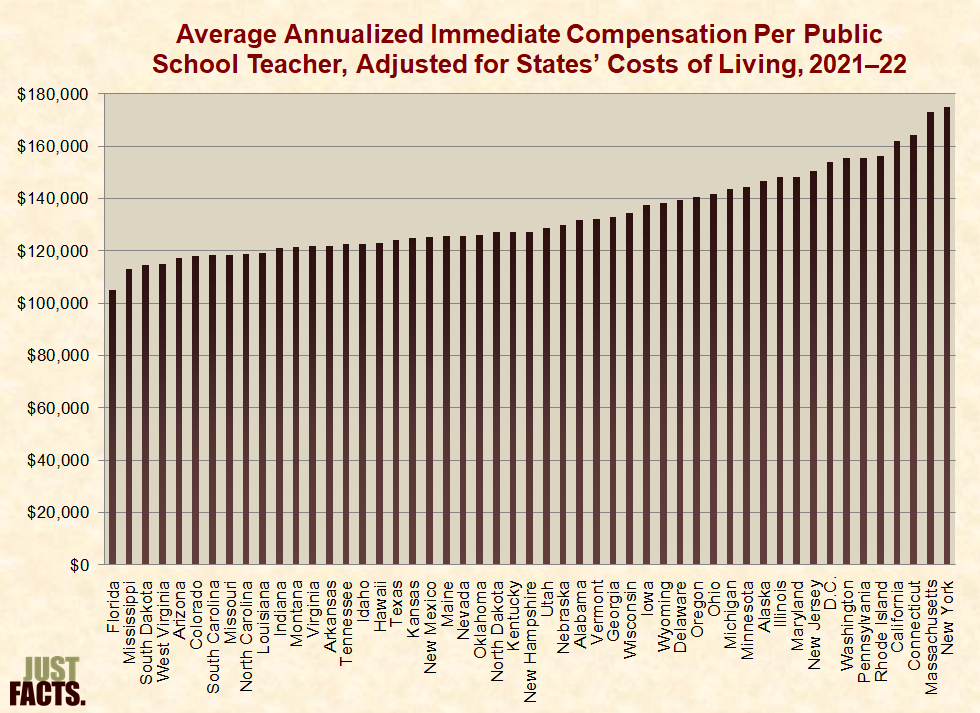
Looking at state-by-state comparisons, we see that Texas – demographically similar to California – spends about 25% less than Golden State, yet its students scored higher on the 2022 eighth-grade NAEP. Similarly, teacher salaries in California are third highest in the country, while Texas comes at number 38 nationally.
Another teacher union mantra is that our classes are too large, and if classes were smaller, students would greatly benefit.
Again, no. Nationally, class size has been shrinking over time. Since 1921, the student-to-teacher ratio has been reduced from 33:1 to 16:1. An extensive analysis of the subject was done by Hoover Institution senior fellow and economist Eric Hanushek in 1998. He examined 277 different studies on the effect of teacher-pupil ratios and class-size averages on student achievement and found that 15% of the studies did show an improvement in achievement, while 72% found no effect at all, and 13% found that reducing class size had a negative effect on achievement. While Hanushek admits that in some cases, children might benefit from a small-class environment, there is no way “to describe a priori situations where reduced class size will be beneficial.”
Jaime Escalante’s experience is instructive when examining class size. Probably the most acclaimed teacher of our time, his calculus class was extremely popular at Garfield High in East Los Angeles. In 1983, the number of his students passing the A.P. calculus test more than doubled. That year 33 students took the exam, and 30 of them passed.
Going well beyond the 35-student limit set by the teacher union contract, some of his classes had more than 50 supposedly “unteachable” students, and the union, of course, complained. But rather than submit to the union, Escalante moved on to teach elsewhere. Just a few years after his departure, the number of AP calculus students at Garfield who passed their exams dropped by more than 80%.
This leads us to the most likely cause of failing American students: there are too many underperforming teachers in our nation’s classrooms. To be sure, the great majority of our educators range from adequate to good, to great. However, as former GE CEO Jack Welch has averred, the bottom 10% of any field should be replaced. In a similar vein, Eric Hanushek asserts that if we just got rid of the bottom performing 5% to 7% of teachers, our education system could rival that of Finland’s world-class system.
In California, there are about 300,000 teachers. If 5% of them aren’t fit to teach, that means we have 15,000 educators who should seek work elsewhere. If each of these teachers has 20 kids in a class, it means they are ruining the educational experience of 300,000 children a year.
And a middle or high school teacher in the bottom 5% can do even more harm, as he or she may have 150 students per year.
But we can’t follow Welch’s or Hanushek’s advice because teacher union-mandated permanence clauses – in place throughout much of the country – make it just about impossible to fire an incompetent teacher. It was revealed during a court case in California in 2012 that, on average, just 2.2 of California’s 300,000 teachers (0.0008%) are dismissed yearly for unprofessional conduct or unsatisfactory performance.
Something else worth consideration is that if a district must lay off teachers, it should not be done by seniority or the “last in, first out” regimen that teachers unions demand. This setup rewards teachers for the number of years on the job, irrespective of their effectiveness. Instead, the poorest performers should be the first to go.
Hence, to turn education around, we must change the system. Until teachers are treated as individual professionals instead of interchangeable union members, millions of children will suffer. Educating children should be the top priority for schools, not kowtowing to the teachers unions’ industrial-style work rules. As such, teachers unions must be limited in power or, better yet, eliminated.
How do you teach someone who doesn’t want to learn? The problem is shared among students, parents, and teachers.
“U.S. School Deterioration: Poorest Performing Teachers Should Be First to Go”
Nope, don’t agree. The FIRST to go are ‘teachers’ and administrators with ‘Education’ Degrees. Replace them with retirees who actually contributed to the country.
Pro tip: it’s not teachers who “perform”, it’s students.
The insane conservative belief that algebra and English composition can be taught to masses of sub 85 IQ rebellious and resentful children if only we had better teachers is one of the main reasons that the conservative opportunity for governance has gone.
“ So, what factors other than Covid are dumbing down our students?”
Genetics.
Perhaps it is because of your sub-85 IQ that you can not understand how they did it.
Never let government workers unionize against the taxpayers.
One starting point: have a surprise exam where the teachers have to take the same proficiency tests that high school seniors are supposed to take.
Fire all the teachers who do not pass.
Most of the students are smarter than these sex change teachers
“ And yet somehow in the past they managed to do it.”
Nonsense.
The white high school graduation rate in 1941 was 25%. That approximates the natural ability (in the white population) that can master 12th grade level studies.
I’ll grant another 10% for dropping out to run the farm or some such, but it’s not 50%, and it’s not close to 100%.
And that’s the white population we are discussing. Average IQ = 100. Population fraction = 90%.
Your belief that the right teachers and the right methods can be successful at making what was impossible in 1941 possible in 2023 when the population in school is so different is, beg your pardon, ridiculous.
Leftists say they fear “monopoly” - but teachers unions and government are the biggest, worst monopoly of all.
The great results at selective schools and poorer results at schools in high poverty areas are down to the student body not the teachers
That’s true.
I recall when my children were growing up looking at the data collected due to the No Child Left Behind law. The following is only an observation on my part and not from any formal research: the school districts that had the highest student proficiency scores had a demographic that stuck out like a sore thumb; the percentage of parents with bachelor degrees. The school districts that had more educated parents had higher proficiency scores. No other statistic made any real difference, whether it was class size, dollars spent per pupil or continuing education of teachers.
It’s not a leap to think that a parent’s perceived value of education influences their involvement in the education of children. That was the case when I was growing up. My government school education was corrected nightly by my father. He was highly educated. That partly lead to me to homeschool my children. It’s easier to teach something correctly, rather than correct someone’s incorrect teachings.
“ The school districts that had more educated parents had higher proficiency scores.”
And therefore better genetics.
Shocker! /s
I'm a retired but still active embedded hardware/software engineer. A few years ago I had a chance opportunity to teach Embedded Computing in the local high school. In Georgia, a non-certified person can teach for three years under a provisional certificate. I taught digital logic, microcontroller fundamentals, and the C language. It was very difficult to organize a decent curriculum and really difficult to compose quizzes, tests, and worksheets. Nevertheless, I enjoyed the experience immensely. The school's staff and regular teachers fully supported me any way they could. The lab was stocked with a lot of electronics components, tools, and test equipment.
This turned out to be an extremely difficult class for most students; and, was way outside of their thinking box. Only seniors with a good math history were allowed to take the class. Many students could not work simple algebra even though they had passed those classes prior to taking mine. It was very difficult to rank students because the grade distribution was an inverted bell curve, with students either getting very high grades or very low grades. Try as I might, I could not bring the low achievers up to par. The base reason was that they really didn't care.
This led to "close encounters" with angry parents. Some sued the school in order to pull their children out of the class once it was passed the drop date. Several tried to dress me down for being way to hard on their baby. I held on, and the school backed me. They did allow withdrawal after being sued. For the three years, classes averaged 25 students. There were always 6 - 9 students who got 100% correct on every test. Then there were 2 - 4 B's. The rest of the students usually landed below 60%, many below 30%. These were all high achieving students in other classes.
I had many students thank me for providing career direction for the rest of their lives. They told me that my class was the best one in all of high school. In general, those who dug into the course were enthusiastic and happy. The loafers would rather die than sit in my class.
A lot of material one must take in order to get a teaching certificate deals with how to motivate and reach students who are not energetic learners. That material also provides insights regarding how to compose quizzes, tests, and worksheets and how to utilize scores to guide teaching efforts. I can assure you, I was in need of help in those areas. Do not assume teaching is easy or doesn't have tricks of the trade. I found teaching to be difficult, but preparations for teaching class and grading tests required a great deal of time and effort. Frankly, teaching was the most difficult job I had; and, I've turned out a lot of sophisticated equipment in my engineering career.
The pay scale was miserable. Since I was non-certified and only taught one class, I made $27 per day. That wouldn't justify the expense and effort of obtaining a certificate. I actually enjoyed teaching a great deal. The students were a blast.
Also fire any teacher who has done a Tik Tok video.
Do you watch Jordon Peterson much? I’m not being snarky. He talks about this frequently. Proficiency scores should be charted with IQ. About 12% (I think I recall) of the population have IQ’s below 85. You can expect zero proficiency from them. It’s not possible, at least very little real work has been done to solve this problem.
There’s a related incorrect belief that all children should go to college. That wasn’t always the case. Today, it’s a widely held belief. Joe Biden was even mumbling something about it yesterday.
It’s not intellectual snobbery to match people’s cognitive abilities to education, careers and performance.
Maybe with you god-like brain you could just explain how that was done so that we can quickly recover lost technique.
In my experience in teaching high school (post #16), I found that the students don't give a damn and the parents support them, insisting that teachers burden them too much.
Be civil. You are among peers.
What factors dumbing down the students?
Peer pressure
Inability to punish the kids who disrupt classes and threaten teachers.
One parent households.
Drugs
poor teachers
Last but not least is the teaching system. Kids need to understand why they need to learn math etc NOT just tell them they have to.
Disclaimer: Opinions posted on Free Republic are those of the individual posters and do not necessarily represent the opinion of Free Republic or its management. All materials posted herein are protected by copyright law and the exemption for fair use of copyrighted works.