To: DUMBGRUNT
Now looking for ideas.
~~~~~~~~~~~~~~~~~~~
I wish I had the time to jump more deeply into this discussion… One of the things I deal with in the professional side of my life is HVAC and ventilation although what I do is more ‘industrial’ than residential or commercial. I can tell you a lot about airflow measurement though. Here are a few thoughts for you….
If you have hot wire and mechanical anemometers (are you referring to a vane anemometer?), you are way ahead of most residential HVAC contractors. I was talking to a furnace distributor/installer recently and said something along the lines of “you sell folks on the idea that you know something about providing either cooled or heated air to their space… while you take a bunch of measurements to establish one thing or another when you sell/install a new furnace and/or AC unit, you don’t do one thing to actually measure the airflow. Am I the only one scratching my head at something being wrong with that concept?” In fact, I’ve never met a ‘residential furnace installer’ who had the foggiest clue about how to actually measure airflow. Whenever I’ve had furnace folks in my basement looking at my unit (which is very rare), the first thing they ask about is why there is a series of plugged ¼” diameter holes in the return air duct just before the filter. That is when I get into a discussion about how to measure airflow because those holes are so I can do my own Pitot tube traverse (which is the most accurate way to establish the volume flow rate). The only caveat to my ‘most accurate way’ comment is that the accuracy starts to fall off once the flow velocity starts to get low…. and since the flow velocity in residential ductwork systems is generally quite low, the Pitot tube method does have this limitation and it does mean that you have to have good equipment for the data to provide something meaningful.
One question for you that may change my following comments… In your post 36, you said the airflow is continuously variable. Why is that? Doe your system use a fan driven by an ECM that is controlled in such a way that the speed is constantly changing?
Regardless, here is what I have done and since by this discussion it is apparent that you are smarter than the average bear, here is what I’d suggest you do…
- Get yourself a Pitot tube, a micromanometer and the required lengths of hosing to connect the two. You will likely want an electronic micromanometer that gives readings into two decimal points of one inch (readings that will go down to 0.01 inch water gauge). I have quite a few different ones, but they are for serious airflow testing (industrial performance guarantee test applications) and I’m not going to promote any particular brand. For the purpose of making some points in this discussion only, I’m going to provide a few links. Dwyer is a company that is well known for a variety of airflow testing equipment for general purpose applications, and I see one of their basic electronic micromanometer units at this link that reads out in 1/100th of an inch. I don’t have this particular unit but at a glance, it looks to be suitable for what you are doing and is certainly reasonably priced… https://dwyer-inst.com/products/pressure/manometers/digital/series475.html You can also use an old fashioned inclined manometer… see the ones that Dwyer sell on page 28 in their catalogue…. https://legacy.dwyer-inst.com/catalog/ Years ago, I was at an auction and for a few dollars, bought a box that had about 30 of the No. 25 inclined-vertical manometers… since they have an upper range of 3 in. wg, I use them for measuring differential pressure and have installed a bunch of them on my HVAC unit so that I can instantly see at a quick glance how things are working i.e. DP across the filters, across the coils, across the heat exchanger, from the fan inlet to the fan outlet etc. As for the Pitot tube, you’ll want one that is long enough to span the duct with enough length to hold on to it when the measurement is being taken. For HVAC applications, the Pitot tube can just be short… good thing since the cost goes up with length. Here is a link that shows what these look like… https://dwyer-inst.com/products/air-quality/pitot-tubes/series-160-stainless-steel-pitot-tube.html In the past few years, the cost of these have gone up a bunch and what I do is just make my own. If you do an ixquick search on ‘DIY Pitot tubes’, you’ll get a bunch of ideas on how to do that. It’s not very difficult and you don’t need to lose hardly anything on accuracy with your homemade one(s).
- Doing accurate flow testing also means being able to do calculations that involve air density and that means including barometric pressure, temperature and humidity measurements. However those additional parameters are just ‘fine-tuning’ that takes the accuracy above and beyond what is typically needed for cursory HVAC applications… you are not doing this as a guarantee test in an airflow testing lab and the kinds of assumptions you will need to make to simplify the calculation are not going to radically change the results.
- To get an accurate airflow reading using a Pitot method, you’ll need to do a ‘velocity pressure traverse’…. Here are a couple of links to explain how to do this. https://tsi.com/getmedia/1a11d344-0a58-4ca6-94fe-65721825686b/AF-106%20Traversing%20a%20Duct?ext=.pdf and http://blog.dwyer-inst.com/2017/10/18/duct-traversing-for-average-air-velocity-and-air-volume/#sthash.dT2lvQ0y.dpbs
- Lastly, every time you want to know what the flow rate is, you don’t want to go through all the above. What you will want to do is take other pressure readings at various points at the same time as when you do the flow traverse testing and effectively what you can do is ‘calibrate’ the pressure drop across some ‘resistive element in the ductwork’ to the flow rate. That way in the future, you can just use the pressure drop as a proxy for the flow. To do this, just make sure that the element you use isn’t something that changes resistance… for this reason, filters don’t work. You also just need to remember that pressure drop varies as the square of the flow velocity.
Some of the above can get complicated… if you have any questions, you are welcome to freepmail me.
To: hecticskeptic
I should have concluded by saying that with a differential pressure calibrated to a flow (by extension of going from an average velocity pressure to velocity to a volume flow rate) all you then need to have is a pressure logger to do what you are looking for.
To: hecticskeptic
--"Some of the above can get complicated… if you have any questions, you are welcome to freepmail me." I have been around pitot tubes a bit and have one or two around of different lengths. And a few used Magnehelics from my now unused ductwork.
That said, my system is a DUCTLESS type mini split heat pump.
Return is in the top. 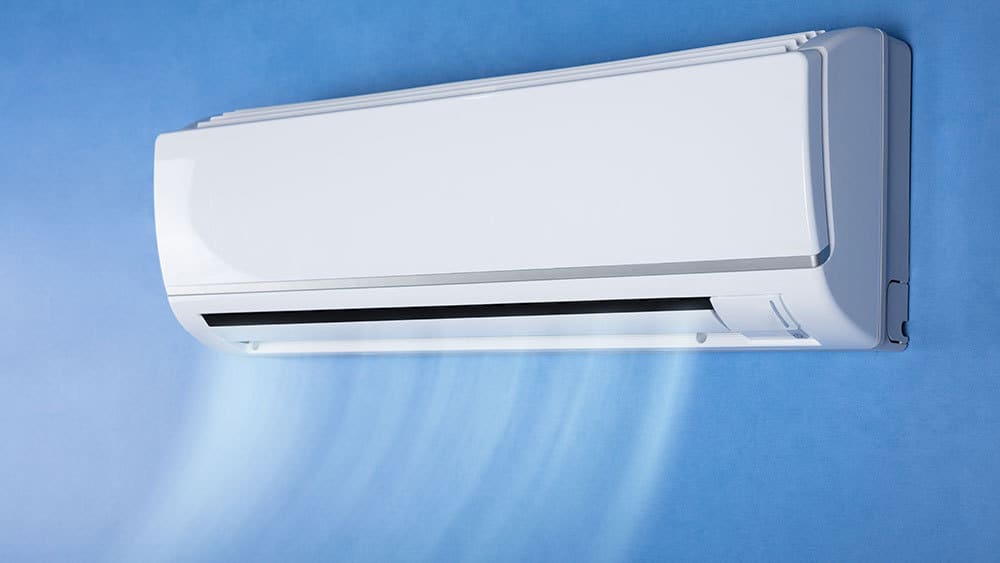 NOTE: This is something I do for fun, I have an HVAC son in law but he is always working and a graduate engineer daughter with three of my grandkids and a full-time job. Even when I'm at my daughter's house she is always thinking about the kids; no time for my projects!!!
To determine the COP I need the S&R temperatures, Airflow rate, and power consumption. Not certain but think that is what is needed. Works well for wet systems GPM x Delta T x 500 yields the total Btu.
The HP uses both an outdoor reset and guessing a PID controller to modulate the pump and blowers so the output just equals the load; very efficient and constantly changing.
I feel like a blind guy describing an elephant, I do not actually know how it works.
--"That way in the future, you can just use the pressure drop as a proxy for the flow. "
Using an anemometer on both supply and return, it is not a nice smooth column of air. Yes, an average across the opening can be determined but guessing it is not linear as the flow changes.
Also guessing that the blowers are DC and a current transformer will not work to measure the current draw.
I have seen procedures to determine the COP using the supplementary electric resistance heat in the unit as a known load and the delta T... I installed the HP mostly for cooling, so no E-R elements.
Thank you for thinking about my system.
Before I retired I was in a large lab full of pilot plants for testing new processes; million dollar tinker toys. After verifying the process... they are scrapped! I'm certain that I could have found what is needed in the scrap bin and I was surrounded by sharp engineers that would point to what would work.
50 posted on
01/24/2023 4:19:18 PM PST by
DUMBGRUNT
( "The enemy has overrun us. We are blowing up everything. Vive la France!"Dien Bien Phu last messa)
FreeRepublic.com is powered by software copyright 2000-2008 John Robinson