Posted on 12/04/2022 5:25:15 AM PST by naturalman1975
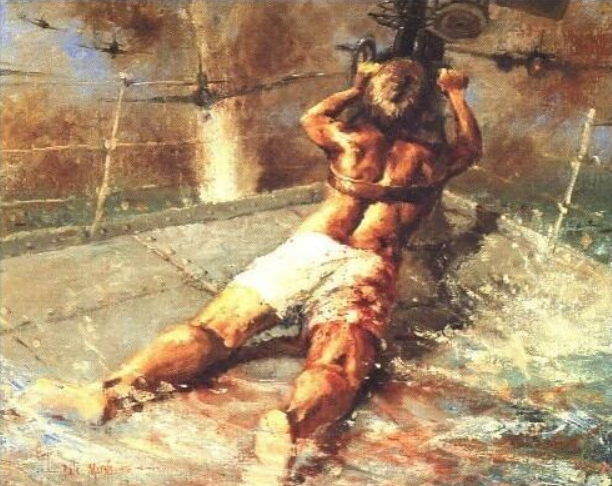
Eighty years ago, the Royal Australian Navy won its only Victoria Cross. It was awarded 78 years later, after decades of campaigning by a host of advocates, but primarily as a result of the dedication of Garry Ivory, one of Teddy’s nephews, and the tireless Guy Barnett, a veteran MP from Tasmania. For that was where the 18 year old Ordinary Seaman Sheean had hailed from, but it was north of faraway Darwin where he died, as the corvette HMAS Armidale sank under the torment of a host of Japanese aircraft, bombing, strafing and firing torpedoes.
What sort of man was this Sheean? For man he was, not boy, despite his youth. Like so many other Tasmanians – more relatively than any other state – he had joined the Navy, inspired by the call to the colours in the face of the British Empire’s desperate need. He and others had watched as Poland was attacked and finally, France and Britain’s patience at an end, war was declared. But that was in late 1939, and it took time to sign up as a reservist, as he did with many friends, and family too – he was the fourteenth child of 16 children. He had been brought up largely in Latrobe, in northern Tasmania, and had left school early. The family lived in rough conditions, in a very basic house, with most of the boys finding employment on local farms.
The work was hard manual labour of a sort which would raise eyebrows in modern times. Teddy rode a pushbike around the state; working as an offsider to his father in fencing, carrying out basic carpentry, and cutting railways sleepers. If you worked you got money. If you didn’t, there was none. The term “social security” was then unknown, and governments provided little services for Australians beyond defence, basic law and order, some utilitarian infrastructure such as roads and a simple electricity supply, and limited pensions and child endowment. Entertainment at home was non-existent beyond a few library books, family conversation, and the radio, although sets were not cheap. But for all that, in a large family such as the Sheeans there was comfort in the security that relatives supplied.
Nephew Max remembered years later being impressed by his uncle Teddy, firstly because he owned: “…a pet ferret. It would run around under the house; he’d whistle for it, it would run up his arm and off they’d go.” But he recognized Teddy’s strength of character, too.
I remember he went crook at me for swearing one day. He had a reputation. He wouldn’t take crap from anybody. He fought a bloke, I know, who kicked his football away. I spoke to one of the [Armidale] survivors once, Rex Pullen, who said: “You always liked to have Teddy with you on shore; you’d be safe with him.”
Aggression was part of the Sheean tradition. The boys organised boxing matches every Sunday in the backyard. Teddy, with an average height at five foot eight inches (174 cm), is said to have done well. When the war broke out the family followed its progress closely, with five of the boys enlisting in the Army, and one in the Navy before Teddy, the youngest brother, joined them in the Forces on 21 April 1941, with initial training at HMAS Huon just below the Domain outside Hobart’s central area.
The onset of World War II led to an increase in naval activity. An examination service and Port War Signal Station were in place. Five requisitioned ships acted as examination vessels, stopping and inspecting ships to ensure they were not smuggling prohibited goods or carrying troops. They also fulfilled training roles: Sheean and his mate Jack Bird carried out duties on Coombar and Bombo respectively for several months. The apprentice sailors lived inside the naval establishment, within barrack dormitories. Their training consisted of routine military matters: learning rudimentary drill, handling firearms, and ceremonial duties, as well as maritime skills on the Derwent. For around half of the year this was a cold grey waterway, but in spring and summer it was often hospitable.
Most Australian eyes were fixed on Europe, where mother country Britain was fighting for her life and where Australian forces were already engaged. Sheean and his fellow trainees would have likely assumed that Europe was their destination. Few would have had the capacity to imagine the implications of the gathering might of the Imperial Japanese Empire and its increasingly hostile dealings with the rest of the world.
The pay of the sailors was quite generous. A private in the Army was on eight shillings a day in November 1941, and a sailor’s wage was commensurate but made more complicated by various allowances he received for sea-going; “hard-lying” and various speciality additions. As they were under training, the naval recruits pay was not so lavish. Jack Bird recalls they received 22 shillings and six pence. Given they were clothed, fed and accommodated, this meant a reasonable sum of money to spend every week ashore on whatever delights took their fancies. Admission to a dance was often one shilling and sixpence, a session at the cinema sixpence, the daily newspaper cost twopence, a basic “Brownie” camera eleven shillings and threepence, and a man’s new long-sleeved shirt around twelve shillings. Twenty cigarettes cost one shilling and ten pence, and incidentally were often advertised as having health-giving qualities!
One aspect of the training would have encouraged Sheean and all his classmates in their tasks. That was that they were doing the right thing by their society. On every side was encouragement. Propaganda posters issued messages: exhortations to join the forces; reminders to conserve materials, work for the country, and carry the fight to the Axis – when Teddy joined up the Germans and Italians, but by mid-December including the Japanese as well. Such a spirit of positive reinforcement would have been like living in a warm bath to the young Navy men: they were admired by society, and it would have lifted every weary step and brought strength to every tired arm.
Sheean did well in training, and got on well with his messmates. Jack Bird recalls his friend as possessing a great sense of humour: he was once met by bemused fellow sailors dragging a dead crayfish across a parade ground; he was taking it for a walk, he explained to the other ratings he encountered, and departed talking to it. On another occasion, on a boat trip to nearby Port Arthur, Sheean led the way in persuading a pack of seven dogs to board their launch back to Hobart, where the animals were let out into a minesweeper which was tied up alongside the wharf. Although Sheen was the type that “let hammocks down”, as Jack put it, he was also very loyal to his friends, and already noted as full of courage.
“How Australia Will Face Pacific Crisis,” was the front page headline after December 7. The war was suddenly a lot closer.
At the end of his initial training time Sheen was rated as “VG” or “Very Good” in “Character; “Satisfactory” in Efficiency, and then saw some sea-going experience aboard the auxiliary minesweeper HMAS Coombar. Bird and Sheean were then sent to the shore base HMAS Cerberus, or Flinders Naval Depot, some 90 kilometres south of Melbourne on the Mornington Peninsula. Cerberus is still the centre for initial naval rating training today. In the winter it is a cold windswept area, but in the summer, towards which the trainees were progressing, it can be hot and humid. Jack recalls they completed courses in “gunnery, depth charges and torpedoes.”
Sheean’s actual position on board Armidale was to be a gun loader on the 20mm Oerlikon anti-aircraft cannon. Each mount was operated by a gunner with his shoulders tucked firmly into supports to assist in maneuvering it. The gun could be operated by two crewmen, a gunner and loader, but an additional loader was usually allocated to each gun. Crews regularly trained in all positions so they could assume any of them in action.
At the time of Teddy’s training the world of aircraft and ships was undergoing a revolution, with the aircraft becoming more dangerous and the world of navies playing catch-up, although this was an informal adjustment, with debate still raging about the exact nature of the air threat and how – or whether at all – to adjust to cope with it. Machineguns were found to be insufficient against aircraft that flew at heights of several kilometres above the earth, so anti-aircraft cannon such as Teddy’s Oerlikon were developed. Furthermore, aircraft flew rapidly, and deflection fire – firing ahead of the aircraft so the projectile and the aircraft collide – was essential. Exploding shells, which dispersed shrapnel over a wide area, were developed, and the concept of fusing them to explode at the same height as the aircraft was refined. Much training took place on the gun systems. Some of this was carried out in the shore base HMAS Penguin in Sydney, with the young Tasmanian being billeted on board a converted ferry, HMAS Kuttabul, moored alongside in Garden Island.
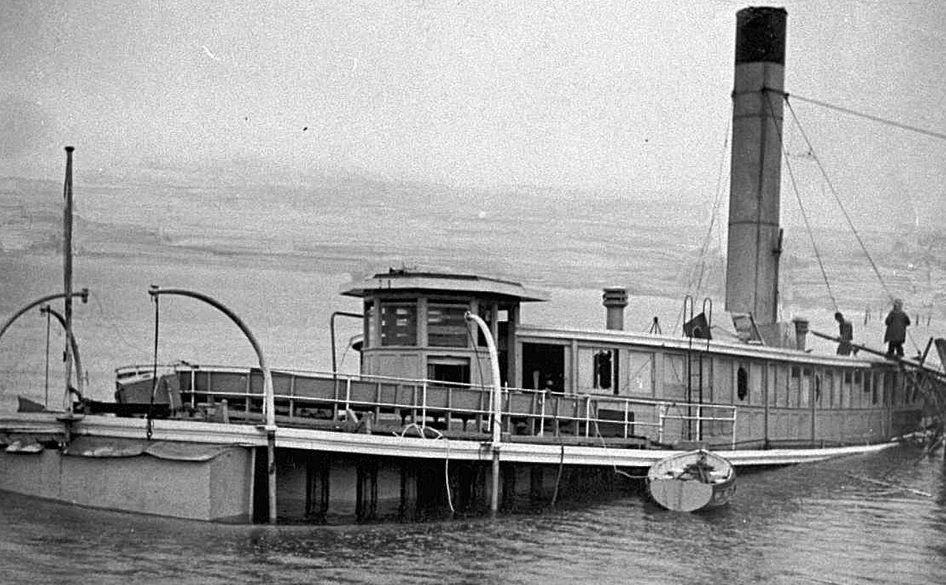
On May 31, 1942, when three Japanese midget submarines attacked shipping in the Harbour, a torpedo hit the Kuttabul (above) and killed 21 naval ratings. Sheean was lucky not to have been on board, for he had been given leave in Tasmania prior to joining his first ship, HMAS Armidale. That was when he saw girlfriend Kath Lapthorne for the last time.
While beginning to concentrate more on the oceans nearer to home, Australian naval forces had fought well in the Mediterranean and the Atlantic, and the RAN had expanded tremendously in size and capability. A high point had been the engagement of the cruiser HMAS Sydney and several British destroyers in sinking the Italian cruiser Bartolomeo Colleoni. The lowest point of the war for the Navy had quickly followed, however, when HMAS Sydney was lost with all 645 crew off Western Australia in a battle with the raider Kormoran. A few weeks later the Japanese attacked Pearl Harbor, catapulting the United States into the war.
The Japanese were doing extremely well. They hit hard at the Philippines, were already involved in China and now quickly overran various Asian countries, including strongpoints of the Allied presence. The British fortress of Singapore collapsed, taking down with it thousands of British and Australian military personnel, dead, missing or captured. On February 19, 1942, the Japanese struck at Darwin, killing 236 people, destroying 30 aircraft, and sinking 11 ships. Air raids would continue for the next two years across all of northern Australia. The Imperial Japanese Navy waged an effective campaign against shipping off the east Australian coast. They were fought to a draw in the Battle of the Coral Sea, then defeated at Midway in June 1942, at the height of their power.
This earlier part of the year for Armidale saw more anti-submarine watches; an exercise for three days against aircraft attack, and then the escorting of the freighter SC Sorenson to the port of Newcastle. Now the corvette had graduated from the school of hard knocks; and her new routine saw her outside protected harbours, escorting convoys along the east coast of Australia and as far north as New Guinea for the first six months of her commission.
In October 1942, Armidale was ordered to Darwin to join a group of other corvettes operating as the 24th Minesweeping Flotilla. The corvette arrived in Darwin on 7 November.
Doubtless the ship’s company spent some time ashore in the doubtful pleasures of Darwin. But there was not much amusement in the town, which was almost completely empty of civilians. The ship’s company would have been familiar with “the Wet” from their northern runs into the tropics on the east coast, with its humidity in the 90% range, and torrential downpours two or three times a day. There was little to do except drink a few beers under the watchful eyes of the shore patrol – Darwin had been cleaned up after some riotous times following the initial raids – and wander the streets. When on board they often had to go to Action Stations to fire weapons against the raiding aircraft of the Japanese Navy – attacks were common, and often more than one a week.
After just three weeks in Darwin Armidale was ordered to make a voyage to Timor in company with another corvette, HMAS Castlemaine.
The corvettes were already crowded vessels, with their original design of living space being further constricted by the addition of radar operators. However on this mission both ships each had an additional complement of several dozen Dutch soldiers being ferried into Timor. For the return, it was planned to extract larger numbers of military and civilian personnel. During the first day north the two corvettes managed to avoid at least two more air attacks.
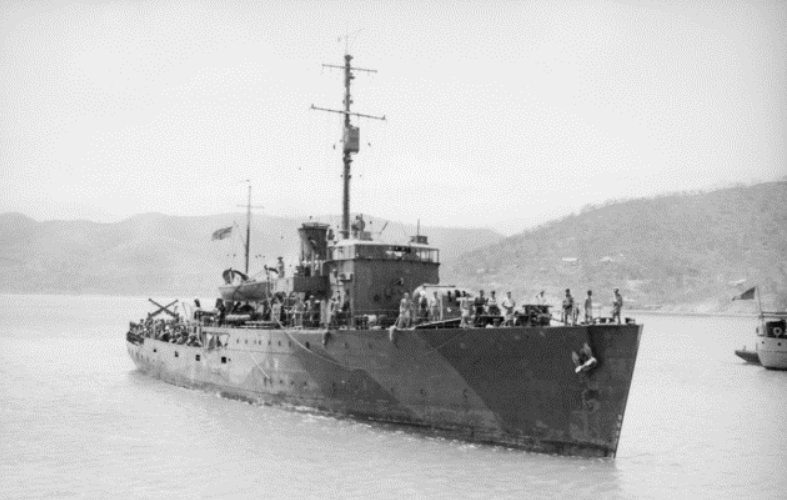
However because of changes, the carefully planned night-time rendezvous arrangements were greatly delayed. As a result by 11am the following morning Castlemaine was ordered to return to Darwin, having completed her transfer of incoming and outgoing personnel. However, Armidale (below) was not to be so lucky. With her Dutch soldiers still onboard, she was ordered to continue to the Timorese coast. For the next days the ship was continually attacked. The ship’s company went to action stations again and again, the alarms ringing and every man racing to his station, cramming his helmet on and readying the guns, with the gunners opening fire as soon as they had swung their weapons onto the target, using their own judgement as to when to depress the triggers.
Teddy Sheean was on the aft Oerlikon, the one closest to the stern. The gun crew alternated positions when they could, partly for experience, and partly to relieve the heavy physical exercise. Added to the hard work of training, firing, removing and replacing the magazines, was the added tension and fear of what failure could mean. The metal gun shield and the crews’ helmets were not much protection, and the ship’s company by now had seen enough action to realise injury and death were their constant companions. In their hearts they would have been afraid, but action left them too busy to dwell on grim thoughts.
In between engagements against aircraft the crews were not allowed to leave their positions; indeed the main gunner stayed ready in the harness with the weapon loaded. This meant that the whole crew ate when they could, usually sandwiches, and drank warm water from canteens. During the engagements they were deafened by the explosions of the three Oerlikons firing, joined by the ship’s several machineguns. At nightfall the ship was brought onto a course for Betano, on the southern coast of Timor, with the weary crew at defence watches, four hours on and four hours off, but always ready for action stations. Those off watch crammed down food and snatched sleep where they could, nodding off with head on arms at the messdeck tables. The corvette was much delayed by the bombing. She was due to meet HMAS Kuru, and to land her cargo of soldiers on the beach where they would meet up those already there. But neither Kuru nor the land force made the rendezvous, and so, somewhat after 0200 in the morning, without landing the soldiers, Armidale withdrew, and set course for Darwin.
On the afternoon of December 1, the corvette was subjected to a more vigorous attack which included torpedo bombers attacking simultaneously at opposing angles; Betty twin-engine machines carrying one massive torpedo each, a weapon now first being used in such waters. At 1450 Armidale’s captain, Lieutenant Commander David Richards, registered the sighting of the incoming force of 13 aircraft and increased the ship’s speed to her full 15 knots. At 1505 the aircraft took up their attacking positions, and Richard commenced zig-zagging the vessel to throw off the bombardiers’ aim.
This was confirmed by the analysis of the later Board of Inquiry. At 1515 (3:15 pm) Armidale was under full attack: “9 bombers and 3 fighters took part.” The fighters strafed the ship with their guns, while the bombers made approaches to release their main ordnance. The small warship was hit by at least one torpedo, perhaps two, and began sinking fast, with the order ‘Abandon Ship’ being almost immediately given.
The explosions had been massive. Many of the Dutch soldiers were killed. The corvette was heeling over, and taking on the sea at speed, and it was now that Teddy Sheean determined to stay on and fight. Ordinary Seaman RM Caro wrote later:
Teddy died, but none of us who survived, I am sure, will ever forget his gallant deed which won him a Mention in Despatches. He was a loader number on the after Oerlikon gun. When the order “Abandon Ship” was given, he made for the side, only to be hit twice by the bullets of an attacking Zero. None of us will ever know what made him do it, but he went back to his gun, strapped himself in, and brought down a Jap plane, still firing as he disappeared beneath the waves.
Of the 149 men onboard, perhaps up to 50 were killed in the initial torpedo and strafing attack. At 3:20pm the ship was fully sunk, well north of Darwin. The survivors took to the ship’s boats and rafts. There was a big delay in rescue operations mainly as it was assumed Armidale was maintaining radio silence. A search was commenced around midday two days after the sinking.
Teddy Sheean was only awarded the Mention in Despatches, the only posthumous award other than the VC. Long after the war, Senator Chris Schacht was one of many who wanted more when he said in Parliament:
From the moment he took the decision to strap himself into the gun mount Sheean must have known he was not going to survive. His actions were pure, selfless heroism.
Schacht’s comments were typical of people from all sides of politics who discovered the Sheean story and determined that here was the best sort of naval hero. It was the start of a long campaign for the best award. Now, 80 years on, we know it has been rewarded.
Dr Tom Lewis OAM, a military historian and retired naval officer, wrote Honour Denied in 2017 (Avonmore) and Teddy Sheean VC, released by Big Sky in 2020.
Hell of a story.
he was once met by bemused fellow sailors dragging a dead crayfish across a parade ground; he was taking it for a walk, he explained to the other ratings he encountered, and departed talking to it.
`````````````````````````````````````
Who among us hasn’t done that?
But that 18 year old was one heck of a man though!
I've recently started dating a Korean-American gal who's taught me much about the Japanese (she doesn't like them one bit...for obvious reasons). I now can't decide who was more dastardly during the first half of the 20th Century,the Germans or the Japanese.
It's obvious that Ordinary Seaman Sheehan had some thoughts on that question.
Courage that I know I lacked at 18...38...58...and,I fear,even today!
After one of the big battles in the Pacific an Admiral,in summing up the performance of the Marines and sailors,said that during the battle "uncommon courage was a common commodity".
IMO that can be said for many,many men in allied armies/navies/air forces during the war.
The accepted version of your quote from the Admiral is found inside the wreath on the front of this memorial outside Arlington Cemetery:
https://en.wikipedia.org/wiki/Marine_Corps_War_Memorial
HMAS Armidale was a Bathurst Class minesweeper (commonly referred to as corvettes). Entirely designed and built in Australia.
Here is a link to the RAN page with the ship’s history:
https://www.navy.gov.au/hmas-armidale-i
Yeah. Until just now, I also thought one of the flag raisers was a Navy corpsman.
The Wikipedia article correctly notes the war memorial statue is based on the famous Joe Rosenthal photograph of the second flag raised when the first proved too small to be clearly seen from afar. The article also notes several revisions over the years as to the actual identities of the Marines involved.
So it is somewhat understandable that we were both confused about it as we may have heard identifications that were later changed. It seems entirely possible that the first flag raisers did include a corpsman. But since many of the men involved were KIA later on in the battle (along with the photographer), that information is likely forever lost to history.
Disclaimer: Opinions posted on Free Republic are those of the individual posters and do not necessarily represent the opinion of Free Republic or its management. All materials posted herein are protected by copyright law and the exemption for fair use of copyrighted works.