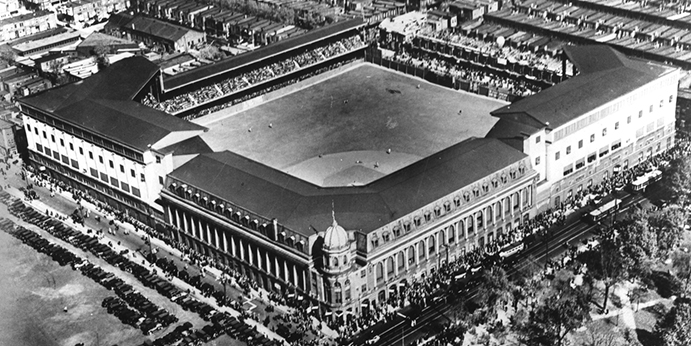
The game of baseball, through the first 30 years of its professional existence, had undergone an aggressive evolution with rules that finally settled in for the long run after the Turn of the Century. But the maturation of the ballparks in which the game was played dragged along at a much slower rate. Yes, they gradually grew bigger, but structurally and aesthetically there was neutral advancement. Elegance, on occasion, would rear its pretty head at the front entrance, such as the classy medieval spires at Boston’s South End Grounds or the Romanesque Palace of the Fans in Cincinnati. But for the most part, major league venues were essentially no different from what they had been decades earlier: Physically basic, architecturally uninspiring and, as purely built with wood, prone to a five-alarm blaze at any moment.
Shibe Park provided baseball with its long overdue great leap forward. The first folks to stumble upon its magnificent, opulent façade could not have imagined that a ballfield hid behind it. This place, a ballpark? Perhaps an opera house or five-star hotel, but not a ballpark.
Constructed with cutting-edge steel-and-concrete techniques, Shibe Park would become, along with the future openings of the Houston Astrodome and Baltimore’s Oriole Park at Camden Yards, one of the seminal turning points in ballpark history. It sprang a revolution that resulted in a turnover of nearly all major league ballparks over the next 15 years and put an end to the fading debate over whether baseball had graduated to modern times.
Over its long life, Shibe Park would be home to two of baseball’s greatest and most fleeting dynasties, a jaw-dropping pennant race collapse, and an awful lot of awful baseball. The fans were often far from civilized—this is Philadelphia, after all—but through thick and (mostly) thin, they got a kick out of the place.
From the "This Great Game" website.