Posted on 09/24/2022 11:40:46 AM PDT by BenLurkin
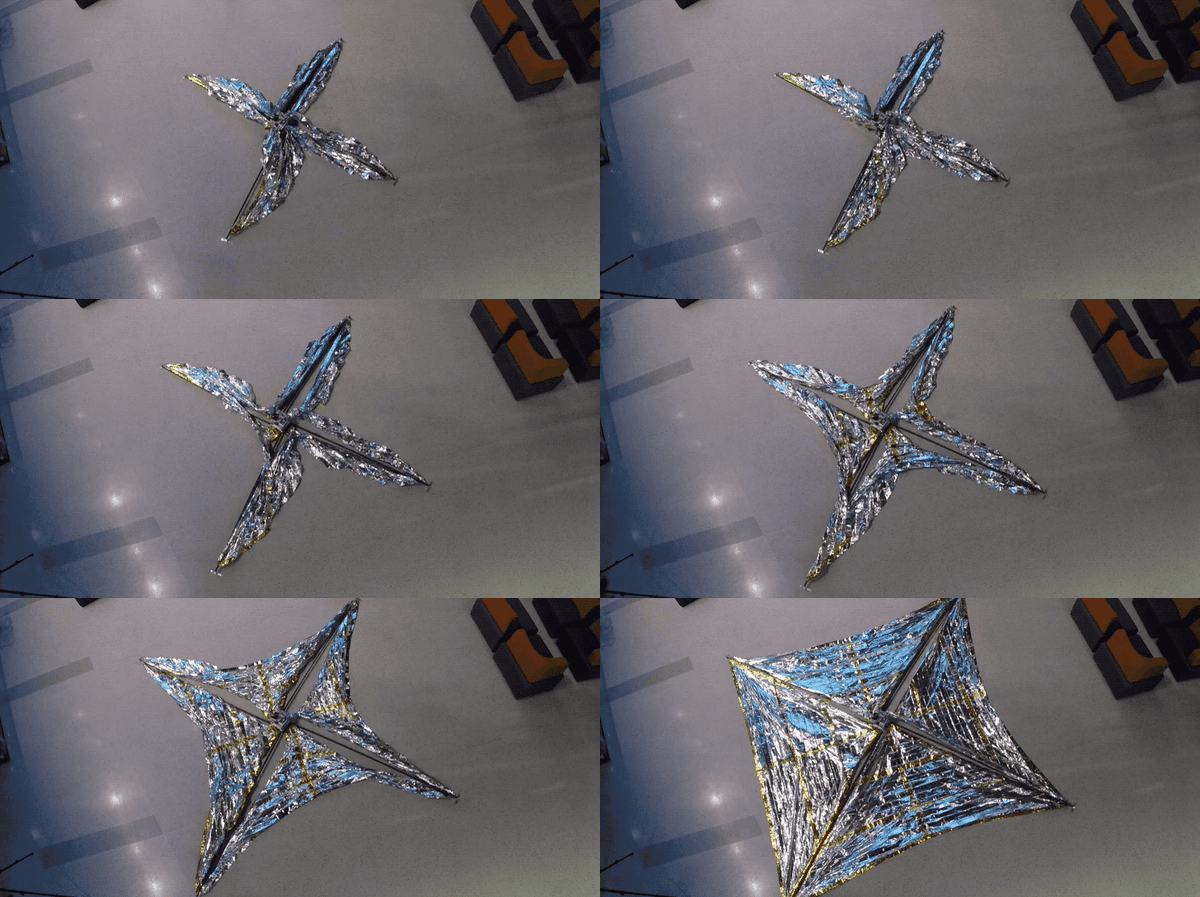
The Spinnaker concept to deorbit small satellites received $375,000 in seed funding from the investment firm Manhattan West, which NASA will match under its Small Business Innovative Research Phase II-Extended (SBIR Phase II-E) contract.
The combined $750,000 in funding will pivot Vestigo Aerospace's product line to commercial manufacturing, the company said in a Purdue University release(opens in new tab), with the first sales expected in 2023.
Vestigo did seek to test out its Spinnaker3 concept in orbit. However, that prototype was destroyed during the debut test flight of Firefly Aerospace's Alpha rocket, which ended with an explosion shortly after liftoff in September 2021.
Once operational, the drag sail should be available for deployment on satellites regardless of whether they are functional or not, Vestigo said. "The drag sails can be deployed on command or via a backup timer, providing reliable deorbit capability even if the host vehicle is inoperative," the release stated.
Spinnaker isn't the only drag sail out there. The first spacecraft to demonstrate similar active space debris-removal technologies deployed from the International Space Station in 2018, and China tested a drag sail of its own in 2022.
(Excerpt) Read more at space.com ...
China tested a kinetic anti-satellite weapon back in 2007, IIRC. It created a lot of debris which threatened to creating an ever-expanding cloud of debris (Kessler syndrome). As a general rule, kinetic anti-satellite weapons are frowned upon.
But it would interesting to deploy a fleet of drag sails ready to mosey over and de-orbit a bunch of enemy satellites.
Isn’t that just a parachute? We’ve had those for, oh, about 100 years now haven’t we?
/Wondering what I can ‘invent’ to get 750k
Invent a way to get your parachute instead space and put it to work there.
Ought to require that everything launched into low earth orbit be equipped with one of these, to be deployed when the usefulness of the satellite is at an end. Would be a lot less useless junk up there.
A publically woke DEI company with a well connected inside investor who will rake off all the profits [including fees to recoup his investment before and further funds are spent] from a diverse and inclusive set of managers and key technical folks who may or many not make a product which may or may not actually work.
And bingo you can add another to the blight of mansions encircling the capitol region all built at your expense.
So will this drag sail incorporate a rainbow flag?
“But it would interesting to deploy a fleet of drag sails ready to mosey over and de-orbit a bunch of enemy satellites.”
Anything we can do they can do better.
The term enemy satellite is a big question. All of them have the possibility of being built to use as weaponry or support to the same. The last of the real insert of low level “communication” satellites was accomplished in the mid 1990’s with the orbiting of a device by a combination of Bill Gates, Craig McCaw, Boeing, Motorola, and the federal government and was called Teledyne operated by Teledyne Technologies.
The second sentence on their about us web site reads:
“These markets include aerospace and defense...”
https://www.teledyne.com/who-we-are/about-us
So just because they are called communication satellites doesn’t make them so. Also the term deorbiting means trash entering the atmosphere that doesn’t always burn up. Where’s it going to hit the ground and how much radiation is it going to spread, especially Russian owned orbiting devices?
The Soviet Union had a few such mishaps since it launched all those nuclear satellites. In 1978, its spy satellite, Kosmos 954, crashed into the Northwest Territories, scattering radioactivity across almost 48,000 square miles.
In 1995, NASA scientists found a cloud of liquid, radioactive sodium and potassium coolant in orbit. The space agency eventually figured out that it came from the Soviet satellite Kosmos 1900. Something else in space crashed into it, causing the nuclear reactor to leak. The cloud of radioactive fluids is still floating up there, and space agencies continue to monitor it.
The good news is that all of these, so called, dead nuclear-reactor-powered satellites are in orbits higher than 430 miles. There’s barely any air molecules at that height to slow down the satellites, so it should take them hundreds or thousands of years to wind their way back to the earth — at which point much of their radioactive contents will have significantly decayed. But not all of it.
Bad news is it’s not over. NASA and Roscosmos, Russia’s space agency, are looking into building nuclear engines again. This time, they want to build hyperefficient rockets that might one day take humans to Mars.
If this sounds like science-fiction, it’s not. NASA built several perfectly functional nuclear rocket engines from 1955 through 1973. All it takes is funding.
wy69
That’s not what they did. They ‘invented’ a “drag sail”, aka parachute.
Here’s a video of a PERSON skydiving from the edge of space in a helium balloon, before it popped, of course.
https://www.youtube.com/watch?v=eAQ8L6YwaTg
Oh, I thought the article was about the newest career path in the US Navy.
Or just find the manual deorbiter activation code on all the US satellites, and engage them all.
Teledyne, Cyberdyne, what’s the difference? As long as Skynet gets built, right?
“As long as Skynet gets built, right?”
What makes you think it isn’t already up there.
wy69

Disclaimer: Opinions posted on Free Republic are those of the individual posters and do not necessarily represent the opinion of Free Republic or its management. All materials posted herein are protected by copyright law and the exemption for fair use of copyrighted works.