Posted on 08/28/2022 8:03:15 AM PDT by oblomov
Charlie Finch, a cantankerous columnist whose gossipy writings were widely read in the New York scene, has died at 68.
Walter Robinson, a former editor of Artnet who hired Finch as a critic, announced Finch’s death on Instagram. Robinson said that Finch had died “by defenestration,” and that he had been battling cancer and other unspecified health issues.
Finch’s writings, which regularly appeared on Artnet Magazine for the better part of two decades beginning in the late ’90s, were frequently met with allegations of sexism, takedowns on competing art blogs, and general chatter about the vicious hearsay he reported. Many of his articles were politically incorrect in a way that seemed deliberate.
He wrote on whether Black art had grown “kitschy” and whether Cy Twombly was a “fraud.” He defended Jeff Koons, whom he once called a “prophet,” and he labeled the New Museum “the Mr. Potato Head of contemporary art museums.” When the critic Hilton Kramer died, he ran a column called “Ding Dong the Witch Is Dead.”
“As the world of art criticism has become indescribably bland, Mr. Finch has remained vicious and victorious; in his 14 years of art writing, he has managed to offend nearly everyone who’s anyone in Soho and West Chelsea,” the Observer wrote in a 2006 profile.
He did not seem to care whether anyone was put off by his writing or his behavior. Dealer Mary Boone, whose artists were frequently derided by Finch, once claimed that he spit on her at an opening; he claimed he did so unintentionally. According to the Village Voice, Finch would appear at the openings of artists whom he reviewed negatively, doing so in a “slightly menacing” way; he called this “nothing serious.” He once attempted to write an unauthorized biography of dealer Larry Gagosian, who now runs a mega-gallery empire.
The Village Voice profile of Finch was filled with attempts by elite art-world figures to explain why he acted in the way he did. Robert Storr, then a curator at the Museum of Modern Art, said, “He is a disillusioned liberal who is interested in how power operates and how it is abused.”
The details surrounding Finch’s biography remain somewhat hazy because he did not seem interested in discussing them. He reportedly grew up on the Upper East Side and launched into a political career after attending Yale University. Finch went on the campaign trial for Gary Hart and Carol Bellamy, Democratic senators who ran unsuccessful bids to become President and Mayor of New York, respectively, during the ’70s.
He eventually left politics, and his whereabouts during the period afterward were kept vague by him, adding to the mystique he cultivated. The Village Voice reported that he spent “a few years working on Wall Street,” but it was not clear in what capacity. “I am a WASP. We don’t discuss money,” he said. The Observer reported that he spent a period as a zookeeper in New Orleans during the ’80s, and that he had enrolled for a few years in the Union Theological Seminary.
Finch became a New York art world fixture during the ’90s, when he briefly ran an East Village gallery called Real Art and then began writing for the zine Coagula, which was founded by Mat Gleason in 1992. Under the pseudonym Jane Preston, he printed gossip about major players in New York.
His barbed writing occasionally involved making personal attacks on figures like artist Cindy Sherman, curator David Ross, and dealer Arne Glimcher. According to the Observer, John Waters and David Bowie were among the readers of Coagula. Some of Finch’s writings ended up in an anthology called Most Art Sucks: Five Years of Coagula.
Walter Robinson, the former Artnet Magazine editor, asked Finch to write for the website in 1997, forging a bond that would continue through 2012. During that time, some of Finch’s columns generated so much controversy that they spawned thinkpieces of their own.
In 2006, Finch reviewed a show at Briggs Robinson Gallery in New York by painter Natalie Frank, who at the time had recently finished graduate school. He called the piece “The Seduction of Natalie Frank,” and it referred to her as a “young, virginal star” whose tireless work, sometimes done while wearing “a wife beater shirt for twelve hours at a time,” had finally paid off. Then he went on to write off her work in a matter of a few paragraphs.
Even before our current age where social media fuels firestorms over published articles regularly, “The Seduction of Natalie Frank” touched off a heated discussion about art-world misogyny. The Art Blog wrote that Finch’s article “feels a little like a date rape: forcefully loving and then dismissive.”
Nearly a decade later, in 2017, Frank reflected on Finch’s column in an ARTnews essay themed around the challenges that female artists face. “I felt disgusted, humiliated and objectified,” she wrote. “Even long after this, I would go to an art opening and upon learning my name, someone would say, ‘Oh! You’re the wife beater girl.’ Why was something like this published?”
In 2005, Finch also had a public-facing spat with the dealer Becky Smith, who had recently joined a wave of gallerists who were relocating to Chelsea. Although the piece was framed as an op-ed about the influx of galleries to a new neighborhood, Finch made it mostly about Smith, whose appearance and business he mocked. The negative response to the piece grew so intense that Robinson ultimately deleted it, in a move rarely undertaken by major U.S. publications. Robinson called the debacle the “low point of my editorial career.”
There were also less heated controversies. After the artist Ai Weiwei was placed under house arrest in 2010 by the Chinese government, allegedly for illegally building a studio in Shanghai, Finch called for Western institutions to “show some balls” and cease their operations in that country. Kyle Chayka, writing for Hyperallergic, rebutted Finch’s piece, saying that “to boycott China also means to boycott its artists and its people, those who have no say in the government’s actions.”
That same year, Finch disparaged rising painters like Marlene Dumas, Wendy White, and Jules de Balincourt, claiming that they had put market success before formal innovation. One popular painting blog wrote, “Naturally, at Two Coats of Paint, we disagree.”
On Instagram, Robinson wrote that there have not been many critics who wrote as Finch did. “Love him or hate him, quite simply nobody was like him.”
Not a conservative (as one can tell from working for Gary Hart, and his mockery of Hilton Kramer), but he seemed to be an authentic art critic rather than an idolater at the temple of Current Thing.
Frankly he sounds like an a hole, the kind of gadfly that would actually call out people for being hypocrites phonies.
Basically the kind of guy that no longer exists in the liberal world.
That said, from the photo, the late Mister Finch did not appear to be a fan of either the gym or the dentists' office.
Uh?.....What is death by defenestration?
Defenestration = being thrown out of a window
It’s usually used in a figurative sense, similar to someone getting cancelled.
It was a dark joke in this case.
Usually it's everyone who's no one who gets most offended.
He jumped out the window, fenestre being the French for window. It’s a common way Putin’s perceived enemies and critics in Russia meet their demise.
What could be more useless, or less useful than an art columnist?
Teeth like that will kill you as sure as poison, and make your life miserable in the meantime.
Interesting article. Thanks for posting.
Who wouldn’t want to spit on liberals?
I agree, but most people, even in the art world, are insecure in their understanding & interpretation of art. So art critics have had enormous influence, especially as the “middlebrow” (middle class people with enough time on their hands to be interested in art/culture) emerged in the 20th century.
Example: the critic Clement Greenberg, and a few others, built the idea that there was an art “movement” that they called Modernism. Among conservatives, writers like John Simon & Hilton Kramer (founder of The New Criterion) shaped how art was received & interpreted.
(Eyes as well.)
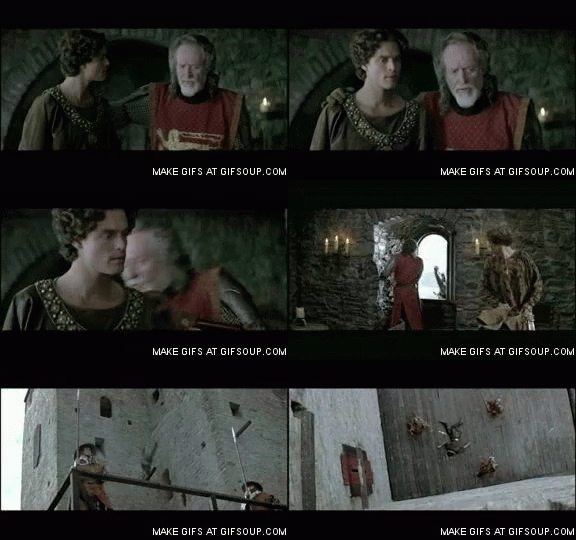
Best illusion is in the movie "Braveheart" where King Edward throws his *ahem* "gentle" son out of a window. 
Edward I throws the gentle boyfriend of his gentle son out the window.
Interesting article all around. The liberals' attempted defense of Red China's censorship is a puissant tidbit.
Natalie Frank. The wife-beater girl and her "art"

When I look at a piece of what is called art, the thoughts that occur to me are do I like it, do I even care or do I not like it. I don’t waste my time attempting to interpret it.
I suspect that most of the people who are trying to interpret it are only virtue signaling, to show others how smart they are. But that is their right; I’ll let them enjoy it.
*Ah* that’s correct, I forgot. After the king gets tired of the boyfriend pontificating.
That was his son's gay lover, IIRC.
Disclaimer: Opinions posted on Free Republic are those of the individual posters and do not necessarily represent the opinion of Free Republic or its management. All materials posted herein are protected by copyright law and the exemption for fair use of copyrighted works.